How Much Is Avenue of Poplars near Moret‑sur‑Loing Worth?
Last updated: March 16, 2026
Quick Facts
- Methodology
- comparable analysis
For a privately held, well‑provenanced oil of this composition and size by Alfred Sisley (circa 60–82 cm across), a realistic auction estimate is US$1,000,000–US$4,500,000. This range is anchored by a near‑identical Moret poplars view sold at Christie’s New York in 2018 (US$4.21M) and bounded by Sisley’s established market ceiling and more typical mid‑market results.
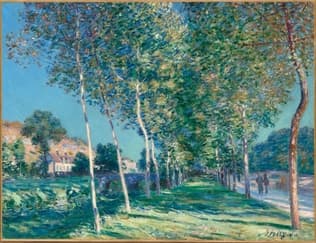
Avenue of Poplars near Moret‑sur‑Loing
Alfred Sisley, 1890 • Oil on canvas
Read full analysis of Avenue of Poplars near Moret‑sur‑Loing →Valuation Analysis
Conclusion and scope: This valuation represents an auction market estimate for a privately held oil of 'Avenue of Poplars near Moret‑sur‑Loing' by Alfred Sisley of a size and execution comparable to the Musée d’Orsay example (c. 62 × 81 cm). The Musée d’Orsay holds a closely related 1890 canvas (inv. MNR 643) that is in public collection and not available to the market — the Orsay/MNR status should be noted when discussing provenance or attribution questions [1].
Method and anchors: I used a comparables‑based approach, giving primary weight to near‑identical Moret poplar views of late Sisley (similar date and dimensions). The principal market anchor is a Moret poplars canvas sold at Christie’s New York (The Rockefeller sale) on 8 May 2018 for US$4,212,500; that lot is the closest direct match by subject and size and therefore sets the upper middle of the practical market band [2]. I also considered Sisley’s auction ceiling (Sotheby’s London, Effet de neige à Louveciennes, 2017 — ~US$9.06M) and a strong late‑period Moret result at Christie’s London in 2025 (~US$2.59M) to define the ceiling and mid‑market evidence respectively [3][4]. Market tone and inflation adjustments inform the top of the band but do not alone justify exceeding documented trophy levels.
Drivers and treatment: Key value drivers are size, condition, signature and technical integrity, and clean, well‑documented provenance (including catalogue raisonné/collaborator attestations). Exhibition and bibliography materially increase price. Conversely, any outstanding restitution questions, wartime acquisition gaps, heavy restoration or uncertain attribution materially reduce marketability and can push a result well below the lower bound. The Musée d’Orsay / MNR provenance notes (recovery/return post‑WWII) and recorded theft/recovery incidents are important provenance facts but pertain to the museum object specifically — a private comparable with clean, long‑form provenance will command a premium over works with gaps [1][5].
Practical positioning: For sale, the best commercial outcome is achieved by evening sale placement in London/New York/Paris with a strong pre‑sale catalogue entry, technical report, and if possible a recent exhibition or bibliography citation. In the absence of that institutional history, the lot is likely to trade in the mid six‑figure to low seven‑figure band. Exceptional documented examples (rare provenance, exhibition history, exceptional condition) can approach or exceed the upper estimate; the absolute trophy ceiling remains defined by record Sisley sales [2][3].
Key Valuation Factors
Art Historical Significance
High ImpactAlfred Sisley’s Moret period (late 1880s–1890s) is a core part of his late oeuvre; the avenues of poplars and Loing river scenes are recurring motifs that testify to his mature handling of light, atmosphere and composition. While individual poplar‑avenue canvases are not singular canonical breakthroughs on the scale of a single, career‑defining masterpiece, they are well regarded by specialists and collectors of late Sisley. A well‑executed Moret poplar painting with convincing authorship and good condition is therefore of high art‑historical relevance within Sisley’s output and attracts consistent collector interest, especially when illustrated or exhibited.
Provenance and Legal Status
High ImpactProvenance clarity is decisive. The Musée d'Orsay example is recorded in the MNR (recovered/entrusted post‑WWII), a provenance circumstance that requires careful legal and archival handling for any dispersal or reproduction [1][5]. For a private comparable, uninterrupted, documented ownership back multiple decades (and any Comité Sisley attestation/catalogue raisonné entry) materially increases saleability and price. Conversely, wartime gaps, contested ownership or unresolved restitution matters can depress value sharply and may render a work unsalable in top venues until resolved.
Condition and Conservation
High ImpactPhysical condition is one of the most immediate price determinants. Original paint integrity, clean varnish, minimal inpainting, stable canvas/ground and absence of invasive restorations preserve market value; lining, heavy overpaint or significant paint loss will reduce buyer confidence and bidding depth. Technical reports (X‑ray/IR) demonstrating original composition and limited restoration substantially support higher estimates. Condition nuances can move a work across valuation bands by hundreds of thousands of dollars for mid‑to‑large Sisleys.
Comparable Auction Results
High ImpactRecent auction outcomes provide the numerical anchors for this valuation. A near‑identical Moret poplars canvas sold at Christie’s New York in 2018 for US$4.21M — the clearest direct comparable for a 60–75 cm poplar avenue view and the principal market anchor [2]. Sisley’s auction record (Sotheby’s London, 2017) establishes an upper trophy ceiling (~US$9.06M) for exceptionally documented works [3]. Mid‑market late‑Moret results from 2023–2025 around $2–3M show continued selective demand, which supports the $1.0M–$4.5M practical band used here [4].
Exhibition & Bibliographic History
Medium ImpactInclusion in major exhibitions, published catalogues and the catalogue raisonné substantially improves visibility and buyer confidence and typically adds a premium. Works with a long exhibition history or illustration in standard monographs or exhibition catalogues will rise toward the upper bound; conversely, an otherwise fine canvas with no exhibition or bibliography record will be judged more conservatively. Preparatory exhibition loans and clear catalogue citations tangibly expand the buyer pool (institutions, museums, and deep‑pocketed private collectors).
Sale History
Christie's New York (The Rockefeller Sale)
Sotheby's London (Evening Sale)
Christie's London
Alfred Sisley's Market
Alfred Sisley is a respected core Impressionist whose market sits below Monet and Renoir in depth but remains steady and collectible. His auction record is in the low tens of millions (Sotheby’s London, 2017, ~US$9.06M) and top late‑career Seine/Moret scenes can realize multiple millions when quality, provenance and exhibition history align. Most commercially available Sisleys trade in the mid‑six‑figure to low‑seven‑figure range; museum‑quality trophies remain rare and command disproportionate attention.
Comparable Sales
Les peupliers à Moret‑sur‑Loing, après‑midi d'août (1888)
Alfred Sisley
Nearly identical subject (Moret poplars), very similar date and size (~60 × 73 cm) — a direct anchor for market value of Moret/poplar views.
$4.2M
2018, Christie's New York (The Rockefeller Sale)
~$5.1M adjusted
Effet de neige à Louveciennes (1874)
Alfred Sisley
Artist record sale — different subject (snow scene) but establishes Sisley's upper market ceiling and buyer willingness for top‑quality works.
$9.1M
2017, Sotheby's London (Evening Sale)
~$11.5M adjusted
Le pont de Moret‑sur‑Loing en été (1888)
Alfred Sisley
Same Moret locale and late‑period subject matter; smaller/mid‑evening‑sale result showing demand for Moret views in the 2023–25 market.
$2.6M
2025, Christie's London
Current Market Trends
Since 2023 the Impressionist market has been more selective: buyers concentrate on well‑provenanced, museum‑quality works while mid‑tier lots face price compression. Top trophies still attract competitive bidding when presented with impeccable provenance and catalogue support. Timing, venue (evening sale), and strong pre‑sale marketing remain essential to achieving top estimates.
Sources
- Musée d'Orsay — Allée de peupliers aux environs de Moret‑sur‑Loing (1890)
- Comparable sale — Les peupliers à Moret‑sur‑Loing, après‑midi d'août (Christie's New York, 2018)
- Sotheby's — Effet de neige à Louveciennes (1874), record Sisley sale (2017)
- Christie's London / market report — Le pont de Moret‑sur‑Loing en été (1888), 2025 (coverage)
- MNR / Rose‑Valland database — MNR 643 (provenance/recovery record)