How Much Is Effet de neige à Louveciennes (Snow Effect at Louveciennes) Worth?
Last updated: March 16, 2026
Quick Facts
- Last Sale
- $9.1M (2017, Sotheby's, London)
- Methodology
- comparable analysis
If the work is the documented 1874 oil on canvas (54 × 65 cm) that sold at Sotheby’s London on 1 March 2017 and entered the Hasso Plattner / Museum Barberini collection, the primary market precedent is the £7,358,750 (≈$9.06M) 2017 result. Anchoring to that recent sale and adjusting for current market conditions, condition and provenance, my market estimate for an identical, well‑provenanced, exhibition‑quality canvas is $8,000,000–$12,000,000 (USD).
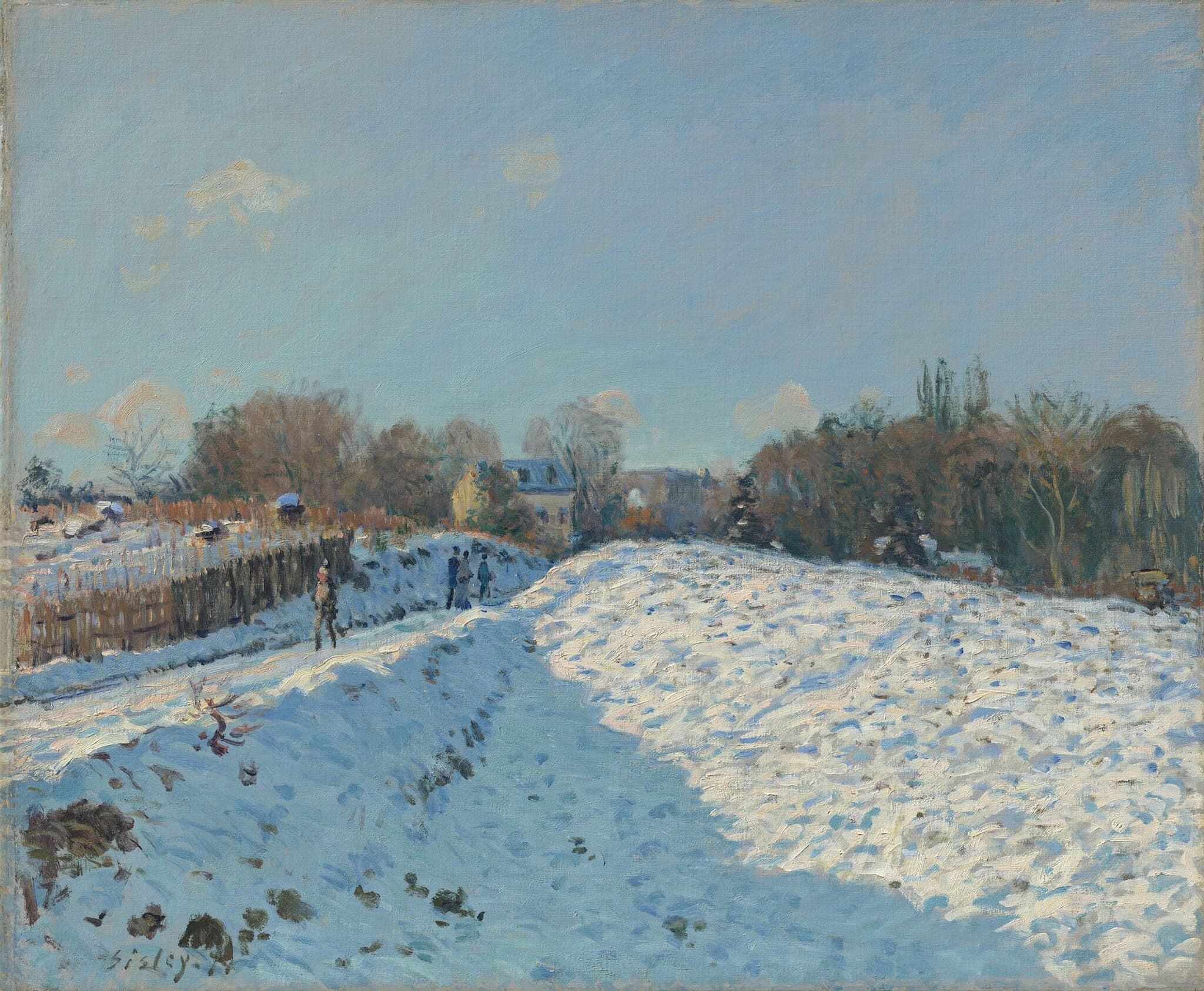
Effet de neige à Louveciennes (Snow Effect at Louveciennes)
Alfred Sisley, 1874 • Oil on canvas
Read full analysis of Effet de neige à Louveciennes (Snow Effect at Louveciennes) →Valuation Analysis
Anchor and headline valuation: This valuation assumes the subject painting is the 1874 oil on canvas (54 × 65 cm) that realized £7,358,750 (≈ $9,064,732) at Sotheby’s London, 1 March 2017 [1], a sale that subsequently placed the work in the Hasso Plattner / Museum Barberini collection [2]. That realized price is the primary market anchor for this composition and sets the demonstrable ceiling for the exact canvas. Taking that precedent, recent market behavior, and typical condition/provenance adjustments into account, the fair‑market range for the identical, museum‑quality work is estimated at $8,000,000–$12,000,000 (USD).
Why this anchor matters: Sisley’s Louveciennes snow views date to his mature Impressionist period and are especially collectible within his output. The 2017 Sotheby’s result is not an isolated mid‑market sale but a clear, authenticated auction record for this composition and therefore carries outsized weight for valuation. The combination of subject, date (1874), size and documented ownership/provenance produced strong competitive bidding in 2017; those same attributes will largely determine whether a comparable price is achievable again [1].
Adjustments and sensitivity: Value is highly sensitive to three factors: (1) attribution and variant specificity — there are several Louveciennes snow works and a pastel version in public collections; only the exact, catalogue‑matched 54 × 65 cm 1874 oil commands the Sotheby’s ceiling; (2) provenance/exhibition/cat‑raissonne documentation — the Sotheby’s/Barberini chain (Depeaux → Petit sales → Drouot/Christie’s → Plattner) materially uplifts value; and (3) condition — heavy relining, unrecorded restoration or extensive inpainting can reduce marketability (20–50% discounts are common depending on severity). If the painting lacks the Sotheby’s/Barberini provenance or is a different variant, realistic auction ranges drop to the mid‑six to low‑seven figures for good examples ($600k–$2M) and to $100k–$600k for uncertain attribution / poor condition items.
Market context and execution advice: The global Impressionist market softened after 2017 then stabilized with selective demand for museum‑quality works; guarantees and single‑owner consignments have been instrumental in achieving top results. To preserve or approach the 2017 level, the owner should (a) verify precise dimensions, signature, verso labels and catalogue‑raisonné entry; (b) obtain a full condition/conservation report and high‑resolution recto/verso photography; and (c) approach a major house (Sotheby’s/Christie’s) for a formal pre‑sale estimate, ideally for an evening or single‑owner sale with marketing/guarantee. If those prerequisites are met, the $8M–$12M band is a reasoned market outcome; absent them, price expectations should be adjusted downward in line with the alternate ranges noted above [1][2].
Key Valuation Factors
Art Historical Significance
High ImpactAlfred Sisley’s snow scenes—especially views of Louveciennes—belong to his most recognized and desirable subject matter from the 1870s, a pivotal decade in his development as an Impressionist landscapist. A well‑executed 1874 Louveciennes snow painting demonstrates mature handling of light, atmosphere and palette that collectors, curators and specialist dealers prize. Because subject and date place the work at a high point in Sisley’s output, the factor exerts strong upward pressure on value when combined with documented authenticity and quality of execution. Conversely, a lesser execution of the motif or an uncertain attribution significantly reduces market appeal.
Provenance & Exhibition History
High ImpactProvenance is decisive. The Sotheby’s 2017 lot benefitted from an unbroken documented line—previously in Depeaux’s collection and handled by Galerie Georges Petit, recorded at Drouot and Christie’s, and lastly acquired by Hasso Plattner. That chain, plus any exhibition loans and catalogue raisonné citation, materially increase institutional and private buyer confidence and command premium prices. Lacking these documentary anchors, the same composition (or a variant) will trade at a substantial markdown. Any confirmed museum loans or catalogue entries elevate the painting toward the top of the $8M–$12M band.
Condition & Conservation
High ImpactPhysical condition drives realized price variability. Issues such as a heavy or poorly executed relining, unstable paint, extensive inpainting, or significant restoration can reduce marketability and produce discounts of 20–50% depending on severity. Conversely, documented sympathetic conservation and stable paint/varnish layers preserve value. A contemporary technical report (X‑ray, IR, pigment analysis where needed) and a recent conservator’s assessment are essential for confirming the painting’s integrity and supporting a high estimate.
Rarity & Variant Specificity
High ImpactMultiple Louveciennes snow compositions and media (oils, pastels) exist in public and private hands. The exact 54 × 65 cm 1874 oil that sold in 2017 is a demonstrably scarce, autograph instance of the motif; that exactness is what created the 2017 ceiling. If the work under review is a different variant, a study, or a pastel, its rarity and therefore value will commonly be lower—even if it remains desirable. Confirming size, signature, and catalogue‑raisonné number is therefore fundamental to value determination.
Market Comparables & Liquidity
Medium ImpactRecent auction comparables show a wide band: a small number of high‑quality Sisleys have achieved multi‑million dollar results (e.g., Sotheby’s 2014 and 2017), while reliably executed mid‑period landscapes frequently trade in the low‑to‑mid seven figures or high six figures. The Impressionist market has stabilized with selective demand; liquidity exists for well‑provenanced evening‑sale lots, but mid‑market pieces may require longer sell‑through periods or private sale negotiation. Guarantees and single‑owner consignments remain important value enhancers.
Sale History
Sotheby's, London
Sotheby's, New York
Bonhams, New York
Christie's, London
Alfred Sisley's Market
Alfred Sisley occupies a strong, collectible position among Impressionists: well regarded by institutions and private collectors but generally priced below top Monet or Renoir works. His best oils—especially from the 1870s–1880s depicting river scenes, bridges and winter effects—regularly achieve mid‑six to low‑seven‑figure results; exceptional, museum‑quality canvases can reach single‑digit millions. Recent years have seen selective demand and stable sell‑through for quality Sisleys; provenance and condition remain the decisive determinants of top prices.
Comparable Sales
Effet de neige à Louveciennes
Alfred Sisley
Exact same composition/variant (1874 oil, 54 × 65 cm) that sold at auction — direct market precedent and artist record.
$9.1M
2017, Sotheby's, London (Impressionist & Modern Evening Sale)
~$11.2M adjusted
Le Loing à Moret
Alfred Sisley
High‑quality Sisley river/landscape (1883) sold for a multi‑million price at a major house — useful for seeing market ceiling for top works of similar period/scale.
$4.9M
2014, Sotheby's, New York
~$6.6M adjusted
Le pont de Moret‑sur‑Loing en été
Alfred Sisley
2025 sale of a Moret/Loing river scene at a major house — comparable period/subject showing current mid‑market demand for strong provincial landscapes.
$2.6M
2025, Christie's, London
La Seine à Suresnes
Alfred Sisley
Mid‑market Sisley landscape (c.1879) sold in 2023 — shows realistic pricing for quality works that are well executed but lack the trophy provenance/rarity of the 2017 Louveciennes sale.
$1.3M
2023, Bonhams, New York
~$1.3M adjusted
Le Pont de Sèvres en fin de journée
Alfred Sisley
Smaller/less prominent Sisley landscape sold in 2025 — illustrates variability: condition/provenance/size materially reduce realized price versus top examples.
$656K
2025, Sotheby's, London
Current Market Trends
Since the 2017 high‑water mark, the Impressionist market softened then stabilized; by 2024–25 buyers became more selective, favoring museum‑quality lots and well‑documented provenance. Guarantees and single‑owner sales have supported record and near‑record outcomes. For Sisley material, demand is steady for textbook subjects, but only works with strong documentation and condition achieve top prices.