How Much Is Sand Heaps Worth?
Last updated: March 16, 2026
Quick Facts
- Methodology
- comparable analysis
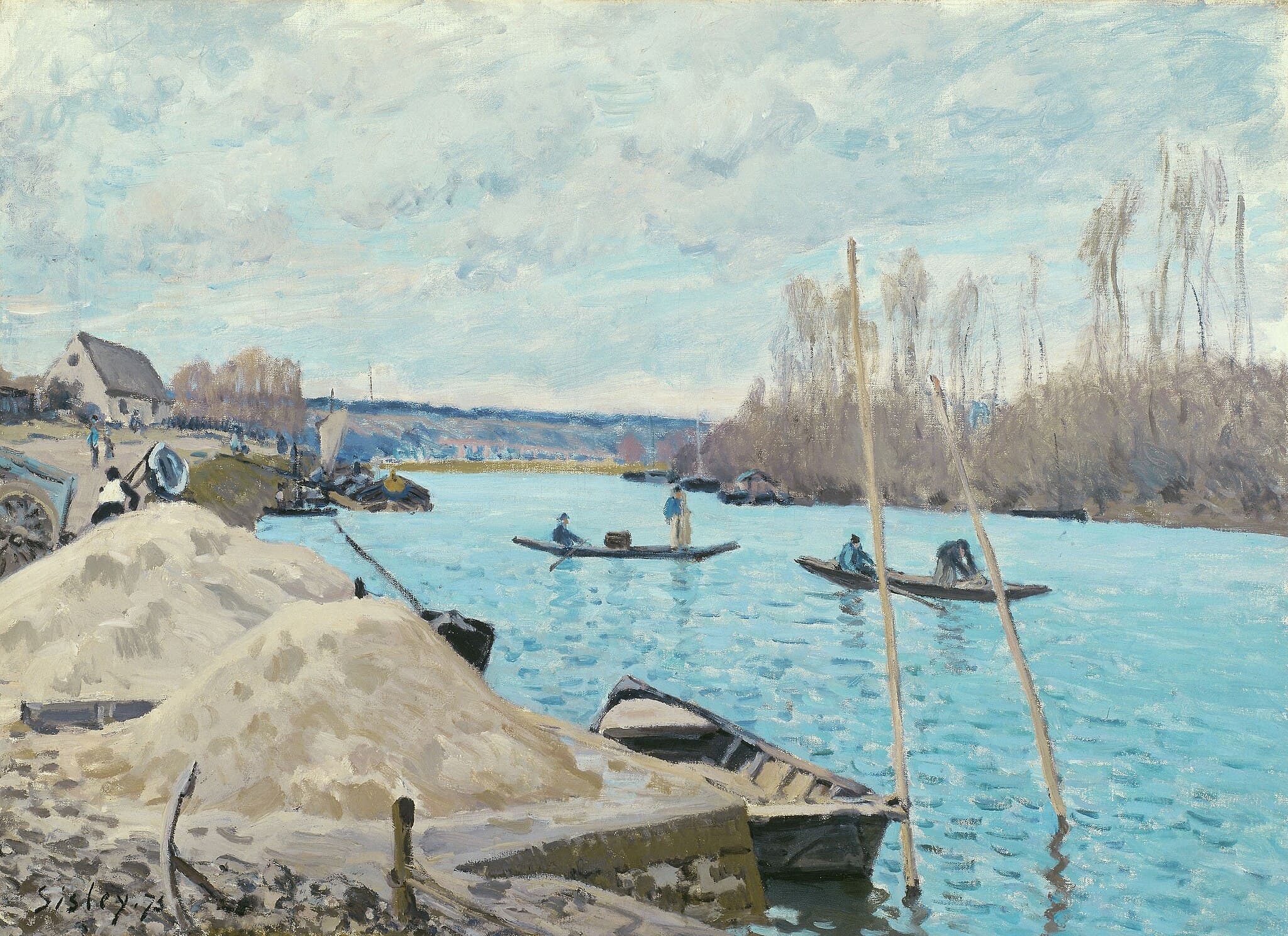
Alfred Sisley’s La Seine à Port‑Marly, Piles of Sand (commonly “Sand Heaps,” 1875) is held by the Art Institute of Chicago (accession 1933.1177) and therefore has not traded in the modern auction market. For a hypothetical market sale of an equivalent museum‑quality canvas, a realistic estimate is USD $1.2–6.0 million, reflecting recent 1870s Port‑Marly comparables in the mid‑six‑figure band and the premium imparted by strong early provenance and institutional ownership [1][2][3].
Valuation Analysis
Valuation conclusion: The painting commonly called “Sand Heaps” (La Seine à Port‑Marly, Piles of Sand), 1875, is in the Art Institute of Chicago (accession 1933.1177) and therefore has no modern hammer price. Using a comparable‑based approach, a plausible market range for an equivalent museum‑quality Sisley of this subject and date is USD $1.2–6.0 million. This range synthesizes recent Port‑Marly/Seine comparables (day‑sale outcomes in the mid‑six‑figure band), the artist’s auction ceiling, and the value uplift normally associated with long, documented provenance and institutional ownership [1][2][3].
Comparable evidence and ceiling: Condensed comparables show late‑1870s Sisley river and quay scenes selling commonly between roughly $0.7–1.0M in day‑sale contexts (a close example is Christie’s London March 2025 Port‑Marly sand/quay result) [2]. By contrast, Sotheby’s London’s 2017 sale of Effet de neige à Louveciennes (~$9.06M) remains the practical market ceiling for the artist’s top masterpieces and demonstrates the upside available to exceptional works with rarity and outstanding condition [3].
How provenance and exhibition history move the price: The Art Institute accession (Ryerson bequest, museum ownership since 1933) and early exhibition history (e.g., Exposition Universelle, 1900 while in Georges Viau’s collection) materially reduce attribution and title risk and make evening‑sale placement and institutional borrowing far more likely. In practice, such provenance frequently lifts estimates from day‑sale comparables into the low‑to‑mid millions because buyers bid more confidently on well‑documented examples [1].
Key uncertainties that keep the range wide: Size, current condition, any restoration history, and catalogue‑raisonné status are decisive. Without a conservator’s report and confirmed catalogue entry the estimate must remain conditional: excellent original condition and catalogue inclusion push the painting toward the top of the stated range; significant conservation work, overcleaning, or gaps in provenance would push results toward the lower bound [1][2].
Sale strategy and recommended next steps: To realize the higher end, the work would need evening‑sale placement at a premier house (NY/London), targeted marketing emphasizing museum provenance and exhibition citations, and corroboration in the accepted Sisley literature. For a formal insurance or sale valuation, obtain high‑resolution imagery, a current conservation report, and a catalogue‑raisonné confirmation; then request a written estimate from an Impressionist specialist at a major auction house [2][3][4].
Bottom line: Hypothetically offered with museum provenance and in good condition, an Alfred Sisley 'Sand Heaps' (1875) is most plausibly valued between USD $1.2 million and USD $6.0 million. The principal determinants of where within that band it would settle are condition, sale venue, and the depth and clarity of the provenance and catalogue documentation.
Key Valuation Factors
Art Historical Significance
High ImpactAlfred Sisley is a central figure among Impressionist landscape painters; works from the mid‑1870s at Port‑Marly exemplify his mature approach to river scenes, atmospheric light and subtle tonal harmonies. 'Sand Heaps' is not ordinarily cited as a canonical, revolutionary masterpiece within Sisley’s output, but it is representative of a well‑collected subject and period. The painting’s cultural weight increases substantially if linked to early exhibitions or important nineteenth/early‑twentieth‑century collectors. Institutional ownership (Art Institute accession 1933) elevates the work’s perceived historical importance in the market context and thereby exerts a strong positive effect on value by improving collectability and institutional loan potential.
Provenance & Exhibition History
High ImpactProvenance is a primary value driver for 19th‑century Impressionist pictures. This canvas’ early provenance—Dr. Georges Viau, exhibition at the Exposition Universelle (1900), dealer passage (Durand‑Ruel, Galerie Bernheim‑Jeune), acquisition by Martin A. Ryerson and bequest to the Art Institute in 1933—greatly reduces attribution and title risk, enhances marketing narratives, and supports evening‑sale placement. Works with continuous, well‑documented ownership histories commonly fetch multiples above similar unprovenanced pieces; museum accession in particular adds measurable premium because it signals institutional vetting and long‑term public exposure.
Condition & Physical Characteristics
High ImpactThe painting’s physical state—original varnish and paint surface, any past restorations, canvas stability and dimensions—directly determine market acceptability and price. Small to medium canvases in excellent, unrestored condition tend to translate comparables into low‑to‑mid millions; conversely, structural issues, extensive overpainting or heavy restoration can reduce demand and push realizations down into the mid‑six‑figure band. Because a formal conservator’s report is not available for the present hypothetical valuation, the estimate remains conditional: pristine condition would justify pricing toward the upper end of the range; serious condition concerns will materially depress value.
Market Comparables & Sale Venue
High ImpactRecent comparable sales of Port‑Marly and Seine views by Sisley (notably day‑sale results around $0.7–1.0M) provide the empirical basis for the lower‑to‑mid portion of the range; the artist’s practical ceiling is demonstrated by Sotheby’s 2017 record (~$9.06M). The sale venue (evening v. day, New York/London v. secondary markets) routinely causes multi‑fold differences in realized price. Placement in a major evening sale with strong marketing and competitive bidding can move a well‑documented canvas from the mid‑six‑figure realm into the multi‑million bracket, making venue a decisive factor.
Catalogue & Authentication
Medium ImpactInclusion in the accepted catalogue raisonné and positive scholarly commentary reduce market friction and justify higher pre‑sale estimates. A catalogue number, literature citations and committee authentication all raise buyer confidence and encourage stronger bidding. Works lacking clear catalogue or scholarly support are more likely to appear in day sales and to attain lower prices. Authentication status thus functions as the gate between mid‑market and evening‑sale treatment; resolving any remaining catalogue or attribution questions is necessary to unlock the higher valuation bands.
Sale History
Sand Heaps has never been sold at public auction.
Alfred Sisley's Market
Alfred Sisley is a well‑regarded Impressionist landscape painter whose works occupy a steady and collectible niche. He generally trades below Monet and Renoir in headline prices, but the market for his best works is robust: the auction record (~$9.06M, Sotheby’s London 2017) shows the ceiling for top masterpieces, while most mid‑period Sisleys commonly realize mid‑six‑figure to low‑million results. Demand is driven by subject (rivers, snow, Port‑Marly), condition, provenance and scholarship. Institutional exhibitions and catalogue activity periodically raise interest, and works with strong documentation and museum provenance command meaningful premiums.
Comparable Sales
Le quai à sable, environs de Port‑Marly (1875)
Alfred Sisley
Near-date (1875) Port‑Marly sand/quay scene by Sisley — same year/subject as 'Sand Heaps'; strong day‑sale comparable for market level of Port‑Marly motifs.
$976K
2025, Christie's London
La Seine à Suresnes (1879)
Alfred Sisley
Seine/river view by Sisley from the same general period (late 1870s); similar subject matter (river landscape) and sale context — useful as a recent US-market comparable.
$945K
2025, Christie's New York
Sisley (Christie's Paris lot) — realized 693,000 €
Alfred Sisley
Mid‑period Sisley sold in Paris (April 2024) for €693,000 — converted and inflation‑adjusted to 2025; represents the frequent mid‑six‑figure band for good‑quality works.
$739K
2024, Christie's Paris
~$750K adjusted
Effet de neige à Louveciennes (1874)
Alfred Sisley
Artist auction record (Sotheby's 2017). Though a different motif (snow scene), it demonstrates the ceiling for top‑tier Sisley masterpieces and is essential for setting market context.
$9.1M
2017, Sotheby's London
~$11.8M adjusted
Current Market Trends
The Impressionist market softened in 2023–24 but showed selective recovery in 2025, producing a bifurcated environment where blue‑chip evening‑sale works outperform while the mid‑market remains resilient. For Sisley this means well‑provenanced, fresh‑to‑market canvases can achieve premiums; lesser provenanced pictures are likely to remain in the mid‑six‑figure band. Sale venue and marketing strategy are therefore critical determinants of realized value.
Sources
- Art Institute of Chicago — The Seine at Port‑Marly, Piles of Sand (La Seine à Port‑Marly, tas de sable), accession 1933.1177
- Christie's — Le quai à sable, environs de Port‑Marly (Christie's London, 7 March 2025)
- Sotheby's — Effet de neige à Louveciennes (Sotheby's London, 1 March 2017)
- Christie's press release — Paris sale (12 April 2024) — Sisley lot realized €693,000