How Much Is Street in Moret Worth?
Last updated: March 16, 2026
Quick Facts
- Methodology
- comparable analysis
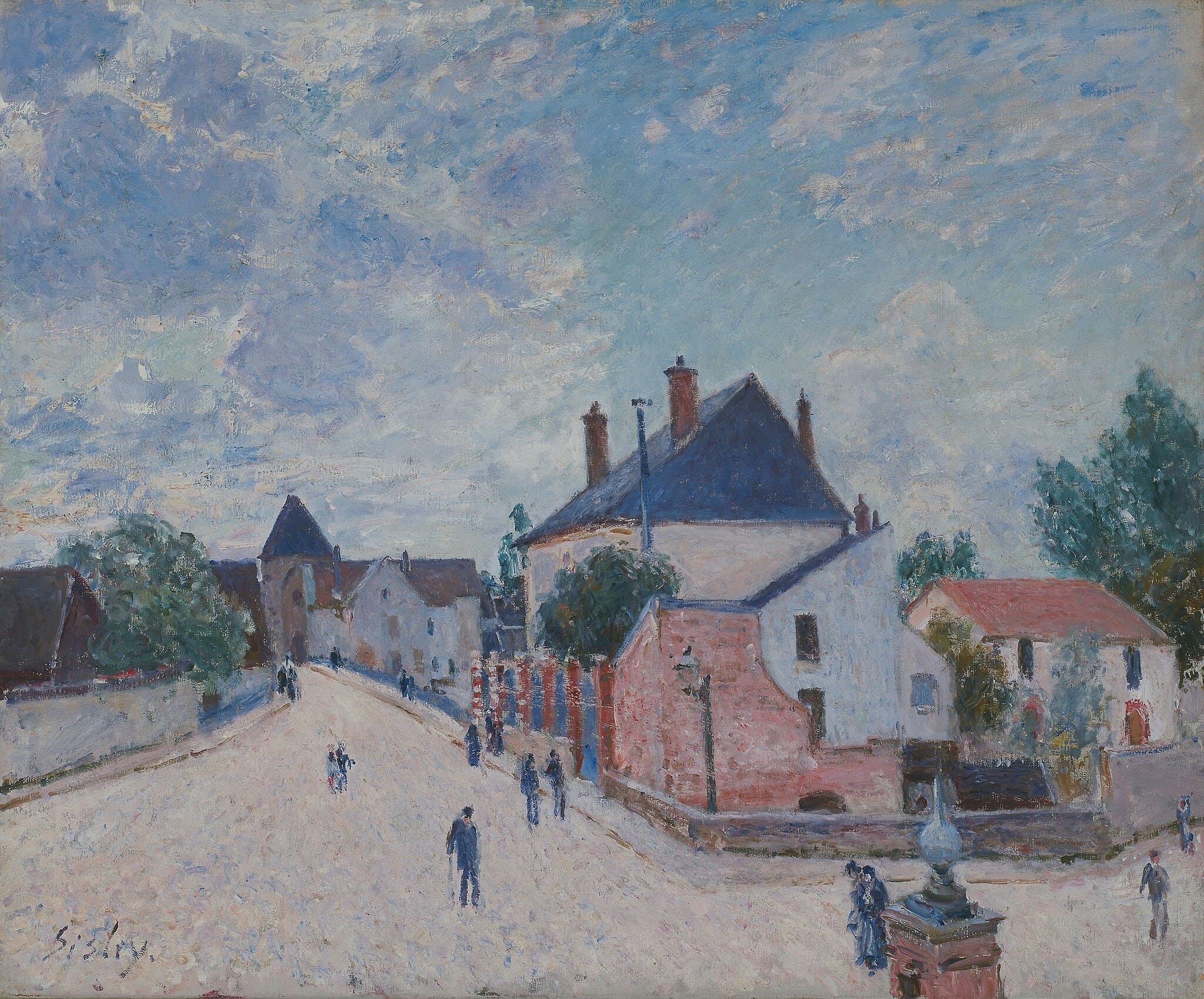
Based on the Art Institute of Chicago’s documented Street in Moret (c.1885–95, 60 × 73.2 cm) and recent auction comparables, a reasoned market range for a sale-ready, well-documented Sisley Moret canvas is $500,000–$2,500,000. This assumes clear provenance, good condition, catalogue‑raisonné concordance, and no restitution encumbrances.
Valuation Analysis
Valuation conclusion: Considering the Art Institute of Chicago’s catalogued Street in Moret (c.1885–95, 60 × 73.2 cm) and comparable auction results, a pragmatic market range for a comparable, sale-ready Sisley Moret canvas is $500,000–$2,500,000. The lower bound represents typical mid‑quality, market-ready Moret pictures; the upper bound represents very strong, well‑provenanced, museum‑quality late‑Moret works that command selective competitive bidding [1].
Comparable evidence and ceiling: Sisley’s auction ceiling remains exceptional (Effet de neige à Louveciennes, Sotheby’s London, 1 Mar 2017), which demonstrates the artist’s upper limit in the right circumstances but is not representative of the usual market for Moret townscapes [2]. More commonly, late‑period river/Moret subjects with strong presentation and provenance have realized in the mid‑six figures to low‑seven figures in 2021–2025 sales; those outcomes anchor the middle of the range and explain why $500k is a defensible entry point and $2.5M an achievable top for an outstanding example [3].
Method and assumptions: This appraisal is a comparable_analysis that synthesizes recent auction results, subject/scale parity, and the documented provenance of the Art Institute example. Key assumptions are: authenticity confirmed (catalogue raisonné or technical concordance), sound condition or restorable condition with benign conservation history, clear title, and normal market access (no legal or export restrictions). Deviations — notably unresolved provenance issues, heavy restoration, or attribution doubts — will materially lower realizable value.
Special considerations — museum ownership: The Art Institute accession (Potter Palmer collection; accession 1922.441) confers strong provenance and curatorial validation, which would typically enhance value. Practically, museum ownership makes a market sale unlikely and complicates valuation by removing recent auction evidence for the specific canvas; it also limits sale routes (deaccession, private transfer, institutional negotiation) and may affect the net proceeds and buyer pool [1].
Recommended next steps: To refine this range to a single estimate (hammer/estimate for auction) obtain high‑resolution recto/verso photographs, a conservator’s condition report, the Brame & Lorenceau catalogue raisonné entry, and any exhibition/publication history. Present the dossier to senior Impressionist specialists at Christie’s or Sotheby’s for a formal pre‑sale estimate and recommended venue. With that documentation the range above can be tightened materially upward or downward.
Key Valuation Factors
Art Historical Significance
High ImpactAlfred Sisley’s Moret views are a defining component of his late oeuvre and are well regarded by museums and collectors for their late‑period refinement of light and atmosphere. A Street in Moret from c.1885–95 sits within the mature phase of Sisley’s career when he distilled compositional economy and palette restraint. Such works carry strong curatorial interest because they illustrate the artist’s late landscape language and the topography of Moret‑sur‑Loing. When a specific work is well documented and appears in scholarship or exhibition catalogues, its art‑historical stature materially raises buyer confidence and price expectations, and this factor can push a mid‑market Sisley into low‑seven‑figure territory.
Provenance & Museum Ownership
High ImpactThe Art Institute of Chicago provenance (Potter Palmer collection; accession 1922.441) is a substantial positive for authenticity and documentation. Clean, institutional provenance reduces buyer uncertainty, increases institutional and dealer interest, and supports higher estimates. However, museum ownership also reduces practical marketability — deaccession or private sale can be complex, time‑consuming and subject to institutional rules. If the exact canvas were to be offered, the museum provenance would typically produce a premium compared with unknown provenance, but the pathway to a competitive public auction is often constrained, which can affect timing and realized price.
Condition & Technical Authentication
High ImpactCondition strongly dictates realizable value. A painting with original paint and stable ground in good condition will achieve stronger results than one with major relining, extensive inpainting, or structural issues. Technical confirmation (X‑radiography, infrared reflectography, pigment analysis) and a conservator’s report are essential; they establish period materials and any later interventions. For Sisley, evidence of original impasto, consistent ground and period pigments supports both attribution and premium pricing. Conversely, major restoration or modern overpaint will reduce marketability and push value toward the lower end of the stated range.
Comparative Market Performance
Medium ImpactRecent auction results for comparable late‑period landscapes by Sisley cluster in the mid‑six figures, with selective works reaching low‑seven figures. The artist’s auction record (a rare snow scene) establishes an exceptional ceiling but is not typical. Therefore, comparable sales — adjusted for size, subject, and provenance — are central to placing Street in Moret within the $500k–$2.5M band. Market appetite for late Sisley Moret views is steady among specialists and institutions, but competition is selective and quality‑driven.
Rarity, Size & Subject Desirability
Medium ImpactThe painting’s dimensions (60 × 73.2 cm) make it a mid‑sized, saleable canvas that fits comparables which have sold in recent seasons. Moret townscapes are desirable but relatively numerous within Sisley’s corpus; rarity is therefore a function of exceptional composition, condition, or proven exhibition history rather than subject alone. Winter views or distinctive vantage points can command premiums. A particularly strong composition or an unusually large, finely worked Moret work would push value toward the top of the range.
Sale History
Street in Moret has never been sold at public auction.
Alfred Sisley's Market
Alfred Sisley is a well-regarded Impressionist whose market sits below Monet and some peers but enjoys steady institutional and private collector interest. Supply is relatively limited, and the best Sisleys — especially late Moret and snow scenes — attract focused competition. Typical auction results for market‑ready Sisley landscapes commonly fall in the mid‑six figures, while exceptional works can reach low‑seven figures; the artist’s auction record remains a rare multi‑million result achieved under exceptional circumstances. Institutional demand and renewed scholarship support the artist’s mid‑market stability.
Comparable Sales
Effet de neige à Louveciennes
Alfred Sisley
Artist's auction record; top-tier museum-quality snow scene by Sisley — establishes the market ceiling for the artist and demonstrates strongest possible demand for a late-period masterpiece.
$9.1M
2017, Sotheby's London (Impressionist & Modern Evening Sale)
~$11.9M adjusted
Port-Marly, avant l'inondation
Alfred Sisley
Mid-six-figure Moret/nearby-subject example of similar period and scale — a practical market-level comparable for a finished late Sisley landscape of good quality.
$565K
2021, Sotheby's, New York
~$670K adjusted
Hiver à Marly, effet de neige
Alfred Sisley
Late-period snow/landscape subject with a mid-six-figure result; snow scenes tend to perform well, so this helps benchmark higher-quality late works in the Moret/nearby group.
$562K
2021, Sotheby's, Paris
~$667K adjusted
La Seine à Suresnes
Alfred Sisley
Recent 2025 sale of a comparable-scale river/landscape subject by Sisley — shows current-market upper-six-figure outcomes for well-presented mid-sized works.
$945K
2025, Christie's, New York
Current Market Trends
The Impressionist market has been selective post‑2021: overall turnover contracted in 2024, with selective recovery into 2025 favoring flight‑to‑quality behavior. Top institutional‑grade works still attract robust bidding, while mid‑tier lots face price discipline. Provenance, exhibition history and technical certainty are increasingly decisive. For Sisley, this means well‑documented, museum‑grade Moret views remain attractive, but ordinary mid‑quality canvases compete in a more cautious market.