How Much Is The Bridge at Villeneuve-la-Garenne Worth?
Last updated: January 30, 2026
Quick Facts
- Last Sale
- $2K (1920, Galerie Georges Petit, Paris)
- Methodology
- comparable analysis
We estimate Alfred Sisley’s The Bridge at Villeneuve-la-Garenne (1872) at $10–15 million in a marquee auction setting. This early, museum-grade bridge scene with Durand‑Ruel/Faure provenance and long-term Met ownership ranks among the artist’s most desirable subjects and periods, and could challenge Sisley’s standing auction record.
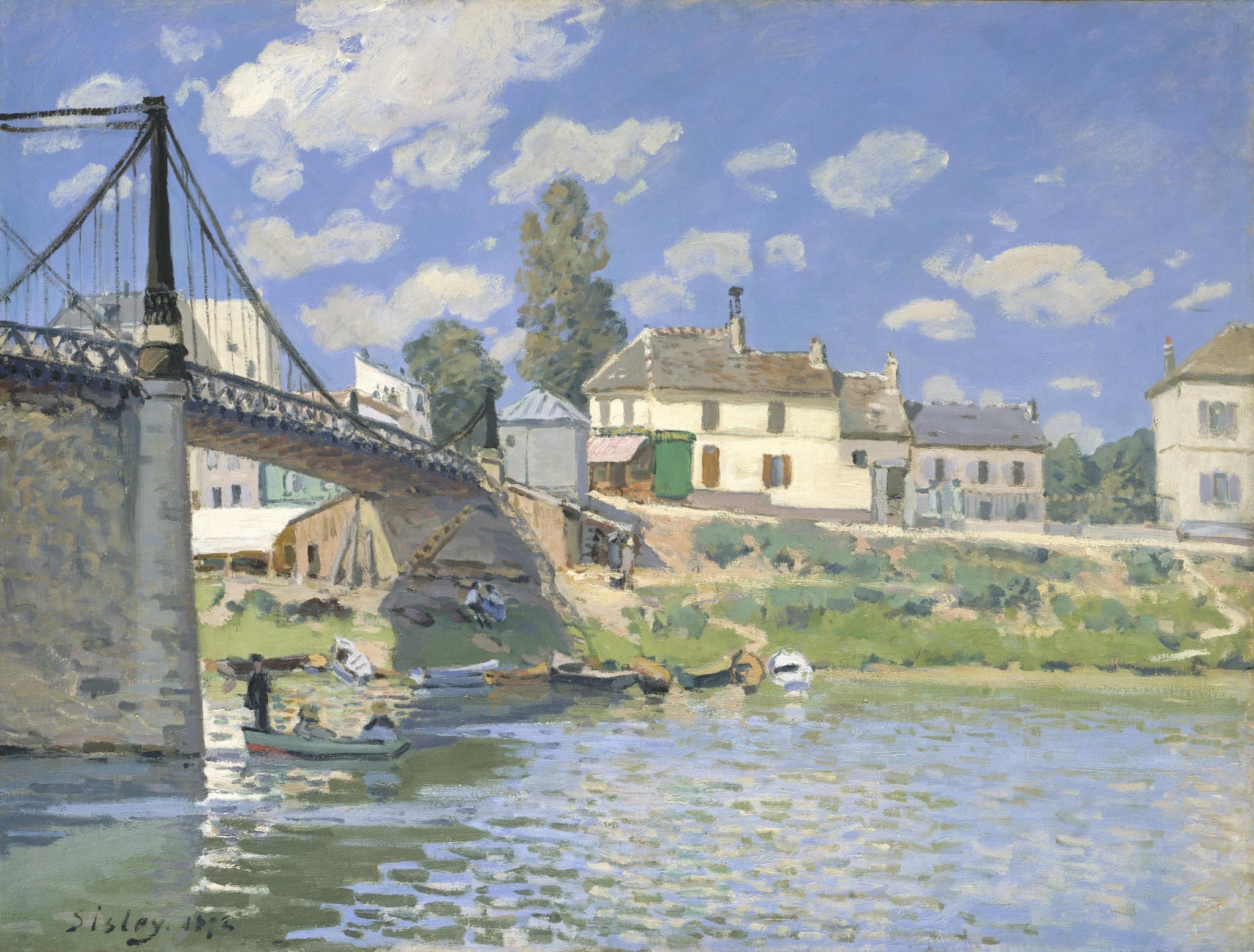
The Bridge at Villeneuve-la-Garenne
Alfred Sisley, 1872 • Oil on canvas
Read full analysis of The Bridge at Villeneuve-la-Garenne →Valuation Analysis
Conclusion: A hypothetical auction estimate of $10–15 million is warranted for Alfred Sisley’s The Bridge at Villeneuve-la-Garenne (1872), reflecting its prime date, universally desirable bridge-over-the-Seine subject, distinguished Durand‑Ruel/Faure provenance, and long, high-profile tenure at The Metropolitan Museum of Art (acc. 64.287) [1]. Within Sisley’s oeuvre, few works combine this subject, period, and visibility; accordingly, the painting could plausibly challenge the artist’s auction record if offered in a top New York or London evening sale.
Market positioning and comps: Sisley’s record stands at $9.06 million for Effet de neige à Louveciennes (Sotheby’s London, 1 March 2017) [2]. Recent, high-quality Sisley river/bridge subjects have realized low- to mid-seven figures: Le pont de Moret‑sur‑Loing en été (1888) achieved about $2.6 million (Christie’s London, 15 Oct 2025) [3], while late‑1870s Seine views such as La Seine à Suresnes (c. 1879) and Le Pont de Sèvres (1877) sold around $945,000 and $656,000 respectively in 2025 [4]. These are materially less significant than an 1872, early-Impressionist bridge scene and thus anchor the mid-seven-figure “floor” rather than the likely outcome for the Met’s painting. Given the subject and year, the Met canvas sits nearer the artist’s top tier—justifying an estimate range that surpasses the 2017 record band.
Why this work commands a premium: Date and subject are decisive. Painted in 1872, the work aligns with Sisley’s most coveted early period, when his luminous, modern views of the Seine suburbs helped define Impressionism’s language of light and atmosphere. Bridge motifs are among his signature themes, prized for their compositional clarity and sense of Parisian modernity. The format (49.5 × 65.4 cm) matches the scale collectors favor, and the provenance—purchased by Durand‑Ruel, owned by the renowned baritone-collector Jean‑Baptiste Faure, later passing through Galerie Georges Petit and entering The Met in 1964—adds “trophy” credibility and broad cultural recognition [1].
Market climate: The broader Impressionist/Post‑Impressionist category has cooled from 2021–2022 peaks, with 2023–2024 auction volumes lower and buyers highly selective. Even so, top‑quality, museum-level works continue to outperform as supply remains tight and competition concentrates on trophies [5]. In that context, an early, canonical Sisley with The Met provenance is precisely the type of asset that can mobilize deep, international demand, supporting a low‑eight‑figure outcome.
Methodology: We triangulated from (i) Sisley’s $9.06m record [2]; (ii) recent bridge/river comparables in the $0.65–$2.6m band [3][4]; and (iii) subject/date premiums and institutional provenance effects observed in the category [5]. Weighting these inputs yields a confident $10–15 million range for a marquee-auction sale, with the upper bound reflecting record‑level potential.
Key Valuation Factors
Art Historical Significance
High ImpactPainted in 1872, this canvas sits squarely in Sisley’s most celebrated early-Impressionist period, when he forged the luminous language of plein-air modernity on the Seine. Bridges, river traffic, and the Parisian outskirts are core to his identity; Villeneuve-la-Garenne is a quintessential example of that modern subject. The work has been widely reproduced and studied, further entrenching its status in the artist’s canon. As a succinct, legible statement of Sisley’s contribution to Impressionism—color, atmosphere, and an elegant, ordered composition—it carries art-historical weight that places it among his most desirable themes and dates, justifying a valuation above routine landscapes and later-period motifs.
Date and Subject Desirability
High ImpactCollectors consistently prioritize Sisley’s early 1870s works, especially Seine-suburb bridges—subjects that showcase the artist’s clarity of light, fresh palette, and compositional rigor. Villeneuve-la-Garenne, like Argenteuil or Sèvres, evokes the era’s modern infrastructure and leisure culture, themes that resonate across top Impressionist collections. Compared with later Moret views, early Seine-bridge scenes typically command a premium due to both historical primacy and market demand. The 49.5 × 65.4 cm format is ideal for private collections, bolstering liquidity. Together, the 1872 date and bridge motif form a best-in-class combination that aligns with record-level performance within Sisley’s market.
Provenance and Institutional Prestige
High ImpactThe painting’s provenance is exemplary: acquired by Durand‑Ruel directly from Sisley, sold to the famed collector Jean‑Baptiste Faure, later handled by Galerie Georges Petit and Sam Salz, and in The Metropolitan Museum of Art since 1964. This chain confers exceptional credibility and visibility. Works long exhibited in top museums often carry a ‘trophy’ premium because they are instantly recognizable, thoroughly vetted, and canonically placed in the literature. In any hypothetical sale, the Met association and early Durand‑Ruel/Faure history would be highly persuasive to global bidders, underpinning confidence at the upper end of the estimate range.
Market Liquidity and Comparable Sales
Medium ImpactRecent Sisley bridge and river-town scenes of comparable size have sold between roughly $0.65 million and $2.6 million, while the artist’s auction record is $9.06 million for an 1874 snow scene. These comparables set a robust baseline but understate the premium warranted by an 1872, museum-grade bridge subject with iconic visibility. The Impressionist market has cooled from 2021–2022 highs, but top-tier, fresh, canonical works continue to attract aggressive bidding. In that context, this picture is properly situated in the low eight figures, with record-challenging potential if two or more bidders compete for a definitive early Sisley.
Sale History
Galerie Georges Petit, Paris
Public auction, lot 56; recorded at 37,200 French francs; USD equivalent approximate based on 1920 parity.
Alfred Sisley's Market
Alfred Sisley is a core Impressionist whose prices sit below Monet and Renoir, and broadly comparable to Pissarro for like‑for‑like quality. His auction record is $9.06 million (Sotheby’s London, 2017) for an 1874 snow scene, with most strong oils trading today in the mid‑six to low‑seven figures. Collectors prize early 1870s works, Seine-suburb bridges, and snow scenes, which command significant premiums over later motifs. Liquidity is international, with the best material sold in evening auctions in New York, London, or Paris. Although the broader category has moderated since 2022, demand for “textbook” Sisleys with top subjects, scale, and provenance remains deep and competitive.
Comparable Sales
Le pont de Moret-sur-Loing en été
Alfred Sisley
Same artist; bridge-over-river motif; comparable dimensions (c. 54 x 73.5 cm vs 49.5 x 65.4 cm); strong commercial subject though later Moret period (1888).
$2.6M
2025, Christie's London
La Seine à Suresnes
Alfred Sisley
Same artist; Seine suburb subject; near-identical size (c. 50 x 65 cm); later 1870s period offers a close but slightly less seminal proxy to an 1872 bridge scene.
$945K
2025, Christie's New York
Le Pont de Sèvres en fin de journée, au fond l’église de Saint-Cloud
Alfred Sisley
Same artist; explicit bridge subject on the Seine near Paris; very similar dimensions (50 x 60 cm); later 1877 date provides a conservative benchmark for bridge views.
$656K
2025, Sotheby's London
Le quai à sable, environs de Port-Marly
Alfred Sisley
Same artist; prime mid-1870s Seine-suburb motif; comparable scale (c. 47 x 56 cm); closely aligned period/subject, though not a bridge per se.
$976K
2025, Christie's London
Moret-sur-Loing au soleil couchant
Alfred Sisley
Same artist; river-town motif central to Sisley; larger but still comparable format (65.6 x 81.6 cm); later Moret period shows upper-day-sale/entry-evening appetite for strong subjects.
$1.6M
2022, Christie's New York
~$1.8M adjusted
Effet de neige à Louveciennes
Alfred Sisley
Same artist; prime early Impressionist period (1874); similar size; canonical snowscape that set the auction record—useful as a ceiling benchmark for top-tier early Sisley.
$9.1M
2017, Sotheby's London
~$11.8M adjusted
Current Market Trends
Impressionist and Post‑Impressionist auctions have softened since 2022, with 2023–2024 totals declining and buyers becoming more selective. Supply of $10m+ masterpieces is tight, and bidding concentrates on canonical, well‑provenanced works. In this environment, mid‑tier lots face price discipline, while blue‑chip trophies can still outperform. Paris has gained share in late‑19th‑century material, complementing New York and London. Against this backdrop, a prime 1872 Sisley bridge scene with Met provenance has the qualities that mobilize international demand and justify a low‑eight‑figure estimate despite the broader market’s cooler tone.
Sources
- The Metropolitan Museum of Art – Object page (acc. 64.287)
- MarketScreener – Sotheby’s London March 2017 Sales (Sisley record noted)
- Christie’s – 20th/21st Century London/Paris sale results (Oct 15, 2025)
- HENI – Recent Sisley auction results (examples cited 2025)
- Art Basel & UBS – The Art Market 2024 (Auctions overview)