How Much Is The Church at Moret Worth?
Last updated: January 30, 2026
Quick Facts
- Insurance Value
- $15.0M (Indicative replacement-cost estimate based on top-tier Sisley comparables and artist record)
- Methodology
- comparable analysis
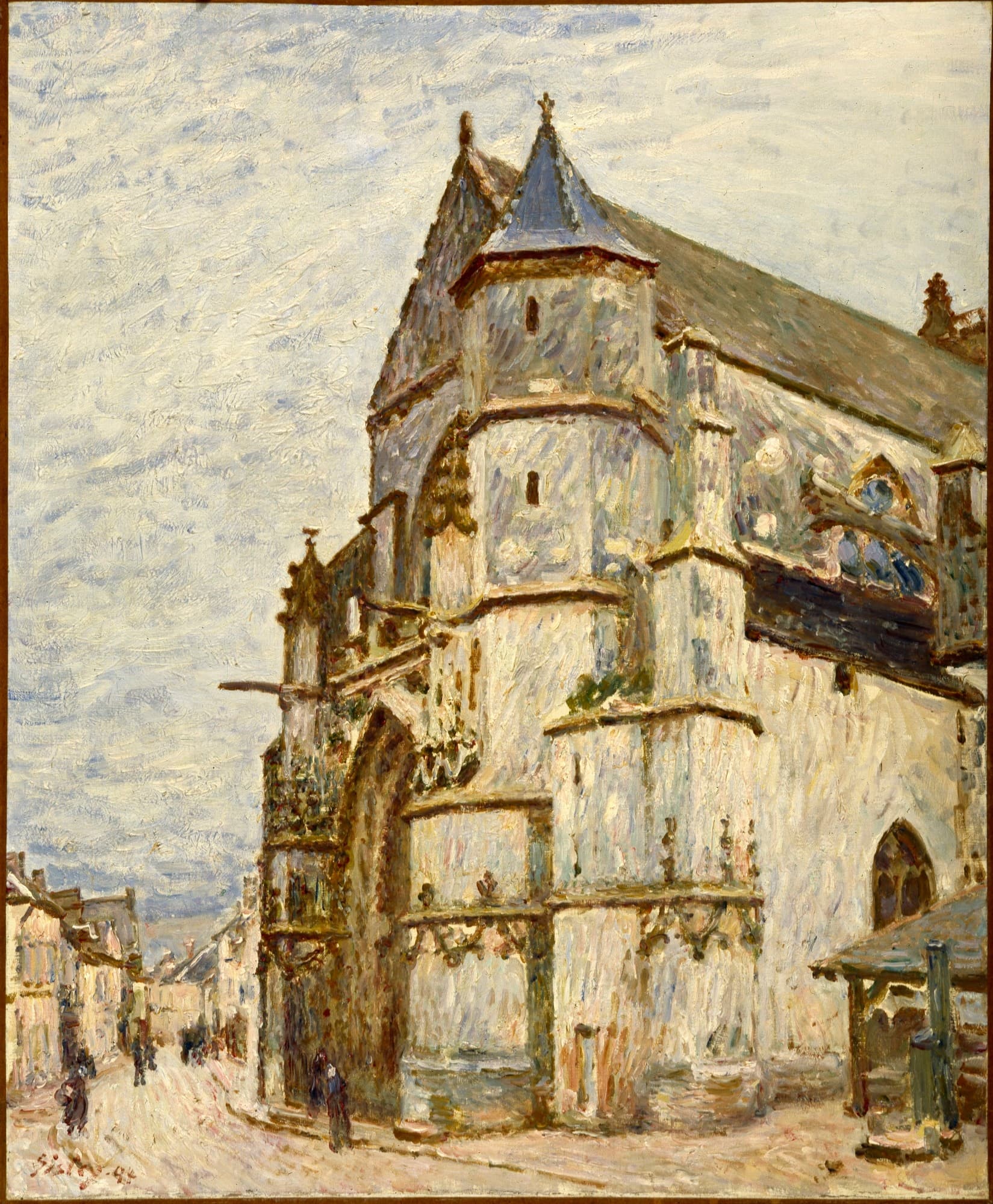
Based on recent Sisley auction benchmarks and the series’ status within the artist’s oeuvre, a museum‑grade Church at Moret (1894) of the DIA painting’s quality, size and pedigree would likely command $8–12 million in a marquee sale. The range is anchored to Sisley’s high‑single‑digit record and premium demand for late, signature Moret subjects. While the DIA work is not for sale, this reflects current replacement-market pricing for a directly comparable example.
Valuation Analysis
Conclusion: A directly comparable Alfred Sisley Church at Moret (1893–94) of similar size, quality, condition, and literature/provenance would likely achieve $8–12 million today in a top evening sale. This reflects the motif’s position at the apex of Sisley’s late oeuvre, scarcity of A‑tier examples in private hands, and the artist’s established high‑single‑digit auction ceiling [2].
Work identification and significance: The Detroit Institute of Arts’ Church at Moret after the Rain (1894; 73 × 60.3 cm; signed “Sisley‑94”) is a canonical entry in Sisley’s celebrated late series devoted to the church at Moret‑sur‑Loing, widely regarded as one of his career‑defining motifs. The DIA record documents its atelier‑sale appearance (1899), Durand‑Ruel acquisition (1916), and museum ownership since 1920, along with comprehensive literature references—an exemplary pedigree for the type [1].
Market calibration: Sisley’s auction record stands at approximately $9.06 million (Effet de neige à Louveciennes, Sotheby’s London, 2017) [2]. Recent high‑quality Moret‑period views have realized $2.59 million (Le pont de Moret‑sur‑Loing en été, Christie’s London, Oct 15, 2025) and $1.62 million (Moret‑sur‑Loing au soleil couchant, Christie’s New York, Oct 21, 2022) [4][5]. A 2018 Sotheby’s evening‑sale entry from the same church series carried a £700,000–900,000 estimate, underscoring the wide dispersion by variant, quality, and condition within the motif [3]. Historically, Sisley’s best works have reached the mid‑single‑digit millions, with the very top approaching his record [2][6].
How the estimate was derived: The $8–12 million range is built by triangulating (i) Sisley’s established top‑of‑market record and rarity premium for late, signature subjects; (ii) a series uplift for the Church at Moret relative to broader Moret landscapes; and (iii) present‑day buyer preference for canonical Impressionist “trophy” works. A best‑of‑series church canvas—fresh, with strong color/light (e.g., morning/evening effects or post‑rain atmosphere), clean condition, and robust publication/exhibition history—would justifiably trade at a significant premium to generic Moret views and could test the artist’s high‑single‑digit ceiling [2][4][5].
Market context and positioning: After a softer 2024, late‑2025 sales reaffirmed a flight to quality in blue‑chip historical categories. Within that backdrop, the combination of iconography, period (1893–94), and pedigree positions an A‑caliber Church at Moret squarely in the high‑single‑digit to low‑eight‑figure bracket, consistent with Sisley’s top outcomes and current category dynamics [6]. While the DIA painting is not on the market, its attributes make it an excellent proxy for replacement‑cost and benchmark valuation.
Key Valuation Factors
Art Historical Significance
High ImpactSisley’s Church at Moret (1893–94) series is a signature late‑career undertaking, analogous—within his practice—to Monet’s serial investigations of Rouen Cathedral. It encapsulates Sisley’s lifelong preoccupation with atmosphere and transient light while focusing on a landmark central to his final years at Moret‑sur‑Loing. The motif is widely published and exhibited, occupies a privileged place in the catalogue raisonné and scholarship, and is instantly recognizable to curators and collectors. Works from this series are frequently held by institutions, limiting supply and reinforcing their perceived importance. This art-historical status commands a material premium over otherwise comparable Moret river, bridge, or orchard views.
Subject Rarity and Desirability
High ImpactWhile Sisley produced multiple views of Moret, the church façade under varied light—morning sun, evening glow, or post‑rain clarity—is a concentrated subset and a collecting target. The series’ tight focus, serial logic, and immediate recognizability create enduring demand across regions. A compelling time‑of‑day effect, balanced composition, and the engaging architectural anchor of the church yield strong wall power and institutional appeal. Because a number of first‑rate examples reside in museums, comparable offerings in private hands are scarce, and when fresh‑to‑market they can catalyze competitive bidding, especially in marquee sales.
Provenance, Literature, and Exhibition
High ImpactThe DIA painting’s chain—from Sisley’s atelier sale (1899) to Durand‑Ruel (1916) and into a U.S. museum by 1920—is exemplary for Impressionist material. Inclusion in the principal catalogue raisonné and repeated scholarly citations elevate confidence and reduce transactional friction. For valuation, such pedigree signals authenticity, continuous care, and historical recognition, all of which tend to compress discounting for risk. Works from this series with similarly complete provenance and strong literature/exhibition histories merit a premium relative to otherwise comparable canvases lacking such documentation.
Market Comparables and Liquidity
Medium ImpactSisley’s auction record is about $9.06 million (2017), establishing a clear high‑single‑digit ceiling. Recent late‑period Moret views have sold between roughly $1.6 million and $2.6 million, with quality and subject driving dispersion. Within this context, the Church at Moret series—a top‑tier motif—commands a meaningful uplift above general Moret landscapes. In a strong, guarantee‑backed evening sale, a best‑available church canvas can approach the artist’s record, reflecting trophy‑seeking demand for canonical subjects. Liquidity is selective but deep for A‑caliber examples, especially with exhibition‑ready condition and provenance.
Condition and Scale
Medium ImpactAt approximately 73 × 60 cm, the DIA example sits in a desirable mid‑scale that suits both private and institutional display. For the series, color balance (e.g., warm morning light or crystalline post‑rain atmosphere), intact paint surface, and minimal restoration are price‑sensitive. Works retaining original dimensions, with stable canvas and unintrusive retouching, sell more efficiently and at stronger multiples. Given the series’ textured handling and light effects, clarity of the façade and sky passages is particularly important to collectors evaluating quality within near‑identical compositions.
Sale History
Galerie Georges Petit (Atelier Sisley sale), Paris
Atelier sale of Alfred Sisley, lot 14; early posthumous studio dispersal context recorded by DIA object entry.
Hôtel Drouot, Paris
Lot 107; acquired by Durand‑Ruel. Price not published on DIA record.
Detroit Institute of Arts (City of Detroit purchase)
Acquired from Durand‑Ruel; accession 20.114. No public price disclosed.
Alfred Sisley's Market
Alfred Sisley stands among the canonical Impressionists, with sustained international demand and a market tier typically below Monet and Renoir but above many peers. His auction record is approximately $9.06 million (Sotheby’s London, 2017), and most high‑quality oils today transact around the mid‑six to low‑seven figures, with exceptional subjects advancing into the multi‑million range. Collectors prize 1870s snow scenes, strong river views, and late Moret subjects—including the church and bridge—while condition, palette, and scale materially affect price. Supply is finite, and fresh, well‑documented works can outperform estimates, particularly when positioned in marquee evening sales with financial backing.
Comparable Sales
Le pont de Moret-sur-Loing en été (1888)
Alfred Sisley
Same artist; core Moret motif (town/river/bridge) and strong late-period subject closely related to the Church-at-Moret series in market appeal.
$2.6M
2025, Christie's London
Moret-sur-Loing au soleil couchant (1892)
Alfred Sisley
Same artist; late Moret view two years before the Church series, very close in period, subject and collector demand profile.
$1.6M
2022, Christie's New York
~$1.8M adjusted
Le verger à Moret-sur-Loing, printemps (c. 1891)
Alfred Sisley
Same artist; Moret subject from the immediate pre‑series years, useful for gauging late‑period demand below the marquee motifs.
$806K
2024, Christie's New York
~$827K adjusted
La Seine à Suresnes (1879)
Alfred Sisley
Same artist; strong river view benchmark illustrating mid‑to‑upper market pricing for good but non‑Moret subjects.
$945K
2025, Christie's New York
Effet de neige à Louveciennes (1874) — Artist auction record
Alfred Sisley
Artist’s auction record; establishes Sisley’s top‑of‑market ceiling against which a trophy‑level Church at Moret would be measured (different subject but critical for price context).
$9.1M
2017, Sotheby's London
~$11.9M adjusted
Current Market Trends
Impressionist and Post‑Impressionist auctions softened in 2024 before rebounding at the top end in late 2025, amid a broader flight to quality. Guarantees and single‑owner presentations supported blue‑chip outcomes, while mid‑tier material remained selective. In this environment, historically validated, institutionally collected motifs—like Sisley’s Moret series—benefit from reinforced demand and reduced risk premia. Buyers continue to pay for freshness, condition, and scholarly pedigree; as a result, A‑caliber Sisley works can approach his high‑single‑digit record, even as routine examples clear at more modest levels.
Sources
- Detroit Institute of Arts – Church at Moret after the Rain (1894) object record
- Sotheby’s London (press summary via MarketScreener): March 2017 sales; Sisley record GBP 7.36m
- Sotheby’s London 2018 Evening Sale – La vieille église de Moret, le matin au soleil (1894), estimate
- HENI News – Sisley, Le pont de Moret-sur-Loing en été result (Oct 15, 2025)
- VeryImportantLot – Sisley, Moret-sur-Loing au soleil couchant result (Oct 21, 2022, Christie’s NY)
- Art Basel & UBS Art Market Report 2024 – Auctions overview