How Much Is Reading Worth?
Last updated: January 31, 2026
Quick Facts
- Insurance Value
- $16.0M (Analyst estimate benchmarked to top Morisot auction results and replacement difficulty for museum-quality early oils.)
- Methodology
- comparable analysis
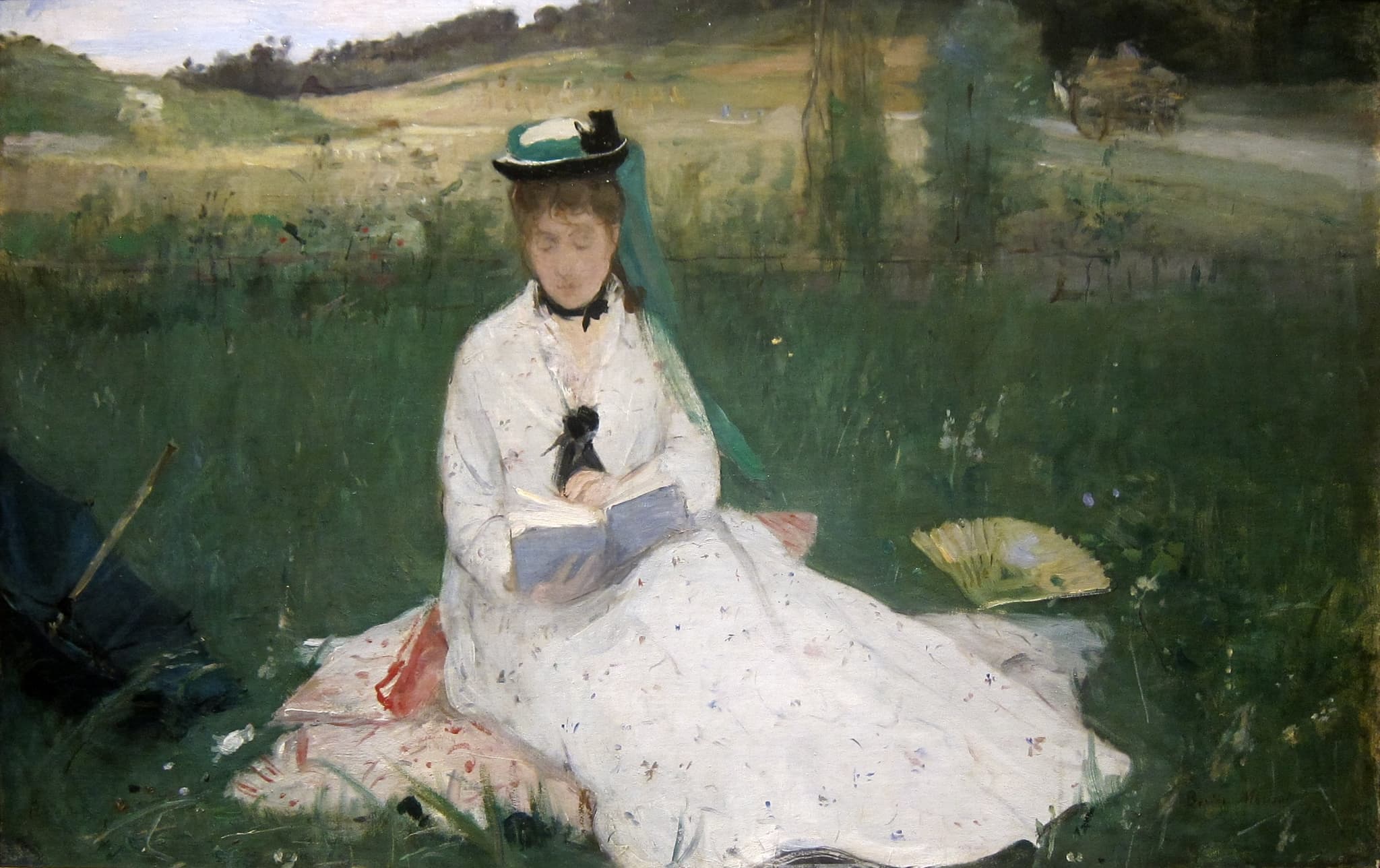
Reading (La lecture), 1873, is a prime early Morisot—an oil of her sister Edma exhibited in the landmark 1874 Impressionist show—placing it near the apex of her market. Based on directly comparable early-1870s figure oils and the artist’s $10.9m auction record, we estimate $9–14 million if offered at auction today, with a recommended insurance guideline around $16 million.
Valuation Analysis
Berthe Morisot’s Reading (La lecture), 1873 (oil on canvas, 18 1/8 × 28 1/4 in.; Cleveland Museum of Art, acc. 1950.89), depicts her sister Edma reading in a garden and was shown in the inaugural 1874 Impressionist exhibition under the title La lecture. The Cleveland Museum of Art dossier records extensive exhibition and literature history and a 2023 conservation treatment that removed discolored varnish and revealed compositional adjustments—both market-positive indicators of authenticity and artistic intent [1].
Our valuation is anchored to direct comparables. Morisot’s auction record stands at $10.9 million for Après le déjeuner (1881), Christie’s London, 6 Feb 2013 [2]. Early-1870s figure oils closest to Reading have realized mid-to-high single-digit millions: Femme et enfant au balcon (1872) brought £4,085,000 at Christie’s London on 28 Feb 2017 (about $5.1m at the time) [3]; Cache-cache (Hide and Seek) (1873)—also shown in the 1874 exhibition—achieved roughly $5.2m at Sotheby’s New York on 2 Nov 2005 [5]. Another refined figure from the same decade, Femme à l’éventail (1876), made $4.365m at Sotheby’s New York on 7 May 2013 [4].
Reading possesses the key value drivers that elevate it above most comparables: a prime 1873 date immediately preceding (and included in) the 1874 exhibition; an emblematic subject (a woman reading, rendered with Morisot’s luminous, brisk facture); and museum-held stature with impeccable provenance. Adjusting the benchmarks for inflation and quality/rarity supports a fair-market range of $9–14 million if placed in a marquee evening sale with full global marketing. Given the painting’s early date and canonical exhibition history, it could plausibly contend near the standing record under optimal conditions [2].
Supply of fully resolved Morisot oils from the early 1870s is extremely tight, and demand for women Impressionists has strengthened with recent retrospectives and scholarship. The CMA’s 2023 conservation clarifies the palette and brushwork, reinforcing the work’s desirability [1]. Considering replacement difficulty for a museum-quality 1873 figure-in-landscape, we recommend an insurance guideline of approximately $16 million. This valuation reflects current market selectivity, yet also recognizes that best-in-class Impressionist works continue to attract deep, competitive bidding when they appear.
Key Valuation Factors
Art Historical Significance
High ImpactReading is a cornerstone early Morisot from 1873, the year immediately preceding the first Impressionist exhibition, and it was exhibited in that seminal 1874 show under the title La lecture. The subject—an intimate portrayal of her sister Edma—epitomizes Morisot’s most celebrated themes of women in private, lyrical moments. Works from the early 1870s are scarce and form the intellectual and stylistic foundation of her mature oeuvre. The painting’s inclusion in the 1874 exhibition firmly situates it within the birth of Impressionism, heightening both scholarly importance and market desirability. This level of historical primacy is a decisive driver of value and places the work near the apex of her market.
Market Comparables and Benchmarks
High ImpactThe artist’s record is $10.9m for Après le déjeuner (1881, Christie’s London, 2013). Closest analogues in date and subject—early-1870s figure oils—have realized mid-to-high single-digit millions: Femme et enfant au balcon (1872) at about $5.1m and Cache-cache (1873; shown in 1874) at about $5.2m (historical). Adjusted for inflation and considering Reading’s superior pedigree (prime 1873 date and 1874 exhibition), a current market range of $9–14m is justified, with upside potential under marquee-evening conditions. These comparables demonstrate the market’s willingness to pay premiums for museum-caliber early works with emblematic subjects, and they calibrate Reading close to record territory.
Subject, Medium, and Quality
High ImpactAn intimate figure subject—woman reading—is among Morisot’s most commercially desirable themes. The medium (oil on canvas) is her top market category, and the canvas is a substantial, display-ready size (c. 46 × 71.8 cm), large enough to compete on the wall while retaining the immediacy of plein-air-inflected brushwork. The composition’s clarity, atmosphere, and luminous handling align with collectors’ preferences for fully resolved early works. Relative to landscapes or slighter sketches, a signature figure-in-garden composition from 1873 commands a decisive premium. In sum, the subject-matter, medium, and execution quality all point to top-tier desirability.
Provenance, Exhibitions, and Conservation
High ImpactReading’s provenance runs through respected private owners and the dealer César de Hauke before acquisition by the Cleveland Museum of Art, signaling long-standing connoisseurship. Its robust exhibition and literature history includes the pivotal 1874 Impressionist show and multiple modern retrospectives, strengthening scholarly and public recognition. A 2023 conservation treatment removed yellowed varnish and revealed compositional adjustments, both supportive of authenticity and enhancing visual impact. Museum-held status underscores the work’s caliber and, from a risk standpoint, implies well-documented condition and care—factors that tend to compress uncertainty and bolster willingness to pay at the high end of the market.
Sale History
Reading has never been sold at public auction.
Berthe Morisot's Market
Berthe Morisot is a core, blue-chip Impressionist whose prime oils are tightly held and infrequently available. Her auction record is $10.9 million for Après le déjeuner (1881, Christie’s London, 2013), and early-1870s figure oils have achieved mid-to-high single-digit millions, with strong demand for emblematic domestic and figure subjects. Institutional attention and scholarship over the past decade have intensified collector interest in women Impressionists, reinforcing pricing power for best-in-class museum-quality canvases. The market for Morisot is bifurcated: routine works trade in the low-to-mid seven figures or below, while scarce, fully resolved early figure compositions—especially with marquee exhibition histories—command a premium and can approach or challenge the artist’s record.
Comparable Sales
Après le déjeuner (After Lunch)
Berthe Morisot
Record-setting Morisot oil with a prime figure subject; fully worked museum-caliber canvas demonstrating the upper bound for mature oils by the artist.
$10.9M
2013, Christie's London
~$14.9M adjusted
Femme et enfant au balcon
Berthe Morisot
Prime early figure composition (1872), close to Reading in date and domestic subject; a strong benchmark for early-1870s oils.
$5.1M
2017, Christie's London
~$6.7M adjusted
Cache-cache (Hide and Seek)
Berthe Morisot
Directly comparable: same year (1873) as Reading and exhibited in the 1874 first Impressionist exhibition; top-tier early figure/genre subject.
$5.2M
2005, Sotheby's New York
~$8.5M adjusted
Femme à l’éventail
Berthe Morisot
Early figure portrait (1876) shown in the 1877 Impressionist exhibition; strong early-period oil and good proxy for demand for 1870s figures.
$4.4M
2013, Sotheby's New York
~$6.0M adjusted
Dans la véranda
Berthe Morisot
Late-1880s domestic subject with strong provenance/exhibition; useful as a lower-bound indicator for high-quality but later oils.
$2.5M
2015, Christie's New York
~$3.4M adjusted
Current Market Trends
Impressionist and Post‑Impressionist auctions remain selective, but top-tier, fresh-to-market works continue to attract deep bidding. The segment saw fewer trophies in 2023–2024, yet 2025 marquee sales demonstrated renewed appetite at the high end, particularly for museum-caliber works with strong provenance and exhibition histories. Supply constraints are pronounced for canonical names, and collectors are increasingly focused on quality, condition, and art-historical significance. Within this context, prime early Morisot oils—especially figure subjects linked to the 1874 exhibition—are exceptionally scarce and well positioned to outperform broader market averages, with competitive dynamics evident when comparable works surface.
Sources
- Cleveland Museum of Art: Reading (La lecture), 1873
- The Art Wolf: Christie's London 2013—Après le déjeuner (Morisot) record
- Christie’s: Impressionist & The Art of the Surreal results (28 Feb 2017)
- Sotheby’s: Femme à l’éventail (1876), Impressionist & Modern Evening Sale (7 May 2013)
- The New York Sun: Picasso Surprise Highlights Sotheby’s Strong Sale (2005) – includes Morisot Cache-cache result