How Much Is The Artist's Daughter with a Parakeet Worth?
Last updated: March 11, 2026
Quick Facts
- Methodology
- comparable analysis
Based on direct comparables and the work’s strong museum provenance (NGA accession 1963.10.50), I estimate Berthe Morisot’s The Artist’s Daughter with a Parakeet (1890) would market in the range $800,000–$2,000,000. This band reflects the Oct 23, 2025 Christie’s Paris sale of a larger related 1890 composition (~€1.08M/~$1.25M) adjusted for the NGA canvas’s smaller study format, condition and provenance premium.
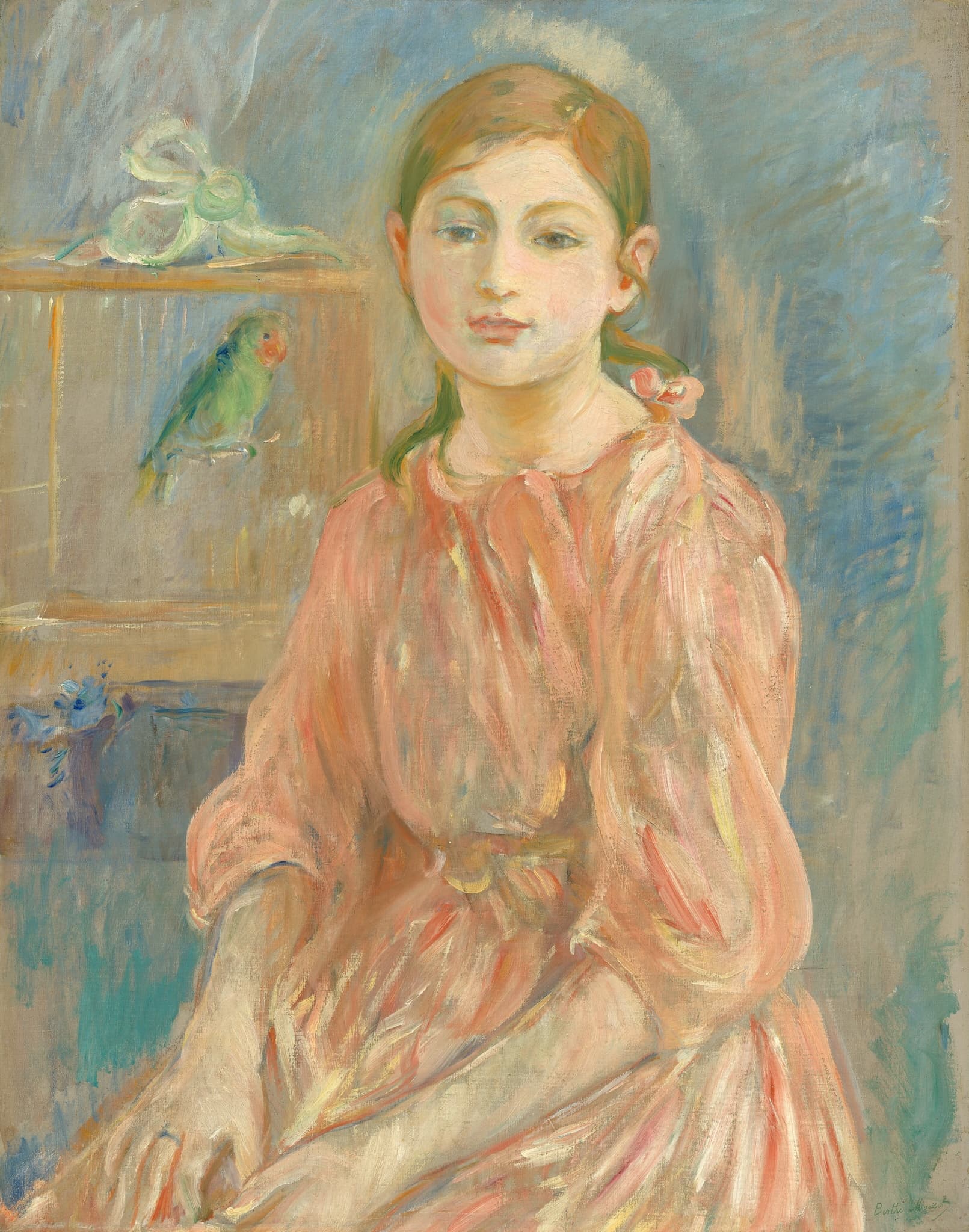
The Artist's Daughter with a Parakeet
Berthe Morisot, 1890 • Oil on canvas
Read full analysis of The Artist's Daughter with a Parakeet →Valuation Analysis
Estimated market range: $800,000–$2,000,000. This estimate applies to Berthe Morisot’s The Artist’s Daughter with a Parakeet (1890), currently catalogued in the National Gallery of Art (accession 1963.10.50; approx. 65.6 × 52.1 cm) and recorded as a study of Julie Manet [1]. Although the NGA canvas has not been publicly sold in the modern era, a closely related, larger 1890 composition (Julie Manet à la perruche) sold at Christie’s Paris on 23 October 2025 for ≈€1.08M (~$1.25M), providing the strongest direct market test for this subject and composition [2].
The valuation uses a comparables-based approach: realized prices for near-identical subject matter are adjusted for scale, finish (study versus larger finished canvas), documented provenance, and condition. The Christie’s 2025 result anchors buyer willingness in the low seven-figure band for a larger, finished canvas; the NGA painting’s smaller scale and its identification as a study ordinarily reduce that expectation. Offsetting this is the painting’s museum-grade provenance and Chester Dale ownership history, which reduce attribution risk and can attract institutional and high-end private bidders, pushing value toward the midpoint or higher depending on documentation and condition [2][3].
Provenance and documentation materially matter. Descent from the sitter (Julie Manet), gallery handling (Galerie Jacques Dubourg), Chester Dale acquisition and eventual bequest to the NGA are strong value drivers because they lower title and attribution risk and imply institutional stewardship and likely publication. If the NGA entry is accompanied by exhibition citations or a catalogue raisonné listing, the work would command a meaningful premium within the range; absent publication the work will typically sell below larger finished counterparts despite the provenance benefit [1].
Condition and technical confirmation are pivotal. The difference between an intact original surface and a heavily restored or relined study can change market outcomes by tens of percent. A modern conservation report, infrared reflectography/X‑ray and pigment analysis will be decisive in moving from an indicative range to a sale estimate. For valuation purposes I assume no catastrophic condition issues; discovery of major interventions would drive the expected result toward the lower bound.
In practical sale scenarios: offered clean, published and in good original condition, expect active bidding with potential outcomes in the $1.0M–$2.0M zone; without publication or with condition concerns, realistic results cluster closer to $800k–$1.2M. This is a working market valuation based on direct comparables and documented provenance; for sale readiness I recommend high‑resolution imagery, a current condition report, catalogue‑raisonné confirmation and pre‑sale consultation with Christie’s or Sotheby’s Impressionist specialists to finalize reserves and timing.
Key Valuation Factors
Art Historical Significance
High ImpactBerthe Morisot’s portraits of Julie Manet are central to her late oeuvre and are much studied by curators and scholars for their intimate domestic focus and refined brushwork. A study titled The Artist’s Daughter with a Parakeet (1890) connects to a small but important group of works in which Morisot explored child portraiture and interior life—subjects that carry cultural and scholarly interest and therefore institutional appeal. The painting’s role as a study related to a larger finished composition increases its academic value because it illuminates Morisot’s working process. This scholarly significance tends to enhance market desirability relative to anonymous studio sketches, supporting a premium when other conditions (provenance, condition) are favorable.
Provenance & Exhibition History
High ImpactThe work’s provenance is a major value contributor: retained by the sitter Julie Manet into the 20th century, handled by Galerie Jacques Dubourg, acquired by prominent collector Chester Dale and bequeathed to the National Gallery of Art. Such a traceable chain reduces attribution and title risk and signals institutional stewardship, often translating to stronger bidder confidence in the market. If the NGA painting has been published or included in exhibition catalogues and/or the standard catalogue raisonné, those citations would materially increase realized prices. Conversely, gaps in publication or exhibition history would cap buyer enthusiasm and limit outcomes.
Physical Attributes & Condition
Medium ImpactAt approximately 65.6 × 52.1 cm (oil on canvas), this work sits between an intimate study and a moderate portrait size. The market differentiates between highly finished canvases and looser studies; studies routinely sell at a discount to larger, fully realized portraits. Equally crucial is conservation state: stable ground and original surface support higher values, while heavy relining, extensive inpainting or structural damage reduce realizations significantly. A modern condition and technical report (X‑ray/IRR/pigment analysis) is required to refine the estimate; condition findings commonly shift the midpoint by 20–50%.
Comparable Auction Evidence
High ImpactDirect auction comparables anchor the valuation. The most relevant market test is Christie’s Paris (23 Oct 2025), where a larger, closely related Julie Manet with parakeet realized ≈€1.08M (~$1.25M). Day‑sale finished oils and other late‑19th‑century Morisot portraits in 2024–2025 sold in the mid‑six‑figure to low‑seven‑figure band, while the artist’s trophy record (Après le déjeuner, 2013) sets a high market ceiling but is not a direct subject match. These outcomes indicate the NGA study should trade below the larger, finished composition but comfortably above studio drawings, supporting the $800k–$2M window.
Market Demand & Rarity (Women Impressionists)
Medium ImpactDemand for women Impressionists has strengthened and Morisot benefits from increased institutional programming and scholarship. Supply of high‑quality Morisot oils is limited, and well‑provenanced portraits of Julie Manet are relatively rare—this scarcity supports stronger results when museum‑quality works appear. However, buyers are selective and prioritize condition, provenance and freshness to market; a well‑documented, exhibition-ready canvas will outperform a poorly documented or restored example. Timing and specialist sale strategy are therefore important to capture optimal demand.
Sale History
Galerie Jacques Dubourg (private transaction)
National Gallery of Art (wash., DC)
Berthe Morisot's Market
Berthe Morisot is one of the principal women of French Impressionism and commands strong institutional and collector interest. Her auction record (Après le déjeuner, 2013) demonstrates that museum‑quality masterpieces can reach the upper single‑digit millions, but such trophies are rare. Routine finished oils and well‑provenanced portraits typically achieve mid‑six‑figure to low‑seven‑figure results; studies and works on paper trade lower. Renewed curatorial focus on women Impressionists has supported demand, but scarcity of top‑quality supply means prices are driven by occasional, well‑presented consignments rather than volume.
Comparable Sales
Julie Manet à la perruche
Berthe Morisot
Directly comparable: same artist, same year (1890) and identical subject (Julie Manet with a parakeet). This is a larger finished oil (84 × 55.4 cm) that Christie’s noted is closely related to the NGA painting (the NGA canvas is a smaller study of the same subject). Provides the closest market test for this composition.
$1.3M
2025, Christie's Paris
Après le déjeuner
Berthe Morisot
Trophy benchmark / artist auction record: not the same sitter but a major finished Morisot oil that sets the high‑end market ceiling for the artist. Useful for establishing top range rather than a direct subject match.
$10.9M
2013, Christie's London
~$14.0M adjusted
Jeanne Gobillard au piano et Julie Manet
Berthe Morisot
Close-period, same sitter group (Julie Manet) and mid‑market realized price for a finished oil in 2025; useful as a lower‑mid tier comparable for finished Morisot portraits/figures of the late 1880s.
$802K
2025, Christie's London (Day sale)
Current Market Trends
As of 2025 the market shows selective recovery for museum‑grade Impressionist works, with institutions and high‑net‑worth collectors actively bidding on fresh, well‑provenanced material. Buyers are more discriminating on condition and documentation; exhibitions and scholarship on women artists have lifted interest in Morisot specifically. This environment favors well‑catalogued, museum‑quality Morisot oils while leaving less documented works in a lower liquidity tier.
Sources
- National Gallery of Art — object page for The Artist's Daughter with a Parakeet (Berthe Morisot, 1890)
- Christie’s — lot: Julie Manet à la perruche (Berthe Morisot), 23 October 2025
- Christie’s press release / sale report — Après le déjeuner (2013) (artist auction record reference)
- Christie’s — 17 October 2025 day sale results (example mid‑market comparable)