How Much Is Laundresses Carrying Linen in Town Worth?
Last updated: January 22, 2026
Quick Facts
- Insurance Value
- $8.4M (Suggested retail-replacement coverage (20% above high auction estimate))
- Methodology
- comparable analysis
Fair market value for Camille Pissarro’s Laundresses Carrying Linen in Town is $3–7 million. This consolidates recent Pissarro auction benchmarks, the desirability of late‑1870s figure subjects, and current Impressionist market selectivity.
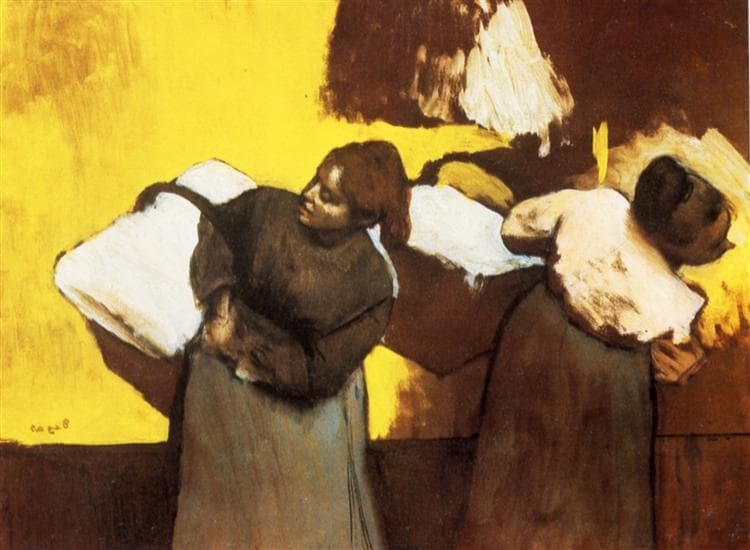
Laundresses Carrying Linen in Town
Camille Pissarro, 1879 • Oil on canvas
Read full analysis of Laundresses Carrying Linen in Town →Valuation Analysis
Estimate: $3–7 million. This range reflects prime‑period appeal (c. 1879), a market‑favored figure/genre subject within Pissarro’s oeuvre, and the pricing profile for strong, mid‑ to large‑format oils by the artist in today’s selective Impressionist market. The estimate assumes an authentic oil on canvas of sound quality and condition with clean provenance and credible literature/exhibition history.
Methodology: We anchor the valuation to recent and relevant Pissarro results rather than to his boulevard record. In 2023, a mid‑size Paris view, Le Louvre, matin, printemps, realized $4.17m, a robust benchmark for non‑trophy works by the artist [2]. In 2025, a prime‑period landscape, Bords de l’Oise à Pontoise (1872), achieved $2.49m in a marquee evening sale—evidence of mid‑seven‑figure liquidity for strong but non‑iconic canvases [3]. Pissarro’s all‑time auction record remains the 1897 Boulevard de Montmartre at c.$32.1m (Sotheby’s 2014) [1], which sets the ceiling for his market but is not the appropriate anchor for a laundress subject.
Subject and period: Laundresses/washerwomen are a recognized and commercial motif across Impressionism. Within Pissarro’s corpus, well‑painted late‑1870s figure scenes benefit from period cachet and collector demand. The broader market’s enthusiasm for laundress imagery is underscored by historic Degas results (e.g., a laundress oil at $13.7m in 1987), which, while not a direct Pissarro comp, corroborate subject‑level desirability in the category [4].
Key drivers: Scale and facture materially affect value: mid‑ to large‑format oils with confident brushwork, intact surfaces, and no material conservation compromises command the upper band of the range; smaller formats or condition issues compress outcomes. Provenance and literature matter: wartime‑era gaps or unresolved claims depress value, while pre‑war records and exhibition pedigree lift it. Restitution scrutiny around Pissarro raises the premium on transparent ownership histories [5].
Market context: The Impressionist/Post‑Impressionist segment remains highly selective, with a pronounced “flight to quality.” Institutional visibility (e.g., the 2025–26 Pissarro retrospective at Museum Barberini/Denver) is supportive of demand, especially for prime‑period, well‑documented works [6]. Auction data since 2023 show solid liquidity for good‑quality Pissarros in the low‑ to mid‑seven figures, with the Art Basel & UBS 2024 report framing a market that cooled after its 2021–22 rebound but remains healthy for blue‑chip quality [7]. Within this backdrop, $3–7 million is a prudent, actionable range for an 1879 laundress oil by Pissarro, subject to final confirmation of size, condition, provenance, and literature.
Key Valuation Factors
Art Historical Significance
High ImpactAn 1879 date places the painting in Pissarro’s prime Impressionist period, when he worked closely with the core group and exhibited at the Impressionist shows. Works from the late 1870s carry a premium over many of the 1890s rural variants because of their centrality to the movement’s formation and the freshness of the brushwork and palette. Figure subjects from this period—distinct from pure landscapes—add narrative and social interest, amplifying appeal. While the subject is not as iconic as Pissarro’s 1897 Paris boulevards, it is nonetheless a meaningful strand within his oeuvre and a clear step above routine late Éragny scenes in terms of both art‑historical importance and market velocity.
Subject Matter & Desirability
High ImpactLaundresses/washerwomen are a recognized and commercially attractive motif across Impressionism. Collectors respond to the balance of genre intimacy and modern‑life subject matter, and the theme enjoys a strong market precedent (with Degas’s laundresses historically performing well), which reinforces category confidence even as artist‑specific pricing differs [4]. For Pissarro, an engaging, well‑composed laundress canvas from the late 1870s typically outperforms many standard landscapes of similar size. The best examples, with lively handling and well‑observed figures, can trade in the mid‑single‑digit millions. The subject’s resonance within the period supports sustained demand, provided that the execution is robust and the surface is fresh.
Scale, Medium & Condition
Medium ImpactOil on canvas is the core medium for Pissarro’s market. Size and facture are decisive: mid‑ to large‑format canvases with confident, intact surfaces can command a 30–50% premium over small, sketch‑like works. Surface freshness (minimal abrasion), absence of overpaint, and stable conservation histories are critical. Relining per se is not disqualifying, but heavy linings or widespread retouch often compress bidding. Given current comparables, a substantial, well‑preserved laundress canvas from the late 1870s would comfortably track to the upper half of the range, whereas a small or condition‑compromised example would sit toward the lower band.
Provenance, Exhibition & Attribution Risk
High ImpactTransparent, pre‑war provenance and inclusion in reputable exhibitions and literature (especially the critical catalogue by J. Pissarro & C.D.-R. Snollaerts) are material value drivers. Ongoing restitution scrutiny around Pissarro means wartime‑era gaps can meaningfully depress value or delay transactions [5]. In addition, title overlap with Degas’s Blanchisseuses portant du linge creates occasional cataloguing confusion; confirming the correct catalogue raisonné number is essential. A watertight ownership chain, clear CR entry, and any major exhibition history can add significant confidence—and price—while ambiguity around title/attribution or WWII‑era gaps is priced in through wider estimate spreads and reduced bidding appetite.
Sale History
Laundresses Carrying Linen in Town has never been sold at public auction.
Camille Pissarro's Market
Camille Pissarro is a blue‑chip pillar of the Impressionist canon with deep global demand. His auction record is held by the 1897 Paris boulevard series, notably Le Boulevard de Montmartre, Matinée de Printemps at roughly $32.1 million (Sotheby’s London, 2014) [1]. Outside these marquee cityscapes, strong oils—especially from the early 1870s Pontoise period and the late‑1870s Impressionist years—trade reliably from the low‑ to mid‑seven figures. Recent results include $4.17 million for Le Louvre, matin, printemps (2023) [2] and $2.49 million for Bords de l’Oise à Pontoise (1872) in a 2025 evening sale [3]. Collectors value period, subject, size, and condition; impeccable provenance and literature/exhibition history meaningfully enhance price, while restitution risks or condition issues compress outcomes.
Comparable Sales
Les Blanchisseuses (Laundresses)
Edgar Degas
Subject-direct comp if the work is the Degas composition: late-1870s laundress motif, two figures, oil format; anchors high-end value for this exact theme.
$13.7M
1987, Christie's London
~$39.2M adjusted
Le Boulevard de Montmartre, Matinée de Printemps
Camille Pissarro
Same artist; record-setting prime 1897 Paris view used to anchor the top of Pissarro’s market (upper bound for valuation, though subject differs from washerwomen).
$32.1M
2014, Sotheby's London
~$44.1M adjusted
Le Louvre, matin, printemps
Camille Pissarro
Same artist; strong, mid-size oil with blue-chip Paris subject sold recently—good benchmark for upper‑mid Pissarro pricing for non-record works.
$4.2M
2023, Sotheby's New York
~$4.4M adjusted
Bords de l’Oise à Pontoise
Camille Pissarro
Same artist; prime 1872 Pontoise landscape of substantial size—recent evening-sale result that benchmarks strong but non-iconic oils.
$2.5M
2025, Sotheby's New York
Paysage à Éragny, le pré
Camille Pissarro
Same artist; late-1890s Éragny landscape—useful lower-mid benchmark for smaller/more routine oils without landmark subject matter.
$983K
2025, Sotheby's London
Le Jardin de Maubuisson, Pontoise
Camille Pissarro
Same artist; 1881 Pontoise subject—solid, recent day/evening-season result to bracket the lower end for standard landscapes.
$970K
2024, Christie's London
~$991K adjusted
Current Market Trends
The Impressionist/Post‑Impressionist sector has normalized after the 2021–22 rebound, with 2023 seeing softer totals but sustained depth for top‑quality, well‑documented works. Buyers have become more selective, favoring blue‑chip names, prime periods, and best‑in‑class examples. Within this context, Pissarro’s mid‑ to large‑scale oils with compelling subjects continue to clear estimates, while routine works are more price‑sensitive. Institutional visibility—such as the 2025–26 Pissarro retrospective at Museum Barberini and Denver—supports demand and scholarship [6]. The Art Basel & UBS 2024 report underscores a flight to quality and the importance of supply cadence, with guarantees and third‑party support shaping outcomes at the top end [7].
Sources
- Le Boulevard de Montmartre, Matinée de Printemps (record price summary)
- Sotheby’s NY (Nov 13, 2023) – Le Louvre, matin, printemps sold for $4.17m (HENI News)
- Sotheby’s NY (Nov 20, 2025) – Bords de l’Oise à Pontoise sold for $2.49m (HENI News)
- Washington Post (1987): Degas Oil Sells for $13.7 Million
- The Art Newspaper (2024): Kunstmuseum Basel settles on Pissarro painting with heirs
- Sotheby’s: The Honest Eye – Camille Pissarro’s Impressionism (Museum Barberini/Denver)
- Art Basel & UBS – The Art Market 2024: Auctions