How Much Is Red Roofs Worth?
Last updated: January 18, 2026
Quick Facts
- Methodology
- comparable analysis
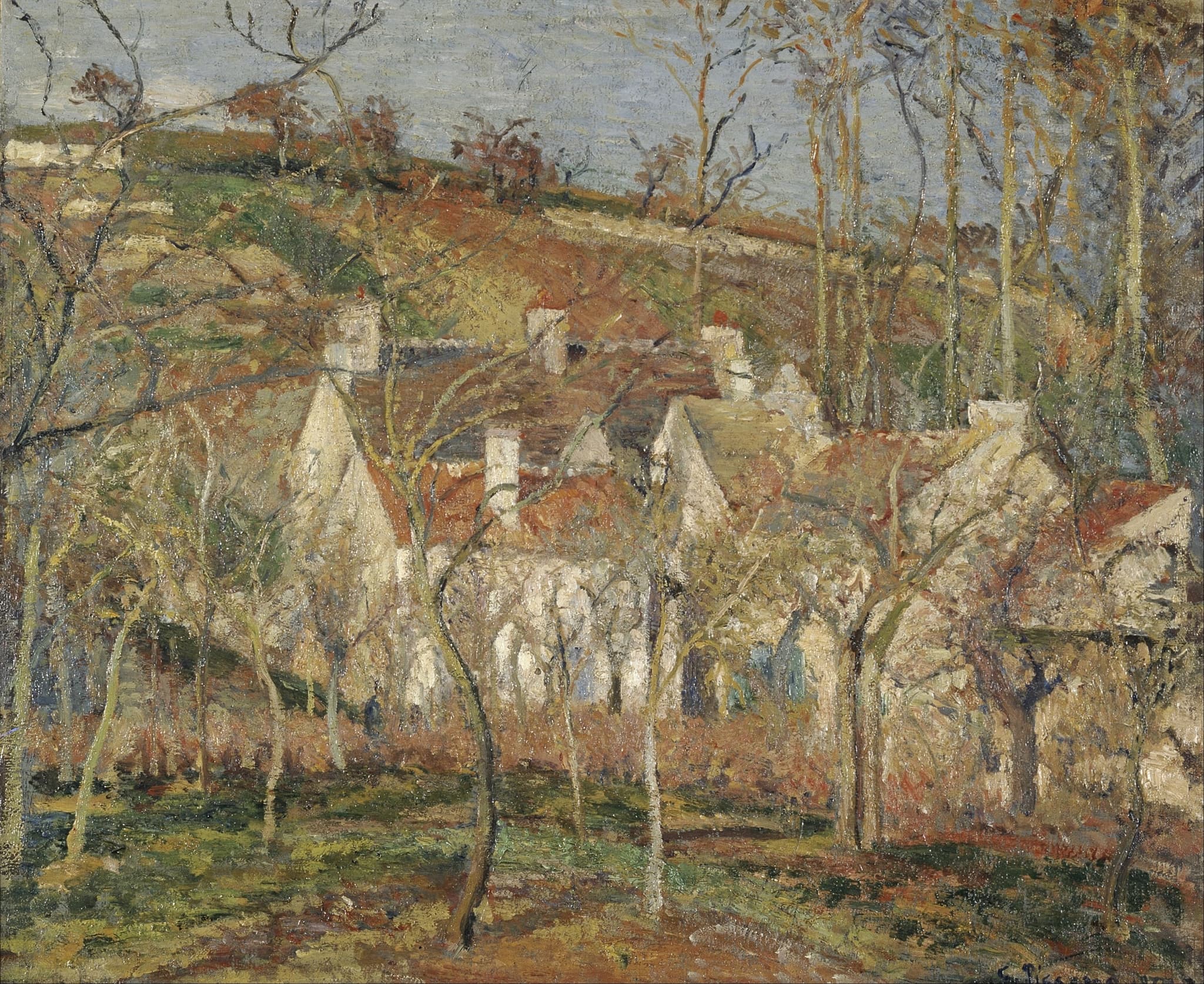
Estimated fair‑market proxy of $20–35 million for Camille Pissarro’s Red Roofs (1877), reflecting its peak‑period date, canonical Pontoise subject, and museum‑grade stature. The work’s prominence in the Musée d’Orsay collection and exhibition at the 1877 Impressionist exhibition place it near the top of the artist’s rural‑landscape market, while remaining just below his boulevard cityscape record.
Valuation Analysis
Conclusion: Red Roofs (Les Toits rouges, coin de village, effet d’hiver), 1877, is a canonical Pissarro from his peak Pontoise years, long enshrined in the Musée d’Orsay. Anchored by direct comparables and the artist’s market benchmarks, a prudent fair‑market proxy for insurance and valuation purposes is $20–35 million. This positions the work at the top end of Pissarro’s rural‑landscape market and just below his marquee Paris boulevard record.
Art‑historical stature and exhibition pedigree: The painting is a signature 1877 Pontoise winter view—crisp light, clustered cottages, and the celebrated “red roofs” effect—and was shown at the 3rd Impressionist Exhibition, a credential central to Pissarro’s corpus. Its museum custody, extensive reproduction, and secure documentation (Musée d’Orsay) underscore its status as a reference image within the artist’s oeuvre [1]. Works of this caliber, date, and visibility define the upper tier of Pissarro’s non‑cityscape market.
Comparable sales and record context: Pissarro’s auction apex is the 1897 Boulevard Montmartre, a large, visually spectacular cityscape that achieved approximately $32.1 million (Sotheby’s London, 2014) [2]. That record establishes a practical market ceiling for the artist’s best city views. High‑quality Pontoise and Éragny landscapes of mid‑format scale typically transact far lower, but the very best 1870s examples with exhibition‑grade provenance and widespread scholarly recognition command a substantial premium. Given Red Roofs’ peak date, textbook subject, and museum renown, it merits valuation immediately below the boulevard record yet materially above routine landscape results.
Object specifics that support the range: The painting’s mid‑format dimensions (approx. 54.5 × 65.6 cm) are standard for Pissarro and highly liquid among blue‑chip collectors [1]. The 1877 date aligns with Pissarro’s most coveted Impressionist period; the motif is widely anthologized, and the image is among his best‑known rural subjects. Continuous public ownership and eminent provenance enhance confidence and perceived quality. Together, these attributes justify a step‑up from typical rural landscapes into the low‑to‑mid eight‑figure band.
Market positioning and constraints: Because Red Roofs belongs to the French national collection, it is inalienable; any valuation is necessarily a fair‑market proxy used for insurance and comparability rather than a sale expectation [3]. Within that framework, the $20–35 million corridor appropriately reflects current demand for masterpiece‑level Impressionist works, Pissarro’s established record structure, and the painting’s singular art‑historical authority. The estimate squarely acknowledges the artist’s cityscape premium while recognizing that a peak 1877 Pontoise of this renown would likely attract competition at the very top of his landscape market.
Key Valuation Factors
Art Historical Significance
High ImpactPainted in 1877, a peak Impressionist year for Pissarro, Red Roofs is a canonical Pontoise motif—winter light over clustered cottages with the signature ‘red roofs’ effect—that is widely reproduced and discussed in scholarship. The painting participated in the 3rd Impressionist Exhibition, conferring a foundational exhibition credential that few works can claim. Its decades of visibility in the Musée d’Orsay place it among the artist’s most recognized rural images. Within Pissarro’s oeuvre, this is read not as a secondary landscape but as a defining statement of his 1870s practice. That art-historical standing justifies valuation at the top of his landscape market and supports a premium relative to comparable-period works lacking similar exhibition and scholarly resonance.
Date, Period, and Subject Quality
High ImpactThe 1877 Pontoise/Osny period is the most sought-after phase of Pissarro’s landscape production. This canvas embodies hallmarks prized by collectors: shimmering light, clear atmospheric effects, and a compositional clarity that reads instantly as Impressionist ‘textbook’ Pissarro. The mid-format size enhances desirability and display flexibility, while the winter ‘red roofs’ subject is among the most celebrated in his rural repertoire. Compared with later Éragny scenes, the 1877 date commands a meaningful premium; compared with earlier 1870s Pontoise works, the picture’s crisp winter effect and iconic motif make it especially marketable at the high end of the artist’s rural landscape pricing spectrum.
Provenance, Visibility, and Exhibition History
High ImpactThe painting’s continuous custody within France’s national collection (and Musée d’Orsay presentation) confers exceptional visibility and institutional endorsement. Its inclusion in the 1877 Impressionist group exhibition further elevates its art-historical profile. Such attributes substantially de-risk quality and authenticity perceptions, concentrate scholarly attention, and enhance the work’s standing relative to otherwise similar landscapes in private hands. Although public ownership precludes sale, these characteristics translate into a stronger fair-market proxy for insurance and valuation purposes. Works with commensurate provenance and exhibition history are scarce, and scarcity at this level is a powerful driver of premium pricing for blue-chip Impressionist masters.
Market Comparables and Record Context
Medium ImpactPissarro’s top auction price (~$32.1 million, 2014) belongs to a large 1897 Paris boulevard view—subject matter that commands a structural premium. High-quality Pontoise and Éragny landscapes commonly transact in the low seven figures, but masterworks with 1870s dates and major exhibition history can approach the low-to-mid eight figures. Given Red Roofs’ peak date, canonical motif, and museum renown, placement immediately below the boulevard record is appropriate. The $20–35 million range balances the cityscape premium with the exceptional qualities of this rural canvas, establishing a defensible band that is meaningfully above routine landscape outcomes while respecting the genre hierarchy embedded in Pissarro’s market.
Sale History
Red Roofs has never been sold at public auction.
Camille Pissarro's Market
Camille Pissarro is a core Impressionist master with a durable, global collector base. His auction record stands at roughly $32.1 million (Sotheby’s London, 2014) for a prime 1897 Boulevard Montmartre cityscape, which sets the top benchmark for his market. Outside of marquee city views, strong Pontoise and Éragny landscapes typically range from mid‑six figures to the low millions, with notable, exhibition‑rich 1870s works achieving substantially more. Demand is selective but deep for best‑in‑class examples with clean provenance, robust scholarship, and compelling subjects. Market participants recognize Pissarro’s importance within Impressionism, and masterpiece‑level works continue to command premium pricing relative to more routine examples, especially when exhibition pedigree and visibility are exceptional.
Comparable Sales
Le Boulevard de Montmartre, Matinée de Printemps
Camille Pissarro
Same artist; large, exhibition‑caliber oil and a prime market bellwether. Similar scale to Red Roofs, though subject is a Paris boulevard (1897) rather than rural Pontoise.
$32.1M
2014, Sotheby's London
~$41.7M adjusted
Le Louvre, matin, printemps
Camille Pissarro
Same artist; oil on canvas with very similar dimensions (c. 65 × 54 cm). Late Paris city view showing current demand for museum‑level, mid‑scale Pissarro oils.
$4.2M
2023, Sotheby's New York
~$4.5M adjusted
Bords de l’Oise à Pontoise
Camille Pissarro
Same artist; prime Pontoise subject (river landscape) from the early 1870s and similar vertical dimension to Red Roofs. Useful for period/locale comparability, though subject differs and width is larger.
$2.5M
2025, Sotheby's New York
Matin, soleil d’automne à Éragny
Camille Pissarro
Same artist; oil of comparable size (c. 65 × 81 cm) and rural subject. Later Éragny period shows pricing for high‑quality pastoral Pissarros of similar scale.
$2.0M
2025, Christie's New York
Paysage à Éragny, le pré
Camille Pissarro
Same artist; oil of similar scale (c. 66 × 89 cm). Later rural landscape establishes the lower bound for larger pastoral scenes absent the exceptional exhibition/provenance factors of Red Roofs.
$983K
2025, Sotheby's London
Current Market Trends
In the Impressionist and Post‑Impressionist segment, the past few seasons have shown a pronounced flight to quality. Aggregate category totals dipped amid fewer trophy consignments, but demand for masterpiece‑caliber works by core names remained resilient. Buyers are discriminating on subject, date, scale, condition, and provenance; institutional exhibitions and scholarship reinforce blue‑chip status and help support pricing for top examples. Within this context, Pissarro’s best cityscapes and peak‑period landscapes continue to outperform, while mid‑tier works face tighter estimate discipline. Overall, the market is stable for iconic material and rewards works with strong narratives, institutional visibility, and exhibition credentials.