How Much Is The Boulevard Montmartre on a Spring Morning Worth?
Last updated: January 30, 2026
Quick Facts
- Last Sale
- $32.1M (2014, Sotheby's London)
- Insurance Value
- $66.0M (Indicative replacement value (FMV high + 10%))
- Methodology
- comparable analysis
We estimate Camille Pissarro’s The Boulevard Montmartre on a Spring Morning at $40–60 million today. The anchor is the same canvas’s 2014 Sotheby’s record of ~$32.1 million, inflation-adjusted into the low-$40 millions and reinforced by apex standing within Pissarro’s most celebrated urban series and exceptional restitution provenance.
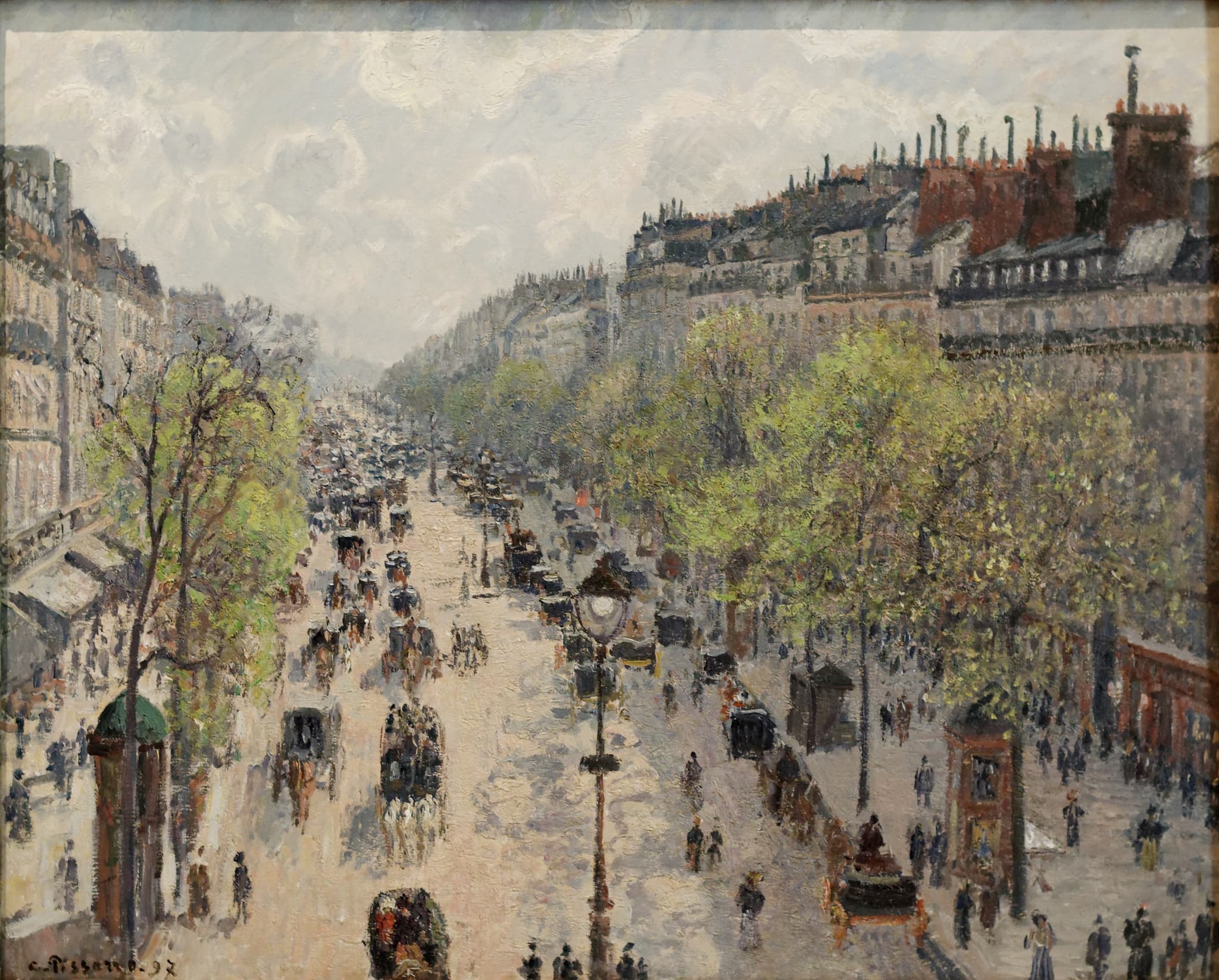
The Boulevard Montmartre on a Spring Morning
Camille Pissarro, 1897 • Oil on canvas
Read full analysis of The Boulevard Montmartre on a Spring Morning →Valuation Analysis
Le Boulevard Montmartre, matinée de printemps (1897; 65 × 81 cm; CD‑RS 1171) is the definitive “Spring Morning” from Pissarro’s Boulevard Montmartre cycle, painted from the Hôtel du Russie. On 5 February 2014 it realized £19,682,500 (≈$32.1m) at Sotheby’s London, setting the standing auction record for the artist and drawing intense interest owing to its Max Silberberg provenance and celebrated restitution to his heir after decades on loan to the Israel Museum [1][2].
This valuation is anchored to that 2014 price and indexed to today’s dollars (low‑$40m baseline), then tested against intra‑series and adjacent comparables. Within the same 1897 group, Le Boulevard Montmartre, fin de journée made about $9m in 2019, and Le Boulevard Montmartre, brume du matin about $4.6m in 2018—results that underscore the Spring Morning canvas’s apex status within the set. Beyond the series, a prime late urban view, La Rue Saint‑Lazare, temps lumineux, achieved $12.4m (2018), and the restituted pointillist masterpiece Gelée blanche realized ~$17.3m (2020), the top post‑2014 Pissarro price [3].
Series prestige and scarcity intensify the premium. Sister canvases from the Boulevard Montmartre sequence reside in cornerstone institutions—the National Gallery, London (At Night), the Hermitage (Afternoon, Sunshine), and the Metropolitan Museum of Art (Winter Morning)—cementing the cycle’s canonical status and limiting opportunities for acquisition at the highest level [4]. The subject’s recognizability and art‑historical weight, combined with clean, published provenance and top‑tier literature/exhibition history, support a result in the mid-to-upper eight figures when optimally presented.
Category conditions also favor this assessment. While Impressionist/Post‑Impressionist auctions contracted in 2023–24 with fewer trophy consignments and tighter pricing at the very top, the late‑2025 rebound for masterpiece‑grade Modern works showed that quality and narrative-rich provenance continue to command deep bidding [5]. Pissarro’s market remains selective but stable at the top; the 2025–26 retrospective cycle (Museum Barberini/Denver Art Museum) provides fresh scholarly and public attention that typically strengthens demand for prime works [6].
Placing this canvas in a marquee evening sale (New York or London), supported by a well‑calibrated third‑party guarantee and global marketing, should concentrate competition from cross‑category buyers. Clear title and a strong condition report would pull the result toward the high end of the $40–60 million range. For insurance, an indicative replacement value of roughly $66 million (≈10% above the high estimate) is appropriate in today’s market.
Key Valuation Factors
Art Historical Significance
High ImpactPainted in 1897, this work is a keystone of Pissarro’s Boulevard Montmartre series—arguably the apex of his late urban oeuvre. Composed from the Hôtel du Russie, the view synthesizes Impressionist light and modern Parisian life in a format and palette that have become emblematic of the artist. Sister canvases reside in major museums, ensuring this series is central to scholarship and widely reproduced. Because canonical status and textbook recognition often drive cross‑category demand, the painting’s standing meaningfully elevates its price potential and underpins its resilience across market cycles.
Provenance and Restitution
High ImpactThe painting’s distinguished and fully published provenance—most notably Max Silberberg’s pre‑war collection, a Nazi‑era forced sale, and subsequent restitution to the heir—adds historical importance, curatorial interest, and buyer confidence. Its decades‑long loan to the Israel Museum reinforced visibility and scholarship. Works with clear, resolved restitution narratives often attract a wider pool of bidders and can outperform comparable pieces without such provenance. This pedigree also mitigates title risk, a key consideration at the high end, and becomes an important component of the painting’s narrative value in cataloguing and press.
Rarity and Series Positioning
High ImpactWithin the 1897 sequence, the Spring Morning composition is one of the most coveted variants: large, pictorially resolved, and compositionally dynamic. Intra‑series sales in 2018–2019 at ~$4.6–9m illustrate the broader demand curve, but also confirm that the definitive Spring Morning version occupies a higher tier. The scarcity of top Boulevard Montmartre canvases in private hands—and the fact that several peers are institutionalized—creates supply pressure likely to persist. As a quintessential subject in Pissarro’s market, this variant’s rarity premium is a primary driver of the $40–60 million range.
Condition and Conservation
High ImpactAt this price level, condition precision matters. A recent, independent report with UV/IR imaging and clarity on any prior interventions will be expected. The 2014 record result implies the work presented strongly at that time; maintaining that state (structurally sound canvas, stable surface, intact impasto, tasteful past conservation) preserves pricing power. Conversely, issues such as lining tensions, widespread overpaint, or discoloration can compress bidding and shift outcomes materially. For a masterpiece‑grade Impressionist canvas, condition differentials can swing results by double‑digit percentages, determining whether a lot clears the midpoint or pushes to the high end.
Market Liquidity and Timing
Medium ImpactBlue‑chip Impressionism remains liquid, though the 2024 auction contraction and reduced trophy volume encouraged selective bidding. Late‑2025 results signaled renewed confidence for masterpiece‑grade Modern works, but depth is focused on canonical names and best‑in‑class examples. This painting fits that profile. Sale strategy—marquee evening slot, concentrated outreach, and a well‑structured third‑party guarantee—will tighten spreads and encourage competition. Currency and venue choice (New York vs. London) can also influence demand and headline conversions. Under a well‑staged campaign, the buyer pool for this canvas extends beyond Pissarro specialists to broader Impressionist and Modern collectors.
Sale History
Sotheby's London
Impressionist & Modern Art Evening Sale, lot 43. Auction record for Pissarro; restituted to the Silberberg heirs; oil on canvas, 65 × 81 cm; CD‑RS 1171.
Camille Pissarro's Market
Camille Pissarro is a blue‑chip pillar of Impressionism with steady global demand. Liquidity is robust for prime‑period oils, especially 1870s Pontoise landscapes and 1890s Paris cityscapes. The artist’s standing auction record is this exact Boulevard Montmartre, Spring Morning canvas at about $32.1 million (2014). Since then, top works have generally achieved low‑to‑mid eight‑figure prices, with the strongest post‑2014 public result at ~$17.3 million (2020) for a restituted pointillist masterpiece. Day‑to‑mid‑evening works typically transact between c.$0.5–3 million. Supply of A+ museum‑quality subjects is thin, which concentrates bidding when such opportunities arise and supports durable pricing for masterpieces.
Comparable Sales
Le Boulevard Montmartre, matinée de printemps (The Boulevard Montmartre on a Spring Morning)
Camille Pissarro
Same artwork; same artist, date (1897), subject, and size (65 × 81 cm). Record price anchor with high-profile restitution provenance.
$32.1M
2014, Sotheby's London
~$42.5M adjusted
Gelée blanche, jeune paysanne faisant du feu
Camille Pissarro
Same artist; masterpiece-tier pointillist work (1888) with restitution provenance; sets post-2014 ceiling for Pissarro prices.
$17.3M
2020, Sotheby's London
~$20.9M adjusted
Le Boulevard Montmartre, fin de journée
Camille Pissarro
Same artist, same 1897 Boulevard Montmartre series (intra-series variant); smaller format; strong London evening result.
$9.0M
2019, Sotheby's London
~$11.2M adjusted
Le Boulevard Montmartre, brume du matin
Camille Pissarro
Same artist and year; another Boulevard Montmartre variant; indicates mid-range pricing within the series.
$4.6M
2018, Sotheby's London
~$5.8M adjusted
La Rue Saint‑Lazare, temps lumineux
Camille Pissarro
Same artist; late-19th-century Paris cityscape of comparable stature among urban views; strong New York result.
$12.4M
2018, Christie's New York
~$15.7M adjusted
Current Market Trends
Impressionist and Post‑Impressionist auction volumes contracted through 2023–24, with fewer $10m+ consignments and greater activity in mid‑price bands. The top end remains quality‑driven: masterpiece‑grade works with clear provenance and institutional narratives continue to attract deep, often cross‑category bidding. Late‑2025 saw selective revival at the very top of the Modern market, signaling improved confidence but continued scrutiny on estimates and condition. Within this context, a canonical, apex‑series Pissarro such as the Boulevard Montmartre Spring Morning should command a scarcity premium and trade near the forefront of the artist’s market, particularly with an optimal venue and guarantee.
Sources
- Sotheby’s London, Lot Page: Le Boulevard Montmartre, matinée de printemps (2014)
- Times of Israel/AP: Restituted Pissarro sells for ~$32m (2014)
- Sotheby’s: Camille Pissarro – market highlights and recent top results
- National Gallery (London): The Boulevard Montmartre at Night
- Art Basel & UBS, The Art Market 2024 – Auctions
- Museum Barberini: The Honest Eye – Camille Pissarro’s Impressionism (2025–26)