How Much Is The Hermitage at Pontoise Worth?
Last updated: January 22, 2026
Quick Facts
- Methodology
- comparable analysis
Camille Pissarro’s The Hermitage at Pontoise (ca. 1867), a monumental early Pontoise landscape in the Guggenheim’s Thannhauser Collection, would likely command $8–12 million today. The estimate balances exceptional scale and museum-grade provenance against market preference for later, higher-key works.
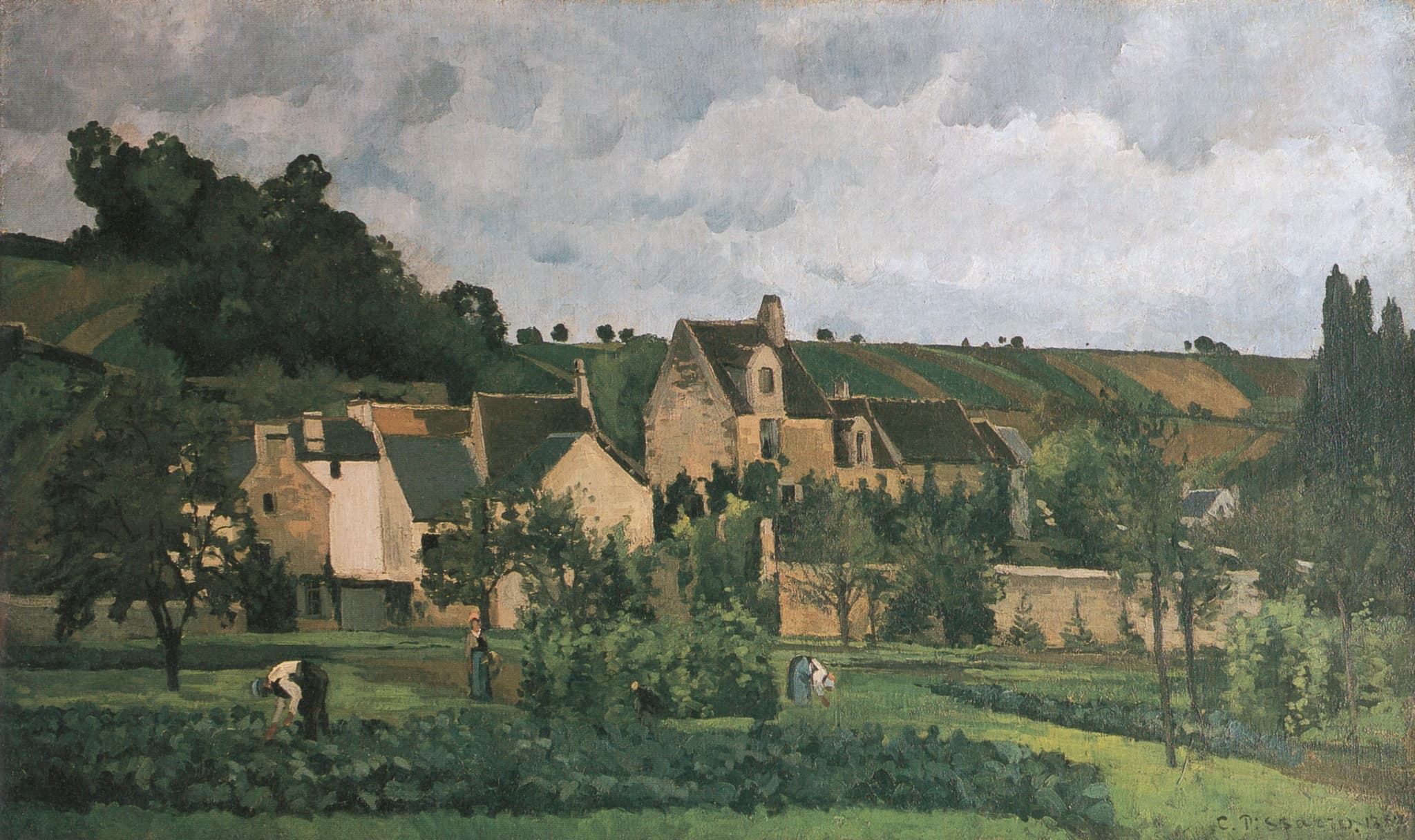
The Hermitage at Pontoise
Camille Pissarro, ca. 1867 • Oil on canvas
Read full analysis of The Hermitage at Pontoise →Valuation Analysis
Work and context. Camille Pissarro’s The Hermitage at Pontoise (Les coteaux de l’Hermitage, Pontoise), ca. 1867, is a monumental oil measuring 151.4 × 200.6 cm, held in the Solomon R. Guggenheim Museum’s Thannhauser Collection [1]. Painted during Pissarro’s foundational Pontoise years, the canvas captures the steep Hermitage hillside and marks his transition from a darker Realist tonality toward the observational rigor and modern subject focus that underpin Impressionism. The Hermitage motif recurs throughout his oeuvre and is central to scholarship, placing this work at the heart of his early development. Its exceptional scale and longstanding museum context elevate its importance and salability versus typical rural scenes.
Market bearings and comparables. Pissarro is a core Impressionist with a strong record at auction, led by the $32.1 million price for Boulevard Montmartre, Matinée de Printemps (Sotheby’s London, 2014) [2]. Recent results show healthy demand across periods: a 1902 Paris view, Le Louvre, matin, printemps, realized roughly $4.17 million in 2023 [4], while a 1900 Eragny landscape made $2.05 million in 2025 [5]. For early Pontoise, a closely related subject from 1873—Paysage aux Pâtis, Pontoise, la moisson—carried a 2024 estimate of $2.5–3.5 million at Sotheby’s [3]. The Guggenheim canvas is dramatically larger and anchored to the seminal Hermitage motif, justifying a significant premium over mid-size rural comparables yet remaining below the pricing tier of Pissarro’s most coveted late cityscape series.
Derivation of value. This estimate is built by comparable analysis, weighted for scale, period, subject, and provenance. Monumental Pissarro oils are scarce; the 151 × 201 cm format, institutional visibility, and Thannhauser/Guggenheim provenance merit a multiple above mid-size early Pontoise works [1]. Balancing this, the ca. 1867, pre–high‑key palette is generally less favored than the luminous 1870s–1890s output, which tempers the ceiling relative to Boulevard Montmartre’s record [2]. On that basis, fair market value is assessed at $8–12 million, with the upper end attainable under optimal sale timing, global marketing, and a recent conservation-grade condition report that confirms strong surface, color, and structural stability.
Market setting. The Art Basel/UBS report recorded a contraction in 2024 Impressionist/Post‑Impressionist auction value amid a shortage of trophies, followed by stronger marquee performance in 2025; liquidity persisted for quality mid-priced works [6]. In this environment, a museum-held, landmark-scale early Pontoise would stand out: sufficiently important to activate top buyers, yet priced below the ultra-competitive late Paris series. The $8–12 million range aligns with recent benchmarks and recognizes the painting’s scale, subject, and prestige.
Key Valuation Factors
Art Historical Significance
High ImpactPainted during Pissarro’s crucial Pontoise years, the Hermitage hillside is a core subject that recurs across the late 1860s and early 1870s, anchoring his progression toward Impressionism. This canvas belongs to the artist’s most studied geographic locus and contributes directly to narratives of his evolving palette, compositional structure, and modern subject focus. Within Pissarro’s landscape corpus, Hermitage/Pontoise is a touchstone that museums and scholars repeatedly cite. That centrality positions the work above generic rural scenes in importance and value. Collectors prize such academically resonant subjects because they secure both art-historical relevance and long-term market defensibility, especially when the work has a robust publication and institutional exhibition footprint [1].
Scale and Rarity
High ImpactAt 151.4 × 200.6 cm, the painting is monumental for Pissarro and visually commanding in a way that smaller canvases cannot replicate. Large-format Pissarro oils, particularly from the late 1860s, are scarce and confer an exhibition-grade presence that resonates in both institutional and private settings. Scale tends to amplify compositional complexity and viewer impact, supporting a meaningful premium relative to mid-size comparables. In the Pissarro market—where many offerings are under one meter—material increases in size can double or more the achievable price band when quality is commensurate. The exceptional dimensions here are a key driver of the eight-figure valuation range and differentiate the work from recent mid-size Pontoise and Éragny results [1].
Provenance and Institutional Visibility
High ImpactLong-term inclusion in the Guggenheim’s Thannhauser Collection provides exemplary provenance, documentation, and scholarly exposure. Such museum-held works carry prestige and buyer confidence, reducing attribution and due-diligence risk. The Thannhauser association is particularly desirable, given the collection’s historical importance and visibility. While museum ownership does not automatically add a price premium, it often correlates with superior publication and exhibition histories, which can enhance marketability and support top-tier sale positioning. In practical terms, a deaccession of a work with this pedigree would benefit from global press and strong auction-house marketing, expanding the bidder pool and improving competitive tension at sale—factors consistent with the high end of the proposed range [1].
Period and Palette vs. Market Preferences
Medium ImpactThe ca. 1867 date places the painting in Pissarro’s pre–high‑key phase, when palettes tend to be more subdued. The market today generally prizes the luminous 1870s–1890s and the late Paris cityscapes most highly, as reflected in the $32.1m record for Boulevard Montmartre (1897) and strong recent results for city views around $4m [2][4]. Early rural Pontoise canvases, while important, typically transact below those peaks; mid-size examples have guided in the $2.5–3.5m band recently [3], with later rural works often trading around $1–2m [5]. This dynamic tempers the ceiling here, even as the painting’s scale and subject push it well above mid-size rural comparables.
Sale History
The Hermitage at Pontoise has never been sold at public auction.
Camille Pissarro's Market
Camille Pissarro is a foundational Impressionist with a deep, globally diversified collector base and dependable liquidity across auction seasons. His auction record stands at $32.1 million for the 1897 Boulevard Montmartre, reflecting the market’s strong preference for luminous late works and iconic city views [2]. Recent sales show consistent demand from mid-six to low-seven figures for good rural landscapes and smaller oils, with Paris views commanding a premium and museum-quality subjects attracting heightened competition [4][5]. Early Pontoise works are academically central and can achieve meaningful premiums when scale, quality, and provenance align. Overall, Pissarro’s market is steady, with trophy-level supply limited and high-end pricing concentrated in exceptional, well-documented examples.
Comparable Sales
Bords de l’Oise à Pontoise
Camille Pissarro
Same artist; early Pontoise subject (1872) close in period and place to Hermitage; indicates current demand for early Pontoise landscapes (though at a much smaller scale).
$2.5M
2025, Sotheby's New York
Le Jardin de Maubuisson, Pontoise
Camille Pissarro
Same artist; Pontoise subject (1881). Later than Hermitage and much smaller, but directly relevant to pricing of Pontoise views.
$962K
2024, Christie's London
~$987K adjusted
Le Louvre, matin, printemps
Camille Pissarro
Same artist; prime Paris city-view series (1902). Not Pontoise, but a benchmark for top-demand Pissarro subjects vs. rural landscapes.
$4.2M
2023, Sotheby's New York
~$4.4M adjusted
Matin, soleil d’automne à Eragny
Camille Pissarro
Same artist; strong rural landscape (1900) and mid-size oil; provides a late-period baseline vs. early Pontoise.
$2.0M
2025, Christie's New York
Paysage à Éragny, le pré
Camille Pissarro
Same artist; rural landscape (1897); shows market level for good late rural scenes below the Paris cityscapes and well below early Pontoise masterworks.
$983K
2025, Sotheby's London
Le Boulevard Montmartre, Matinée de Printemps
Camille Pissarro
Same artist; record-setting Paris series (1897). Not comparable in subject/period but establishes the modern auction ceiling for Pissarro.
$32.1M
2014, Sotheby's London
~$43.7M adjusted
Current Market Trends
Impressionist/Post‑Impressionist auctions softened in 2024 amid a scarcity of trophies and broader macro caution, with overall category value declining even as lot counts rose; liquidity remained for quality works priced rationally [6]. Marquee weeks in 2025 signaled improved buyer appetite at the top, especially for fresh-to-market, museum-quality material. Against this backdrop, a landmark early Pissarro with exceptional scale and institutional pedigree would stand out, attracting both private collectors and institutions. Pricing discipline persists, but competition intensifies when rarity, provenance, and subject converge—supporting an $8–12 million fair market value for this canvas, above mid-size rural comparables yet below the artist’s late cityscape benchmarks.
Sources
- Solomon R. Guggenheim Museum — The Hermitage at Pontoise (artwork page)
- Wikipedia — Le Boulevard de Montmartre, Matinée de Printemps (2014 Sotheby’s record)
- Sotheby’s — Paysage aux Pâtis, Pontoise, la moisson (1873) lot page and estimate (2024)
- HENI — Sotheby’s Modern Evening Auction (Nov 2023) sale report including Pissarro
- Christie’s — Press release: Impressionist & Modern Day Sale results (May 13, 2025)
- Art Basel & UBS — The Art Market 2024: Auctions