How Much Is Bacchus Worth?
Last updated: February 26, 2026
Quick Facts
- Methodology
- comparable analysis
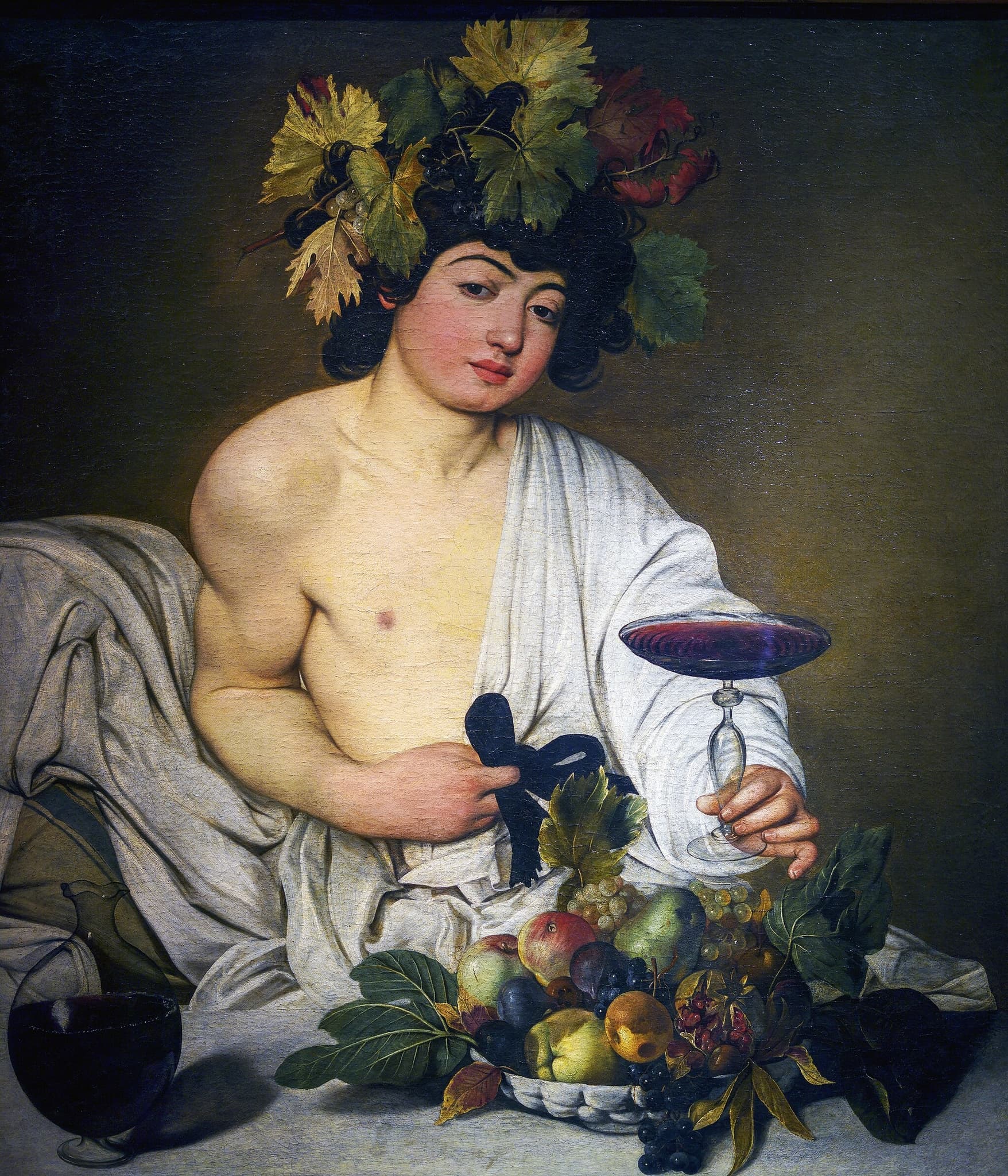
Caravaggio’s Bacchus at the Uffizi is a canonical, museum-held masterpiece with no public sale history. Triangulating from top Old Master benchmarks (Leonardo at $450.3m; Rembrandt pair at ~€160m; Botticelli at $92.2m) and the few recent Caravaggio datapoints, a defensible hypothetical market/insurance equivalent today is $150–300 million.
Valuation Analysis
Conclusion: A reasonable current market/insurance equivalent for Caravaggio’s Bacchus (Uffizi) is $150–300 million. This is a hypothetical valuation for a non‑market, museum‑held masterpiece—derived from best‑in‑class Old Master benchmarks and the limited but telling evidence of recent Caravaggio transactions and attempted offerings [1–6].
Position within the oeuvre: Bacchus is a signature early Roman‑period picture painted for Cardinal del Monte, central to understanding Caravaggio’s sensual naturalism, still‑life precision, and secular innovation. It is among the artist’s most reproduced images and a cornerstone of his early patronage narrative. The Uffizi confirms the work’s status in its collection; it has no modern sale history and is effectively non‑market under Italian cultural‑heritage protections [1].
Benchmarking logic: The modern trophy ceiling for Old Masters is set by Leonardo’s Salvator Mundi at $450,312,500 (Christie’s, 2017) [2]. A powerful private‑sale precedent near the category’s top end is the Rembrandt wedding portraits pair acquired jointly by the Rijksmuseum and the Louvre for ~€160 million in 2016 (≈$174m then) [3]. Nine‑figure demand for best‑of‑breed Renaissance/Baroque works at auction is also evidenced by Botticelli’s Young Man Holding a Roundel at $92,184,000 (Sotheby’s, 2021) [4]. A prime, uncontested Caravaggio of Bacchus’s stature would reasonably sit between Botticelli and Leonardo—closer to the high nine‑figure band suggested here.
Direct Caravaggio signals: Liquidity for autograph Caravaggio paintings is extraordinarily thin. Nonetheless, the market recently absorbed an authenticated late work, Ecce Homo, in a 2024 private transaction widely reported around €36 million before its prominent Prado display [5]. The 2019 Toulouse Judith and Holofernes (attributed) carried a €100–150 million presale expectation before a private deal at an undisclosed price, underscoring private‑market price discovery for the artist [6]. Against these signals, Bacchus—earlier, canonical, and academically central—would command a substantial multiple.
Range setting and sensitivities: The $150 million lower bound is anchored by the Rembrandt private‑sale precedent and Botticelli’s public auction benchmark, adjusted for Caravaggio’s rarer supply and higher brand salience. The $300 million upper bound reflects scarcity, cross‑category trophy demand, and the fact that only Leonardo surpasses this zone among Old Masters, establishing a practical ceiling. Variation would turn on condition (paint‑layer integrity, abrasion/restoration), the exact legal posture of any hypothetical transfer, and competitive depth among a small cohort of global buyers. Given museum retention and heritage restrictions, Bacchus’s irreplaceability can further support higher indemnity valuations even absent an open‑market price [1–4].
Methodology: Comparable‑analysis synthesis of top Old Master prices (auction and private), recent Caravaggio datapoints, and qualitative weighting of art‑historical rank and scarcity, normalized to today’s market context [2–6].
Key Valuation Factors
Art Historical Significance
High ImpactBacchus is a keystone of Caravaggio’s early Roman period under Cardinal del Monte, epitomizing the artist’s secular naturalism, psychological immediacy, and breakthrough still-life fidelity. It is one of his most reproduced and studied images and occupies a crucial place in narratives of Baroque realism and the shift from idealization to observation. The work’s fame extends beyond specialist audiences and regularly anchors scholarly and popular discussions of Caravaggio’s innovations. Within the oeuvre, it ranks just below the most iconic religious narratives (e.g., the Matthew cycle) yet surpasses most other secular subjects in recognition, making it a natural target for nine-figure trophy demand in any hypothetical trade. Its centrality to Caravaggio’s development magnifies scarcity and elevates value resilience.
Scarcity and Market Liquidity
High ImpactSecurely attributed Caravaggio paintings almost never reach public auction; the few that change hands typically do so privately, often under national heritage controls. Recent activity underscores this: an autograph late Ecce Homo reportedly traded privately around €36 million in 2024 before its public display at the Prado, while the debated Toulouse Judith carried nine-figure expectations ahead of a private deal. Most accepted works are held by institutions and are effectively off-market. Such structural illiquidity compresses price discovery into rare, high-stakes moments and intensifies competition among the few buyers able to acquire a canonical example. For a museum-grade, uncontested masterpiece like Bacchus, this scarcity exerts strong upward pressure on a hypothetical price.
Market Benchmarks and Trophy Demand
High ImpactThe top of the Old Master market has demonstrated robust depth when presented with singular works: Leonardo’s Salvator Mundi at $450.3 million (2017), the Rembrandt wedding portraits at ~€160 million (2016, private), and Botticelli’s $92.2 million portrait (2021) serve as load-bearing comparables. Cross-category trophy buyers continue to underwrite outsized results for universally recognized names with museum-level stature and airtight scholarship. A prime Caravaggio of Bacchus’s rank logically situates above Botticelli and around or below the Rembrandt pair on a quality-adjusted basis, far beneath the unique Leonardo ceiling but firmly in nine figures. These datapoints collectively support a $150–300 million band for an uncontested, canonical Caravaggio masterpiece.
Legal/Export Constraints and Irreplaceability
Medium ImpactAs property of the Uffizi in Florence, Bacchus is effectively inalienable under Italian cultural heritage protections and is publicly presented as a non-market collection highlight. Such status means any valuation is hypothetical—used for insurance or indemnity rather than imminent sale. Paradoxically, these constraints can elevate insured or indemnified values: the object is uniquely important and practically irreplaceable, so coverage is often structured around market-equivalent replacement assumptions rather than observed prices. While legal constraints remove near-term liquidity and typical auction dynamics, they also reinforce the painting’s singularity and perceived scarcity premium. If a fully legal transfer were ever possible, the same irreplaceability would catalyze exceptionally strong trophy demand.
Condition and Technical State
Medium ImpactFor sixteenth-century oils, panel stability, paint-layer preservation, historical restorations, and surface presentation (abrasion, overpaint, varnish) are decisive pricing variables at the very top. Bacchus has long been studied and exhibited; however, a current conservation dossier (IRR/X-radiography, varnish history, and retouch mapping) would be necessary to calibrate a final figure. Our $150–300 million band assumes no material condition liabilities beyond those typical of a work of its age and exhibition history. Should new technical findings confirm exceptional preservation and minimal intervention, appetite could skew toward the upper half of the range; conversely, evidence of significant abrasion or structural issues would warrant discounting. Absent such red flags, stature and scarcity dominate value formation.
Sale History
Bacchus has never been sold at public auction.
Caravaggio's Market
Caravaggio occupies the absolute top tier of Old Masters, but his market is uniquely opaque because securely attributed paintings almost never appear at public auction. The artist’s public auction record is not representative, reflecting the absence of prime material in open sales. Instead, price discovery has occurred privately or through near-sales: the widely reported 2024 private transaction of an authenticated late Ecce Homo around €36 million, and the 2019 Toulouse Judith (attributed) with a €100–150 million auction expectation before a private deal. Against broader Old Master benchmarks—Leonardo at $450.3 million, Rembrandt’s pair at ~€160 million, Botticelli at $92.2 million—a prime, uncontested Caravaggio would be expected to command nine figures. Collector demand is deep, global, and cross-category at the trophy level.
Comparable Sales
Ecce Homo
Caravaggio
Same artist; rare authenticated autograph work trading recently; sets a contemporary floor for a securely attributed Caravaggio (though late style/subject and export-restricted).
$39.0M
2024, Private sale (Spain); publicly exhibited at Museo del Prado
~$40.2M adjusted
Portraits of Maerten Soolmans and Oopjen Coppit
Rembrandt van Rijn
Top-tier Old Master trophy of comparable historical stature and museum-level importance; a nine-figure private transaction illustrating pricing for irreplaceable Baroque masterpieces.
$174.0M
2016, Christie’s Private Sales (private treaty) to Rijksmuseum and the Louvre
~$226.2M adjusted
Salvator Mundi
Leonardo da Vinci
Record Old Master sale; demonstrates the modern trophy-market ceiling for a canonical, exceptionally scarce Renaissance/Baroque master—useful as an upper bound for a prime Caravaggio.
$450.3M
2017, Christie’s New York
~$576.4M adjusted
Young Man Holding a Roundel
Sandro Botticelli
Benchmark Renaissance/Old Master portrait that cleared nine figures with premium; indicates depth of cross-category trophy demand near the lower bound of a hypothetical prime Caravaggio.
$92.2M
2021, Sotheby’s New York
~$106.9M adjusted
Current Market Trends
Old Master auctions saw a supply-driven soft patch in 2024, but results in 2025/26 confirm robust demand for masterpiece-level works when they appear. Category performance is increasingly bifurcated: canonical names with ironclad attributions and museum-level quality attract cross-category trophy buyers, while lesser works remain price-sensitive. Heritage regulations in key European markets continue to restrict export of masterpiece-grade pictures, pushing important transactions into private channels and further tightening observable benchmarks. Within this context, values for truly irreplaceable Renaissance/Baroque paintings remain resilient to macro volatility. For a prime Caravaggio, the combination of extreme scarcity, global brand recognition, and institutional validation supports sustained nine-figure pricing in any plausible sale or insurance scenario.
Sources
- Uffizi Galleries – Caravaggio, Bacchus (object page)
- Christie’s Press Release – Leonardo da Vinci, Salvator Mundi sells for $450.3m (2017)
- Christie’s – The Rembrandt wedding portraits (private treaty to Rijksmuseum/Louvre, ~€160m)
- Sotheby’s Press – Botticelli’s Young Man Holding a Roundel sells for $92.2m (2021)
- The Guardian – ‘Lost Caravaggio’ Ecce Homo on view at the Prado; price widely reported at €36m
- The Art Newspaper – Toulouse ‘Caravaggio’ withdrawn and sold privately; presale est. €100–150m