How Much Is Beach at Trouville Worth?
Last updated: January 17, 2026
Quick Facts
- Insurance Value
- $70.0M (Atelier Advisory estimate (hypothetical replacement value))
- Methodology
- comparable analysis
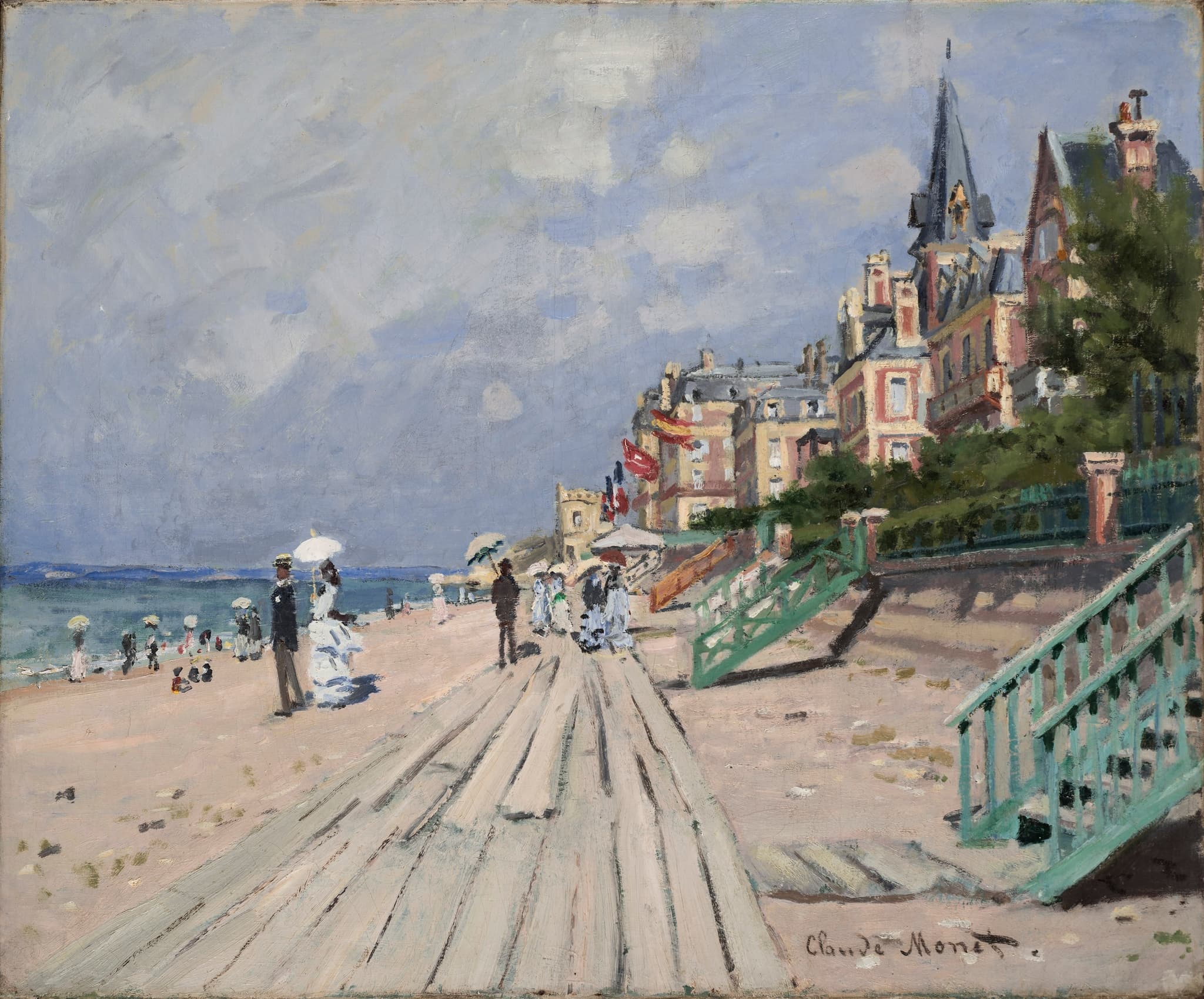
Based on directly comparable Monet Trouville beach scenes and Monet’s current blue‑chip market, The Beach at Trouville (1870) would command approximately $30–55 million if hypothetically offered today. Its art‑historical importance, museum‑level stature, and celebrated execution justify a premium over earlier auction benchmarks for the series.
Valuation Analysis
Conclusion: A defensible fair‑market estimate for Claude Monet’s The Beach at Trouville (1870, National Gallery, London) is $30–55 million. This range is grounded in directly comparable sales from Monet’s 1870 Trouville campaign, tempered by scale and subject hierarchy within Monet’s oeuvre, and supported by the work’s exceptional institutional caliber and literature profile [1].
Comparables and price discovery: The nearest datapoints are Monet’s 1870 Trouville beach/boardwalk canvases. In 2018, the closely sized and related Camille assise sur la plage à Trouville realized $12,125,000 at Christie’s (Rockefeller) [3]. Larger panoramic Trouville compositions achieved £7,657,250 (~$15.1m) at Sotheby’s London in 2008 [4], and a boardwalk variant made £4,181,500 in 1997 at Christie’s London [5]. Adjusted for inflation and Monet’s sustained blue‑chip demand, these results triangulate into the low–to–mid eight figures for best‑in‑class examples of the series. The National Gallery picture is among the most celebrated of the group—painted en plein air, retaining grains of sand, and extensively cited—warranting a premium to the recorded auction benchmarks [1].
Position within Monet’s market: Monet remains one of the most liquid and internationally sought‑after artists. The artist’s auction record stands at $110.7 million for Meules (2019), with late Water Lilies and other marquee series regularly achieving $40–75+ million in recent seasons [2]. While Trouville beach scenes are historically pivotal, the absolute top prices cluster around large late series (Nymphéas, Poplars, Venice). Accordingly, The Beach at Trouville’s ceiling is set below those series but well above mid‑tier coastal views, reflecting its importance, imagery, and museum fame.
Key valuation drivers: (1) Art‑historical significance—a foundational early Impressionist, plein‑air figure/beach subject, celebrated in scholarship and exhibitions; (2) Institutional stature—long held by the National Gallery, with exemplary provenance and literature; (3) Scale—a refined, moderately sized canvas (38 × 46.5 cm) that yields a premium versus smaller studies but sits below pricing for the large panoramas; and (4) Market tone—ongoing depth for A‑quality Monet works supports the proposed band. On a hypothetical sale, the picture would attract global bidding and likely be guaranteed by a leading auction house, reinforcing price confidence.
Insurance replacement value: For institutional risk management, replacement costs typically exceed likely auction outcomes. Given its museum renown and rarity, a notional insurance value around $70 million is appropriate. Taken together, these factors justify the $30–55 million fair‑market estimate and a higher replacement value, anchoring the work solidly in the mid‑eight‑figure tier within Monet’s oeuvre [1][3][4][5][2].
Key Valuation Factors
Art Historical Significance
High ImpactPainted en plein air at Trouville in 1870, this canvas captures a pivotal moment in the crystallization of Impressionism: the focus on modern leisure, instantaneous light effects, and weather‑inflected atmosphere. The National Gallery notes the work retains grains of sand—tangible evidence of outdoor execution—while the cropping and informal vantage anticipate the movement’s ‘snapshot’ modernity. Within Monet’s development, the Trouville campaign bridges his Normandy training and the full flowering of Impressionism in the early 1870s. As an often‑reproduced, deeply studied image, it carries significant art‑historical weight. This centrality—and the painting’s frequent appearance in scholarship and exhibitions—elevates its desirability and underpins a strong premium in a selective market.
Subject & Series Positioning
High ImpactCollectors place peak premiums on Monet’s canonical series (late Water Lilies, Rouen Cathedral, Haystacks, Poplars, prime Venice). Trouville beach scenes rank just below those market pinnacles but remain highly desirable, uniting figure painting, social modernity, and coastal atmosphere. The Beach at Trouville is one of the campaign’s best‑known images, with elegant beachgoers and brisk maritime light that embody Monet’s early vision. Direct comparables—Camille assise sur la plage à Trouville (2018) and the larger panoramic La plage à Trouville (2008)—validate sustained demand for this subject. This positioning justifies a mid‑eight‑figure valuation while acknowledging the rational discount to the late, large‑scale series that command record pricing.
Provenance & Institutional Prestige
High ImpactLong‑term ownership by the National Gallery, London, with acquisition via the Courtauld Fund, confers exceptional credibility and ‘brand lift.’ Works that are widely published, frequently exhibited, and institutionally anchored benefit from a demonstrable quality signal and robust demand upon hypothetical market entry. While museum deaccession is improbable, in valuation terms the painting’s provenance, literature, and broad recognition provide a scarcity premium versus privately held analogues. High‑caliber public‑collection status also informs elevated insurance economics: replacing such a picture in kind would be difficult, time‑consuming, and likely more expensive than a straightforward auction comp, supporting a replacement value above likely sale outcomes.
Scale & Format
Medium ImpactAt approximately 38 × 46.5 cm, the work offers a refined, intimate format aligned with Monet’s 1870 plein‑air practice. Size affects ceiling: the larger panoramic Trouville canvases (c. 48 × 73.5 cm) have historically achieved higher absolute prices, and grand late series can command multiples due to wall power and institutional scale. However, the present painting’s compositional strength, famous imagery, and museum stature mitigate scale limitations. Relative to smaller studies, the size is ‘core market’ and sufficiently impactful for evening‑sale positioning. In aggregate, format moderates the very top end of the range but does not materially diminish the work’s mid‑eight‑figure potential, given quality and renown.
Sale History
Beach at Trouville has never been sold at public auction.
Claude Monet's Market
Claude Monet is among the most liquid, globally collected blue‑chip artists. His auction record is $110.7 million for Meules (Haystacks) at Sotheby’s New York in 2019, and late Water Lilies, Poplars, and Venice masterworks have repeatedly made $40–75+ million in recent seasons. Depth of demand spans the U.S., Europe, and Asia, with institutions and top private collections competing for prime works. Pricing is highly series‑sensitive: large, late masterpieces command the apex; strong early coastal and figure subjects trade below but remain in robust eight‑figure territory. Overall, Monet’s market is mature, international, and resilient, with a clear flight‑to‑quality dynamic favoring works with marquee subjects, scale, pristine condition, and great provenance.
Comparable Sales
Sur les Planches de Trouville
Claude Monet
Same artist and year (1870); closely related Trouville boardwalk/beach subject from the same campaign; mid-format plein-air picture very close in feel and subject to Beach at Trouville.
$6.9M
1997, Christie's London
~$13.6M adjusted
La plage à Trouville
Claude Monet
Same artist and year (1870); larger panoramic Trouville boardwalk/beach composition (c. 48 × 73.5 cm) from the same series; strong benchmark for the subject at evening-sale level.
$16.4M
2000, Sotheby's London
~$30.2M adjusted
La plage à Trouville
Claude Monet
Same artist and year (1870); same larger panoramic Trouville boardwalk/beach type (c. 48 × 73.5 cm); confirms market range for the series in a later cycle.
$15.1M
2008, Sotheby's London
~$22.1M adjusted
Camille assise sur la plage à Trouville
Claude Monet
Same artist and campaign (1870–71); intimate seated-figure variant from Trouville, close in size (approx. 46.2 × 38.3 cm) to Beach at Trouville; recent, high-visibility provenance (Rockefeller).
$12.1M
2018, Christie's New York
~$15.3M adjusted
Current Market Trends
Impressionist and Post‑Impressionist auctions have become more selective since 2023, with fewer trophies but steady depth for best‑in‑class works. Monet sits at the category’s core: top series continue to fetch premium prices, supported by global buyer participation and heavy use of third‑party guarantees. While mid‑tier material has seen tighter bidding, quality-led lots with strong subjects, freshness, and institutional provenance perform convincingly. In this environment, a celebrated, museum‑level Monet from a significant campaign is well‑positioned to achieve a competitive mid‑eight‑figure price, even as the market rewards discipline and discriminates sharply between A‑tier and merely good examples.
Sources
- National Gallery, London — Claude Monet, The Beach at Trouville (NG3951)
- Sotheby’s — Monet Record: Meules achieves $110.7 million (2019)
- Christie’s — Camille assise sur la plage à Trouville (2018 Rockefeller Sale)
- Sotheby’s London — Impressionist & Modern Art Evening Sale (includes La plage à Trouville, 25 Jun 2008)
- The Independent — Monet beach scene fetches £3.8m (1997)