How Much Is Camille (The Woman in the Green Dress) Worth?
Last updated: January 24, 2026
Quick Facts
- Methodology
- comparable analysis
If deaccessioned and offered today, Monet’s Camille (The Woman in the Green Dress) would likely command $100–140 million. The estimate is anchored to Monet’s auction record and recent top-tier results, adjusted for the work’s monumental scale, rarity as a full-length portrait, and career-making importance.
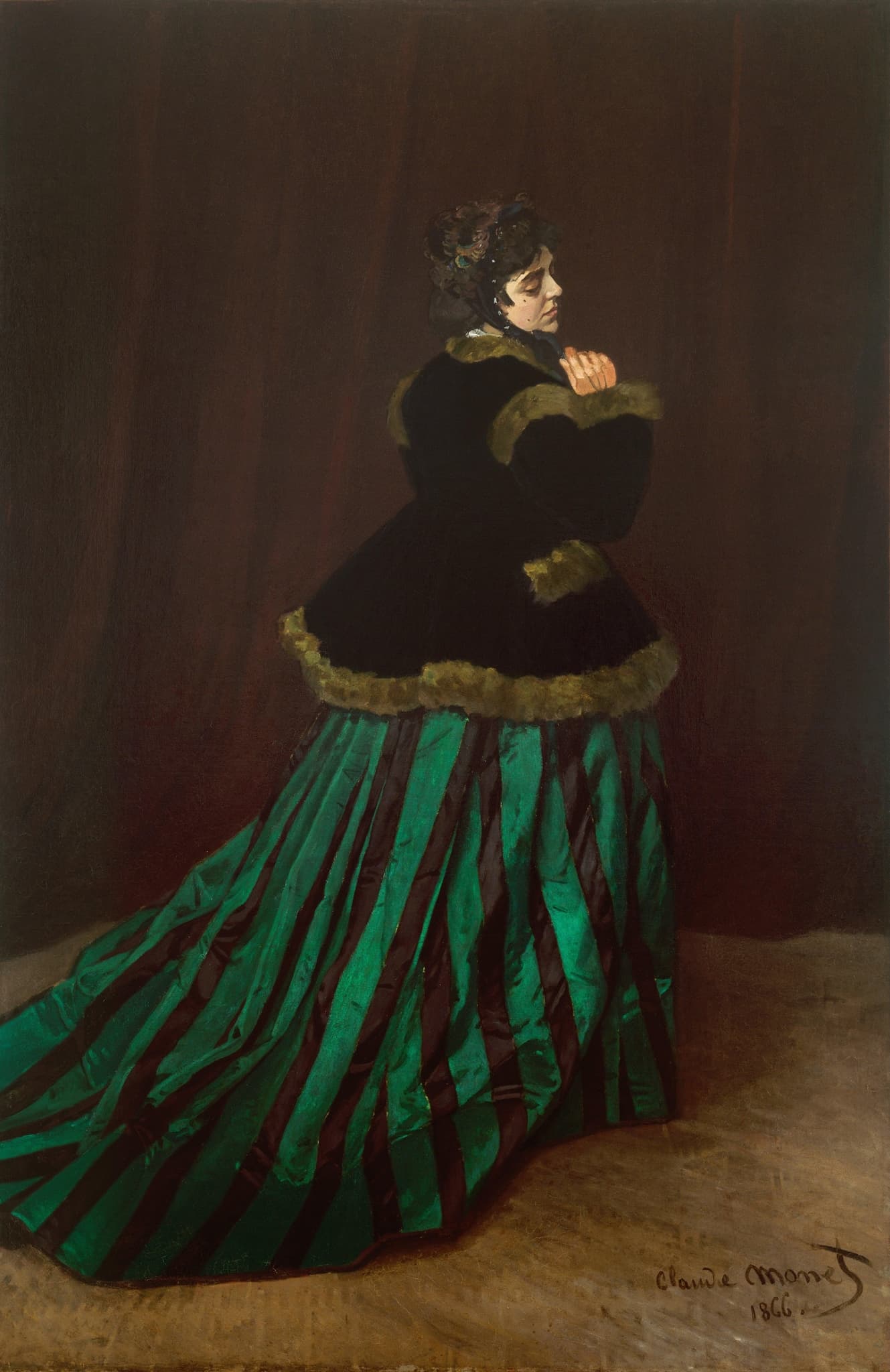
Camille (The Woman in the Green Dress)
Claude Monet, 1866 • Oil on canvas
Read full analysis of Camille (The Woman in the Green Dress) →Valuation Analysis
Conclusion: We estimate Claude Monet’s Camille (The Woman in the Green Dress) (1866) at $100–140 million, assuming a well-publicized offering at a major evening sale or equivalent private-treaty context. This range triangulates from Monet’s record ($110.7m for Meules in 2019) and recent blue-chip results for his most commercially dominant series, then adjusts upward for the picture’s singular art-historical stature as a monumental, full-length Salon masterpiece that helped launch Monet’s career [1][2].
Market benchmarks and positioning: Monet’s top auction price remains $110.7 million (2019, Haystacks) [1]. In the 2023–2025 period, best-in-class late works continued to trade strongly: a major Nymphéas achieved $74.01 million in November 2023 [2]; a 1914–17 Water Lilies realized $65.5 million in November 2024 to an Asian buyer, underscoring global demand depth [3]; and further 2024–2025 Monet sales in the $30–45 million band confirm ongoing liquidity for prime material, even in selective conditions [4][8]. Monet’s London Parliament variant sold for $75.96 million in 2022, indicating sustained appetite for signature series beyond Water Lilies and Haystacks [9]. Against this backdrop, Camille’s trophy attributes—rarity, scale (231 × 151 cm), and canonical status—justify record-adjacent pricing.
Work-specific merits: Camille is not only an iconic early Monet; it is also an exceptionally rare, full-length portrait that electrified the Paris Salon of 1866 and remains a touchstone image of French modern painting. The Kunsthalle Bremen object record confirms long institutional stewardship since 1906 and the work’s imposing dimensions [5]. Conservation undertaken ahead of the museum’s 2005–06 exhibition further documented the canvas’s execution and importance, reinforcing the painting’s singular place in Monet’s development and the broader narrative linking him to Manet-era modernity [6]. These factors—combined with the work’s image recognition and scarcity within Monet’s oeuvre—support a valuation that can approach, and in the most competitive scenario challenge, the artist’s auction record in today’s dollars.
Macro context and execution risks: While the $10m+ auction segment contracted in 2024, late-2025 marquee weeks rebounded on the strength of masterpiece supply, suggesting that demand remains robust for authenticated, fresh, best-in-class works with institutional-level provenance [7]. Recent results show continued Asian participation at the top end, which is material for a global bidding pool [3]. Practical considerations—deaccession policy, export/licensing, and buyer diligence (full technical condition)—would shape pricing and feasibility. With a top-tier guarantee and full international touring, the work should find multiple trophy-seeking bidders; absent that momentum, outcomes would gravitate toward the lower end of the range. On balance, we judge $100–140 million a fair, market-grounded indication today [1][2][3][7][9].
Key Valuation Factors
Art Historical Significance
High ImpactPainted for the Paris Salon of 1866, Camille (The Woman in the Green Dress) is a landmark early Monet that helped establish his reputation. It is one of the very few full-length portraits in his oeuvre and a pivotal statement of modern fashion and painterly ambition at a formative moment in his career. Its canonical status is reinforced by sustained scholarly attention, frequent reproduction, and long-term museum stewardship. The Kunsthalle Bremen record confirms the work’s central place in the collection since 1906, and conservation research tied to the 2005–06 exhibition deepened understanding of its execution and critical reception. As a career-defining image, it commands peak-tier attention from connoisseur buyers.
Rarity and Scale
High ImpactAt 231 × 151 cm, Camille is monumental. Full-length portraits by Monet are exceptionally rare, and among those, few possess this level of salon-scale theatricality and finish. Scarcity strongly differentiates it from the many late landscapes that dominate Monet’s auction market. While Water Lilies, London, and grainstack series supply consistent high-value comps, their relative availability contrasts with the singularity of Camille’s format and subject. Rarity at this scale typically invites trophy-level bidding, particularly when the image is instantly recognizable and museum-held. This scarcity premium is a primary driver of the estimate sitting near Monet’s record pricing, despite the market’s usual preference for his late series.
Market Benchmarks
High ImpactMonet’s auction apex is $110.7m for Meules (2019). Recent sales anchor a robust upper band: $74.01m for a major Nymphéas (Nov 2023), $75.96m for Le Parlement (May 2022), $65.5m for a Water Lilies to an Asian buyer (Nov 2024), and additional strong results in the $30–45m range during 2024–25. These benchmarks confirm sustained global demand for top Monet works. Given Camille’s art-historical weight and rarity, it plausibly prices at record-adjacent levels in today’s market. Our $100–140m range reflects this comp set, with the high end aligning to the inflation-adjusted apex, and the low end reflecting outcome scenarios with tighter bidding or a private-treaty context.
Provenance and Museum Pedigree
Medium ImpactThe painting has been in the Kunsthalle Bremen since 1906, a top-tier institutional provenance that amplifies its scholarly profile, exhibition history, and public familiarity. Museum ownership can both elevate desirability (through prestige and documentation) and limit real-time price references (no modern public sale). Should deaccession be permitted, the fresh-to-market nature of a long‑held museum masterpiece typically catalyzes global interest, especially if accompanied by full technical reports and strategic touring. The documented 2005–06 conservation and dedicated exhibition further build buyer confidence in the work’s status and narrative. While export/licensing and policy considerations affect feasibility, pedigree is a net positive for value.
Condition and Technical Dossier
Medium ImpactA painting of this scale and date must be underpinned by a current technical report. The 2005 restoration ahead of the Kunsthalle’s Monet und Camille exhibition indicates professional stewardship and close study, which is advantageous for market readiness. Trophy buyers at this level expect transparency about structural condition, conservation history, and pigment stability. Assuming a sound structure and high-quality surface, condition would support the top half of the range; material issues (lining, extensive retouching, or instability) would temper competition. Given the known conservation history, due diligence is unlikely to reveal surprises, but final pricing would still be sensitive to the most recent condition assessment.
Sale History
Camille (The Woman in the Green Dress) has never been sold at public auction.
Claude Monet's Market
Claude Monet sits at the pinnacle of the Impressionist market. His auction record is $110.7 million for Meules (Haystacks) at Sotheby’s in 2019. Since then, top late series works have consistently achieved high prices: a major Water Lilies made $74.01 million in 2023, a London Parliament variant fetched $75.96 million in 2022, and a 1914–17 Nymphéas realized $65.5 million in 2024 to an Asian buyer—evidence of a broad, global collector base. Even in a selective market, fresh, best-in-class Monets continue to command tens of millions, with a resilient $30–75 million band for strong works and record-adjacent potential for singular masterpieces. Guarantees and irrevocable bids are common, smoothing outcomes for blue-chip offerings.
Comparable Sales
Meules (Haystacks)
Claude Monet
Same artist; apex of Monet's market and a trophy benchmark to cap the high end for any Monet. While a different subject (late landscape series), it sets the ceiling for what the very best Monets can achieve.
$110.7M
2019, Sotheby's New York
~$139.6M adjusted
Le Parlement, soleil couchant (Houses of Parliament, Sunset)
Claude Monet
Same artist; late series trophy with deep global demand (Anne H. Bass collection). Helps bracket where a top, blue‑chip Monet can trade in today’s market, even when not a Water Lilies or Haystacks.
$76.0M
2022, Christie's New York
~$83.6M adjusted
Le bassin aux nymphéas
Claude Monet
Same artist; late Water Lilies are among Monet’s most commercially dominant series. Strong recent result shows current trophy pricing for top Monets.
$74.0M
2023, Christie's New York
~$77.7M adjusted
Jeanne (Spring) [Le Printemps]
Édouard Manet
Peer artist; iconic single-figure portrait of a fashionable woman. A touchstone price for 19th‑century modern portraits and a strong proxy for the market’s appetite for landmark figure images of this era.
$65.1M
2014, Christie's New York
~$88.6M adjusted
Jeune homme à sa fenêtre (Young Man at His Window)
Gustave Caillebotte
Peer Impressionist; major early, large‑scale figure picture with Salon‑era modernity. Useful for gauging price levels for career‑defining 19th‑century figure works outside the most commercial series.
$53.0M
2021, Christie's New York
~$62.6M adjusted
Camille à l’ombrelle verte
Claude Monet
Same artist and subject (Camille), figure genre; confirms market receptivity to Monet’s portraits of Camille. Smaller, later, and far less important than the 1866 full‑length, but directly relevant on subject.
$9.4M
2016, Sotheby's New York
~$12.6M adjusted
Current Market Trends
After a 2024 contraction at the $10m+ level, late‑2025 marquee auctions rebounded on the strength of masterpiece supply. Data from the Art Basel & UBS Art Market Report indicate lower top-end auction values in 2024, but increased lot counts at lower tiers, reflecting a shift toward connoisseur-led buying. In this environment, canonical names like Monet remain favored when works are fresh, fully documented, and marketed globally. Recent high-profile results confirm depth for best-in-class Monets, with meaningful participation from Asia alongside US and European demand. Execution—guarantees, touring, and scholarly framing—will strongly influence whether outcomes sit at the lower or upper bounds of guidance.
Sources
- Sotheby’s – Monet’s Meules sells for $110.7m (artist record)
- Christie’s – 20th Century Evening Sale (Nov 9, 2023) totals; Monet Le bassin aux nymphéas at $74.01m
- Artnet News – Sotheby’s fall 2024: Monet Nymphéas sells for $65.5m to Asian buyer
- The Art Newspaper – Sotheby’s Modern Evening Sale, May 2024 results
- Kunsthalle Bremen – Object record: Monet, Camille (1866)
- Bremen Senat Press – Restoration ahead of 2005–06 exhibition Monet und Camille
- Art Basel & UBS – The Art Market 2025, Auctions chapter
- HENI News – Christie’s 20th Century Evening (Nov 17–18, 2025): Monet Nymphéas $45.48m
- The Value – Christie’s NYC, The Collection of Anne H. Bass (May 12, 2022): Monet Le Parlement $75.96m