How Much Is Haystack, Sunset Worth?
Last updated: February 2, 2026
Quick Facts
- Methodology
- comparable analysis
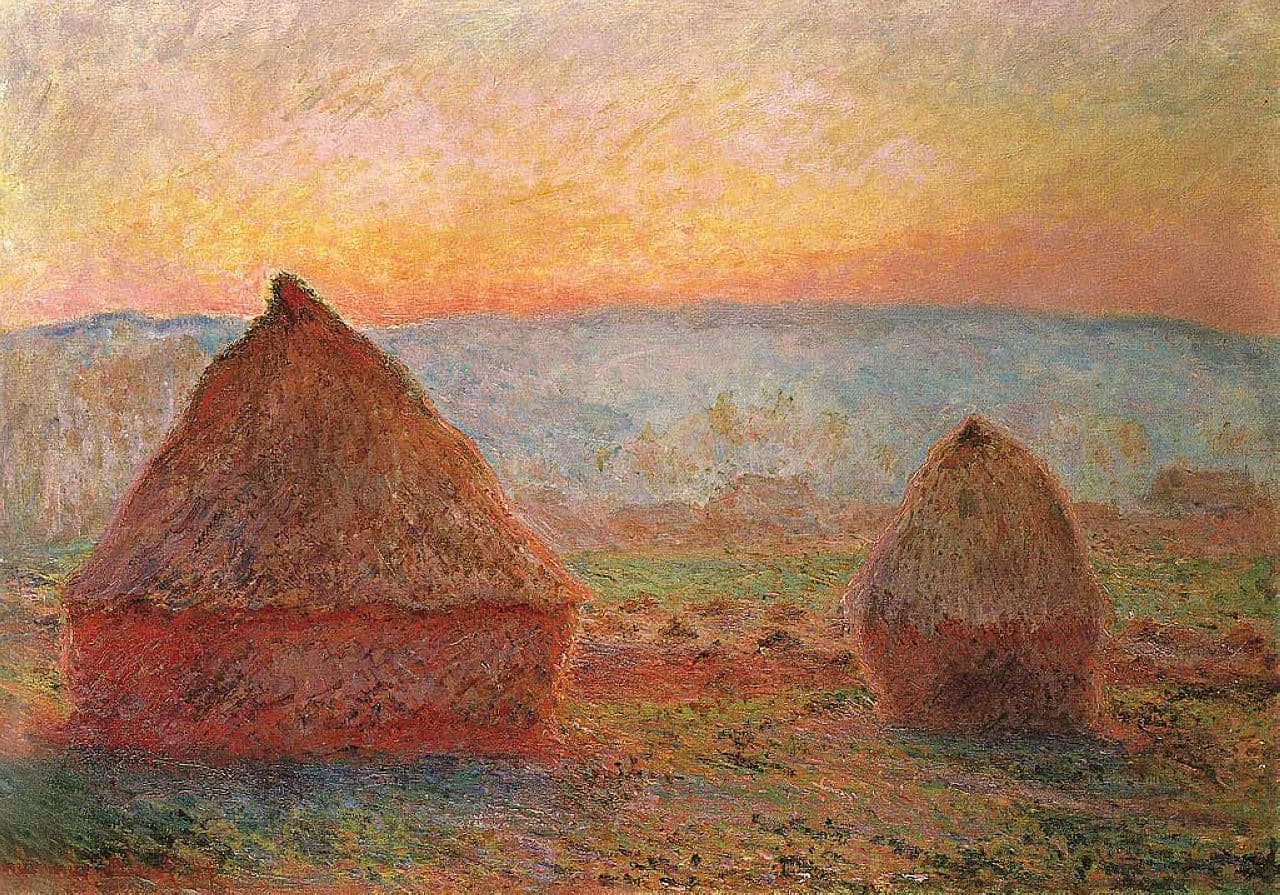
Claude Monet’s Grainstack (Sunset) (1891) at the MFA Boston is a top-tier canvas from the most coveted phase of the Haystacks series. Based on direct comparables—including the 2019 Meules at $110.7m and the 2016 Meule at $81.4m—this work would command approximately $100–150 million if hypothetically offered today.
Valuation Analysis
Conclusion: Monet’s Grainstack (Sunset) (1891), Museum of Fine Arts, Boston, aligns with the apex of the artist’s market and the most sought-after tranche of his serial practice. Anchoring to direct series comparables—Sotheby’s 2019 Meules at $110.7m and Christie’s 2016 Meule at $81.4m—supports a robust $100–150 million hypothetical valuation for an A‑quality sunset variant of the 1890–91 campaign [2][3]. The MFA canvas is a standard horizontal format from 1891 with a high‑impact chromatic register, attributes that have historically commanded premiums in this series.
Object and significance: The MFA Boston painting (Wildenstein CR no. 1289; 73.3 × 92.7 cm) is a canonical “sunset” Grainstack—precisely the kind of motif that epitomizes Monet’s breakthrough exploration of light, time of day, and seriality. Its early, distinguished provenance (including Durand‑Ruel and the 1917 American Art Association “Sutton sale”) and long museum tenure calibrate it among the most secure and recognized examples of the theme [1]. Sunset effects within the series are exceptionally coveted for their saturated palette and visual immediacy, a pattern underlined by the record‑setting Meules in 2019 [2].
Comparable market evidence: Two like‑for‑like anchors from the core 1890–91 Haystacks define the upper band: Meule brought $81.45m at Christie’s in 2016, and Meules achieved $110.7m at Sotheby’s in 2019, still Monet’s record [2][3]. A later haystack outside the core campaign, Meules à Giverny (1893), realized $34.8m in 2024, illustrating the steep discount on non‑core iterations [4]. Cross‑series markers confirm persistent depth for iconic Monet serial motifs: Water Lilies canvases fetched $74.0m (Christie’s 2023) and $65.5m (Sotheby’s 2024) [5][7], while the London series Le Parlement, soleil couchant achieved $75.96m in 2022 [6]. Together, these results triangulate the current, selective but resilient demand for blue‑chip Monet trophies.
Positioning and assumptions: The indicated range presumes standard dimensions, compelling sunset palette, and sound condition—attributes typical of best‑in‑class 1890–91 Haystacks. Scarcity is acute: many peak examples are in museums, restricting private supply and reinforcing pricing power when canonical works do surface. While top‑end market volume has moderated since 2021, true A‑assets in established historical categories continue to attract broad global bidding, frequently supported by third‑party guarantees [5][7]. In this context, a museum‑grade sunset Grainstack aligns credibly with the $100–150m band, with upside possible given pristine condition, exemplary literature/exhibition history, and strong sale choreography.
Bottom line: Calibrated to the 2016 and 2019 Haystacks benchmarks and corroborated by adjacent series results through 2024, the MFA’s Grainstack (Sunset) would reasonably be expected to realize approximately $100–150 million if hypothetically deaccessioned and offered in a marquee sale today [2][3][4][5][6][7].
Key Valuation Factors
Art Historical Significance
High ImpactGrainstack (Sunset) sits at the center of Monet’s pivotal 1890–91 serial practice, which crystalized his exploration of light and temporality and helped define Impressionism’s public image. The Haystacks rank, alongside Water Lilies and the London series, as the most canonized and academically cited bodies of work in Monet’s oeuvre. A sunset variant further heightens the art‑historical resonance by foregrounding chromatic intensity and atmospheric effect—the qualities most often reproduced in survey texts and exhibitions. This status translates directly to market demand, with collectors viewing core‑series Haystacks as a finite set of “benchmark” Monets. The combination of iconography, period, and scholarly anchoring exerts a decisive positive impact on value.
Series and Palette (Sunset Variant)
High ImpactWithin the Haystacks, time‑of‑day effects and palette saturation are major pricing drivers. Sunset canvases—distinguished by incandescent reds, oranges, and violets against cooling shadows—are consistently perceived as the most dramatic and photogenic. The 2019 record for Meules underscored the premium for luminous, high‑chroma examples from 1890–91. By contrast, later or less chromatically charged haystacks trade at a steep discount, as evidenced by the 1893 Meules à Giverny result. The MFA’s work, catalogued as a 1891 “sunset,” aligns with the top desirability tranche on both subject and palette. This factor materially supports placement in the upper third of the estimate band, assuming condition and scale are best‑in‑class.
Condition, Format, and Scale
High ImpactThe standard horizontal format around 73 × 92 cm is the canonical size for many 1890–91 Haystacks and is strongly preferred by the market. Works in excellent, unlined or sensitively conserved condition with intact surface and color balance command a significant premium and broaden the global bidder pool. While a formal condition report is required for precision, the valuation assumes a conservationally stable canvas with no material compromises. Even minor issues—overcleaning, extensive retouch, or structural intervention—can deflect bidding in today’s more discriminating environment. Conversely, pristine condition combined with the sunset palette and standard format can catalyze competition and push a trophy into or above the upper estimate band.
Provenance and Museum Status
Medium ImpactThis painting’s early provenance—linked to Durand‑Ruel and a 1917 American Art Association sale—confers strong historical legitimacy and confidence. Its long tenure in the MFA Boston further affirms its stature and public recognition. While deaccession is unlikely, the cachet of museum provenance can heighten market interest were the work ever to be offered, signaling vetted authenticity and scholarship. That said, museum status can introduce practical complexities (public scrutiny, potential restrictions, or institutional conditions) that temper near‑automatic premiums. Net impact is positive: distinguished provenance expands the buyer base at the top end, but the pricing effect is ultimately subordinate to core drivers such as series, palette, size, and condition.
Sale History
Haystack, Sunset has never been sold at public auction.
Claude Monet's Market
Claude Monet is a foundational, highly liquid blue‑chip artist with broad global demand across institutional and private buyers. His auction record remains $110.7 million for Meules (Sotheby’s New York, 2019), the first Impressionist work to exceed $100m at auction. Since late 2023, marquee results have remained strong for iconic series: Water Lilies works achieved $74.0m (Christie’s, Nov 2023) and $65.5m (Sotheby’s, Nov 2024), while the London Houses of Parliament series reached $75.96m in May 2022. Depth below the absolute peak persists, but the market has become more selective, rewarding best‑in‑class examples with museum‑level provenance, saturated palettes, and prime dates. Within this landscape, Haystacks from 1890–91 occupy a privileged pricing tier.
Comparable Sales
Meules (Haystacks), 1890
Claude Monet
Same artist and core 1890–91 Haystacks series; large horizontal format; high‑chroma motif closely aligned with a sunset effect; market‑peak benchmark for the subject.
$110.7M
2019, Sotheby's New York
~$137.3M adjusted
Meule (Grainstack), 1891
Claude Monet
Same artist, same 1890–91 Grainstacks/Haystacks series and standard format; extremely close like‑for‑like proxy for a sunset Grainstack.
$81.4M
2016, Christie's New York
~$108.3M adjusted
Meules à Giverny, 1893
Claude Monet
Same haystack motif but later (1893) outside the core 1890–91 campaign; useful for showing the discount applied to non‑core examples.
$34.8M
2024, Sotheby's New York
~$35.5M adjusted
Peupliers au bord de l’Epte, crépuscule (Poplars at Dusk), 1891
Claude Monet
Same year and serial practice as the Haystacks with a dusk/sunset palette; strong proxy for 1891 series demand and color impact.
$43.0M
2025, Christie's New York
Le Parlement, soleil couchant (Houses of Parliament, Sunset), 1900–03
Claude Monet
Top‑tier serial subject with sunset effect; triangulates pricing for Monet’s most coveted series adjacent to Haystacks.
$76.0M
2022, Christie's New York
~$82.8M adjusted
Current Market Trends
Impressionist/Post‑Impressionist auctions have cooled in dollar volume since 2023 due to fewer trophy consignments, even as lot counts held or rose. Despite this, demand for historically secure, blue‑chip works remains resilient, with top Monets continuing to clear at $60–$75m+ in 2022–2024 for Water Lilies and London series benchmarks. The segment’s risk profile is comparatively low, and guarantees are common for A‑assets. Supply, not demand, is the key swing variable: when best‑in‑class Monet masterpieces surface—especially from prime series and dates—competitive global bidding returns. Against this backdrop, a sunset 1891 Haystack would reasonably test or exceed prior series benchmarks, supporting a $100–150m expectation in a strong marquee sale.
Sources
- Museum of Fine Arts, Boston – Grainstack (Sunset) object record
- Sotheby’s – Monet’s Meules sells for $110.7m (artist record, 2019)
- Christie’s – Meule (Grainstack) achieves $81.45m (2016)
- The Art Newspaper – Sotheby’s Modern Evening sale; Meules à Giverny fetches $34.8m (2024)
- Christie’s – 20th Century Evening Sale totals; Le bassin aux nymphéas $74,010,000 (2023)
- The Value – Christie’s Anne H. Bass Collection; Houses of Parliament, Sunset $75.96m (2022)
- The Art Newspaper – Sotheby’s New York; Sydell Miller Collection; Nymphéas $65.5m (2024)