How Much Is Haystacks Series by Claude Monet | Light, Time & Atmosphere Worth?
Last updated: January 16, 2026
Quick Facts
- Insurance Value
- $150.0M (Internal benchmark anchored to 2019 Sotheby's record and related auction results)
- Methodology
- comparable analysis
Fair-market value for a canonical 1890–91 Haystacks (Meules) oil by Claude Monet is $90–140 million. This range is anchored by Sotheby’s 2019 record at $110.7m, Christie’s 2016 result at $81.45m, and a closely related 2024 variant at $34.8m that establishes a floor for less canonical examples. Assumes prime quality, strong light effect, excellent condition, and clean provenance.
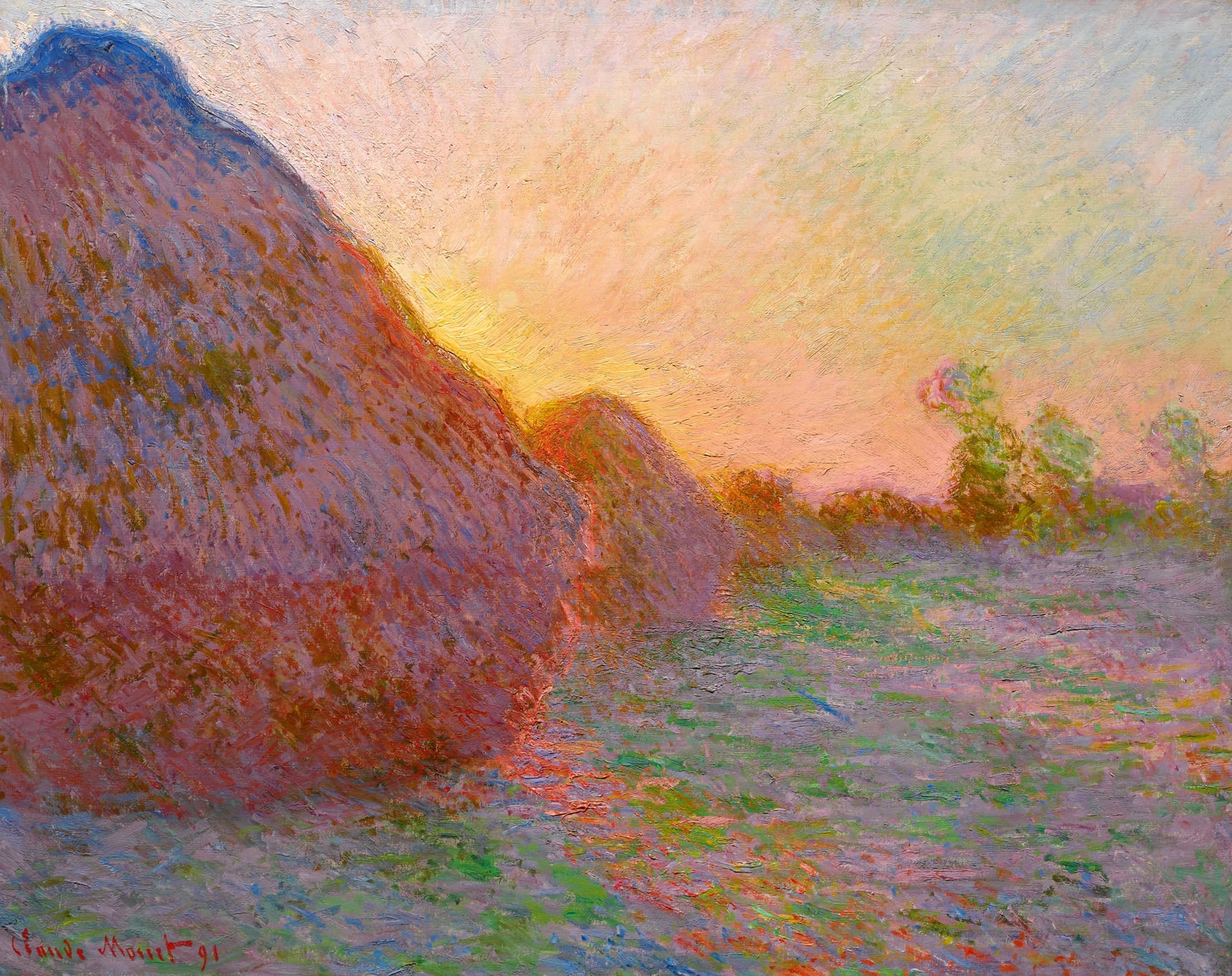
Haystacks Series by Claude Monet | Light, Time & Atmosphere
Claude Monet
Read full analysis of Haystacks Series by Claude Monet | Light, Time & Atmosphere →Valuation Analysis
Estimate: $90–140 million fair-market value for a canonical 1890–91 Haystacks (Meules) oil on canvas, assuming prime size, strong light/color effect, excellent condition, clean provenance, and New York marquee-auction context. This is one of Monet’s most coveted serial motifs; top-tier examples sit at the apex of Impressionist collecting and trade as trophy assets.
Core comps and anchor points. The series benchmark is Meules (1890), Sotheby’s New York, 14 May 2019, achieving $110.7 million including premium—Monet’s standing auction record and a landmark for Impressionism [1]. Earlier, Meule (1891) realized $81.45 million at Christie’s New York on 16 November 2016, establishing the prior record [2]. A later, closely related variant, Meules à Giverny (1893), sold for $34.8 million at Sotheby’s New York on 15 May 2024, which functions as a realistic floor for non‑canonical or later Haystack pictures with somewhat less chromatic drama or period cachet [3]. These data points bracket today’s likely clearing price for a strong, canonical 1890–91 Haystack.
Position within Monet’s oeuvre. Haystacks, painted primarily in 1890–91 at Giverny, crystalizes Monet’s serial method—charting shifts of light, season, and atmosphere across near‑identical motifs. Alongside the Water Lilies, Rouen Cathedral, Poplars, and Parliament, it is among the most culturally recognizable and academically significant bodies of work in late 19th‑century painting. The very best Haystack canvases combine saturated twilight or snow effects, nuanced color harmonies, and a resolved surface, placing them among the artist’s highest expressions. This art‑historical centrality explains why top examples command record pricing relative to other Monet subjects [1][2].
Market calibration. Monet’s broader top‑end remains resilient, with late Water Lilies pictures achieving $74.01 million at Christie’s New York in November 2023, reinforcing that canonical series works still command deep global demand in marquee contexts [4]. At the same time, the Impressionist/Post‑Impressionist segment has seen fewer ultra‑high‑value lots and increased selectivity since 2023, with auction houses leaning more on guarantees and third‑party support; this has compressed outcomes for mid‑tier works while leaving true trophies comparatively insulated [5]. Our range reflects that bifurcation: $90–140 million for a prime Haystack, with the lower bound informed by the 2024 related variant and the upper bound justified by the 2019 record, scarcity, and ongoing trophy demand.
Key sensitivities. Condition (lining, restoration load, UV fluorescence), scale, light effect (sunset/snow/winter light generally commands premiums), provenance (notable collections; no gaps or restitution issues), and literature/exhibition footprint can swing value tens of millions. Works on paper (pastels/gouaches) related to the motif typically transact an order of magnitude lower, and posthumous prints/reproductions carry only decorative value. Under the assumptions stated, we fix fair‑market value at $90–140 million and recommend an insurance replacement value of ~$150 million, consistent with trophy‑level replacement practices tied to record‑setting comparables [1][2][3].
Key Valuation Factors
Art Historical Significance
High ImpactMonet’s Haystacks (Meules) are a cornerstone of Impressionism and a foundational demonstration of serial observation—tracking the same motif under changing light, season, and atmosphere. The 1890–91 campaign at Giverny marks a pivotal moment when Monet’s inquiry becomes both methodical and modern, prefiguring later series like Rouen Cathedral and the Water Lilies. Within the canon of late-19th-century painting, few subjects are more instantly recognizable. This visibility amplifies demand across geographies and collecting categories, driving exceptional liquidity at the top end. The series’ centrality also supports strong institutional interest, enhancing scholarly citations, exhibition history, and long-term reputational durability that underwrites value.
Series Rank & Subject Quality
High ImpactNot all Haystacks are equal. Prime 1890–91 canvases with compelling light effects (e.g., sunset, winter snow, raking twilight) and saturated, balanced color harmonies achieve trophy pricing. Compositional strength—crisp stack geometry against atmospheric distance, with rich impasto and resolved surfaces—routinely separates $100m-plus candidates from mid-tier examples. Later or less chromatically dramatic variants price materially lower. Works that show the motif’s transitional states (e.g., frost, melting snow) can command premiums due to rarity and visual intensity. Our estimate assumes a canonical example with best-in-series attributes, which is the key driver of the $90–140 million fair-market range.
Condition and Conservation
High ImpactAt this price level, condition is often the decisive swing factor. A structurally sound, unlined canvas with minimal, skillful retouching and no color abrasion will command a premium. Conversely, heavy overcleaning, extensive overpaint, compromised impasto, or significant restorations can depress value by tens of millions. Even surface phenomena like discolored varnish or uneven gloss can influence bidding in a marquee sale. A recent independent conservation report (including UV/raking-light imagery) is essential to confirm that the paint film, ground layer, and support are stable. The estimate presented assumes excellent condition consistent with A‑tier institutional standards.
Provenance, Literature, and Exhibition History
Medium ImpactClean, distinguished provenance—especially early sales through Paul Durand‑Ruel, ownership by notable collectors, and significant museum loans—magnifies confidence and demand. Inclusion in the Wildenstein catalogue raisonné and citations in major monographs or exhibition catalogues are critical for price optimization. Works with marquee exhibition histories (e.g., loans to leading museums or inclusion in landmark surveys) enjoy a credibility premium and broader bidder participation. Any provenance gaps (particularly in the 1933–45 period) or unresolved title issues can chill interest and force discounts. The valuation presumes a fully documented ownership chain, literature citations, and strong exhibition pedigree.
Sale History
Sotheby's New York
Meules (1890); Monet auction record; price incl. premium
Christie's New York
Meule (1891); prior Monet record; price incl. premium
Sotheby's New York
Meules à Giverny (1893); related variant; price incl. premium
Claude Monet's Market
Claude Monet is a blue‑chip cornerstone of the global art market, with deep cross‑border demand from private collectors and institutions. His all‑time auction record stands at $110.7 million for Meules (Sotheby’s New York, 2019), and late Water Lilies canvases regularly command $60–75 million in marquee sales, underscoring sustained appetite for his most iconic series. Supply of top‑tier, fresh‑to‑market examples is scarce, and houses frequently secure guarantees to place them. While outcomes are increasingly selective across the category, the very best Monet pictures—especially from the Haystacks, Water Lilies, and Rouen Cathedral series—remain among the most reliable trophy lots in Modern art.
Comparable Sales
Meules (1890)
Claude Monet
Same artist; same Haystacks series (1890); benchmark A+ example and current Monet record; directly comparable in subject and period.
$110.7M
2019, Sotheby's New York
~$135.1M adjusted
Meule (Grainstack) (1891)
Claude Monet
Same artist; same subject (Grainstack/Haystack) from 1891; prime series example sold in a New York evening sale.
$81.4M
2016, Christie's New York
~$105.9M adjusted
Meules à Giverny (1893)
Claude Monet
Same artist; closely related Haystacks motif, though a later 1893 variant; helpful as a floor for non‑1890/91 examples.
$34.8M
2024, Sotheby's New York
~$35.8M adjusted
Le bassin aux nymphéas (c. 1917–19)
Claude Monet
Same artist; late Water Lilies of top quality anchor Monet’s trophy market and bracket demand/ceiling for iconic series pictures.
$74.0M
2023, Christie's New York
~$77.7M adjusted
Peupliers au bord de l’Epte, crépuscule (1891)
Claude Monet
Same artist; same 1891 campaign of serial motifs exploring light/time effects; strong adjacent series to Haystacks.
$43.0M
2025, Christie's New York
Current Market Trends
Impressionist/Post‑Impressionist auctions have seen thinner supply of $50m+ trophies and greater reliance on guarantees since 2023, leading to selective bidding and more pronounced price dispersion. Even so, canonical, museum‑grade works by the movement’s keystone figures continue to perform, while mid‑tier examples face tighter underwriting. UBS/Art Basel reporting highlights contraction in high‑end auction turnover and a shift toward private sales, yet top-quality lots still catalyze global competition. Against this backdrop, Monet’s A‑material retains exceptional liquidity; record‑setting Haystacks and strong Water Lilies results provide concrete anchors for a $90–140 million range on a prime Haystack.
Sources
- Sotheby's: Monet's Meules sells for $110.7m (artist record)
- Christie's: Meule (Grainstack) achieves $81.45m (2016)
- Artnet News: Sotheby’s Modern Evening Sale 2024 (Meules à Giverny at $34.8m)
- Christie’s: 20th Century Evening Sale Results, Nov 2023 (Monet at $74.01m)
- UBS & Art Basel: The Art Market 2025 – Auctions