How Much Is Poppy Fields near Argenteuil Worth?
Last updated: March 11, 2026
Quick Facts
- Methodology
- extrapolation
If hypothetically deaccessioned and offered without legal constraints, Claude Monet’s Les Coquelicots (Poppy Fields near Argenteuil, 1873) would be expected to realize about $120–180 million. Its Argenteuil-period importance and iconic, widely reproduced image position it to challenge—and likely surpass—Monet’s standing auction record.
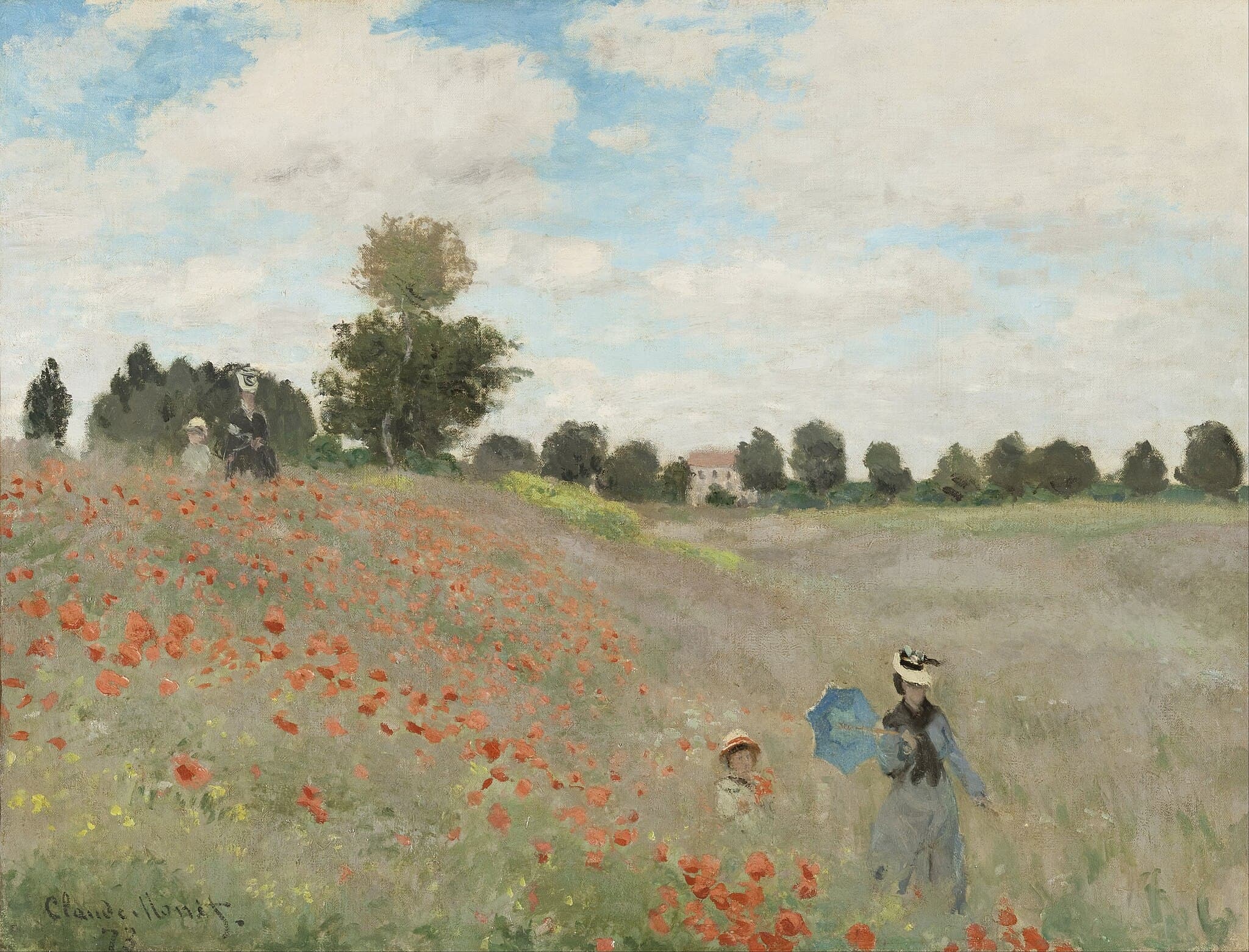
Poppy Fields near Argenteuil
Claude Monet, 1873 • Oil on canvas
Read full analysis of Poppy Fields near Argenteuil →Valuation Analysis
Overview and identification. Claude Monet’s Les Coquelicots (1873; 50.0 x 65.3 cm, oil on canvas) is in the collection of the Musee d’Orsay, Paris, and is legally inalienable under French law. Any pricing is therefore hypothetical and framed as a replacement-cost/market-consensus estimate assuming an unrestricted, fully marketed sale at a top auction venue [1][5].
Method and range. The $120–180 million range is an upward extrapolation from Monet’s market apex and adjacent blue-chip comparables. Monet’s auction record stands at $110.7 million for Meules (Haystacks) at Sotheby’s New York in 2019, a benchmark for the artist and for Impressionism at auction [2]. Recent marquee results confirm deep demand around $70–80+ million for prime series pictures: a late Water Lilies made $74.01 million in November 2023 at Christie’s New York, and a Houses of Parliament canvas achieved $75.96 million in May 2022, also at Christie’s [3][4].
Why this work can exceed the record. Les Coquelicots is a canonical Argenteuil-period image and a touchstone of early Impressionism—open air, scintillating light, seasonal color, and modern life with figures—reproduced in countless survey texts and widely recognized beyond the specialist market [1]. This “textbook” status commands a trophy premium that extends beyond series hierarchies. While many record-tier Monets derive from late serial projects (Nympheas, Meules, Poplars, Parliament), this picture’s cultural resonance, period significance (1873, on the eve of the 1874 Impressionist exhibition), and museum-grade visibility support a value above the current $110.7 million record in a well-choreographed sale.
Moderators and mitigants. The work’s moderate scale (50 x 65.3 cm) is smaller than many record Monets, which can temper absolute price potential; conversely, its fame, pristine art-historical positioning, and near-total market scarcity of equivalents mitigate format risk. As with any masterpiece, exact condition, conservation history, and sale timing can influence the final number. Assuming sound condition and full global marketing with a third‑party guarantee, competitive bidding would be expected at or above the record threshold.
Bottom line. On a hypothetical, unrestricted basis, Les Coquelicots would credibly sell in the $120–180 million range. Its unique blend of art-historical importance, instant recognizability, and Monet’s enduring blue‑chip demand place it among the small set of 19th–20th century trophies capable of resetting the artist’s high-water mark today [1][2][3][4][5].
Key Valuation Factors
Art Historical Significance
High ImpactPainted in 1873 at Argenteuil, Les Coquelicots encapsulates the birth of Impressionism: plein-air practice, broken color, atmospheric effects, and modern life with figures. It sits within Monet’s pivotal early 1870s production, contemporaneous with works shown at or around the first Impressionist exhibition (1874). The painting’s frequent appearance in survey literature and exhibitions signals its status as a definitive exemplar of the movement. Works that both inaugurate a style and serve as its public-facing emblem command premiums across categories. This is not simply a strong Monet; it is a foundational image for Impressionism itself, placing it at the very top of the artist’s oeuvre by scholarly and cultural measures.
Iconicity and Museum Visibility
High ImpactHoused at the Musee d’Orsay and reproduced widely, the composition is recognizable to a broad global audience beyond specialists. Such museum-level visibility compounds "brand" equity and generates a trophy premium when analogues surface on the market. Buyers at the apex value cultural impact as much as technical or serial distinctions, rewarding pictures that symbolize an era or movement. Les Coquelicots functions as a visual shorthand for early Impressionism; its image circulates in education, media, and tourism, dramatically enlarging the buyer pool. In today’s cross-category trophy market, that ubiquity translates directly into pricing power well above typical series-based comparables.
Comparable Benchmarks and Record Calibration
High ImpactThe artist’s standing auction record is $110.7m for Meules (2019). Since then, top-tier Monets have consistently traded around $70–$80m+ (late Nympheas at $74.0m in 2023; Houses of Parliament at $75.96m in 2022), confirming depth in the upper band. Les Coquelicots’ art-historical primacy and cross-genre appeal reasonably justify an extrapolation above $110m in today’s market. While late serial masterpieces often anchor the highest prices, this picture’s canonical status within the genesis of Impressionism supports a premium beyond the typical series hierarchy. The proposed $120–180m range places it decisively above the current record while acknowledging execution risk and sale‑specific dynamics.
Scale, Physical Attributes, and Condition Sensitivity
Medium ImpactAt 50.0 x 65.3 cm, the work is more modest in scale than many record-setting Monets, which can influence absolute price ceilings. Ultra-high-end buyers frequently prize impact and presence, and larger formats can broaden competition. However, the composition’s clarity, coloristic punch, and extraordinary familiarity help offset scale constraints. As always at this level, surface condition, lining history, and any retouch are material to final outcomes. While no public conservation issues are cited by the museum, recent imaging and a clean bill of health would be expected to activate peak demand. Hence, scale modestly moderates value, but condition confirmation can neutralize most downside.
Sale History
Poppy Fields near Argenteuil has never been sold at public auction.
Claude Monet's Market
Claude Monet remains a cornerstone of the Modern market with deep global demand from both private collectors and institutions. His auction record—$110.7 million for Meules (Sotheby’s, 2019)—is also the highest auction price ever achieved for an Impressionist work. Recent marquee seasons show strong liquidity for prime series pictures in the $70–80+ million range, including late Water Lilies and Houses of Parliament canvases. Even amid selective buying, the very best Monets consistently anchor evening sales. Scarcity of blue-chip examples with top provenance and visibility sustains competition at the top end. Against this backdrop, an instantly recognizable, museum-canonical early Monet can credibly command a trophy premium above established series benchmarks.
Comparable Sales
Meules (Haystacks)
Claude Monet
Same artist; canonical serial rural landscape; mature trophy subject that sets the market ceiling for Monet. Later period and typically larger than Poppy Fields, but directly comparable for brand power and cross‑category demand.
$110.7M
2019, Sotheby's New York
~$140.0M adjusted
Le Parlement, soleil couchant (Houses of Parliament, Sunset)
Claude Monet
Same artist; top‑tier serial work with iconic visibility and intense atmospheric effects. Later than 1873 and generally larger, but a direct indicator of blue‑chip Monet trophy demand just below the record tier.
$76.0M
2022, Christie's New York
~$83.9M adjusted
Le Bassin aux nymphéas (1917–19)
Claude Monet
Same artist; late, museum‑grade Water Lilies—one of Monet’s most collectible series. Demonstrates sustained trophy‑level pricing for prime Monets in today’s market.
$74.0M
2023, Christie's New York
~$78.6M adjusted
Le Bassin aux nymphéas (1917–19)
Claude Monet
Same artist; late Water Lilies from the most in‑demand Monet series. Confirms depth around $70m+ for prime works across different seasons.
$70.4M
2021, Sotheby's New York
~$83.9M adjusted
Peupliers au bord de l’Epte, crépuscule (1891)
Claude Monet
Same artist; core Poplars series (serial landscape and optical effects). Closer to Poppy Fields in outdoor/nature motif; strong but a step below Haystacks/Water Lilies in market hierarchy.
$43.0M
2025, Christie's New York
Meules à Giverny (1893)
Claude Monet
Same artist; haystacks subject but smaller‑scale/later variant. Useful for gauging size/format effects and pricing for strong, non‑record series pictures.
$34.8M
2024, Sotheby's New York
~$35.7M adjusted
Current Market Trends
The upper-tier Impressionist/Modern segment remains bifurcated: A+ works with name recognition, great provenance, and solid condition continue to attract multiple bidders, while mid‑tier material is priced more selectively. Despite a cooler broader auction climate in 2024–2025, houses posted robust totals when stocked with strong Modern trophies and supported by guarantees. Scarcity of museum-grade Impressionist icons has intensified competition for the few that surface, with Asia, Europe, and the US all active at the top. Financial structuring (irrevocable bids, third‑party guarantees) and disciplined estimates are key determinants of outcomes. In this environment, culturally emblematic masterpieces continue to command premium pricing and can reset artist records.
Sources
- Musee d'Orsay – Les Coquelicots (1873) object record
- Sotheby’s – Monet’s Meules sells for $110.7m (artist and Impressionist record)
- Christie’s – 20th Century Evening Sale (Nov 9, 2023) total; Water Lilies at $74,010,000
- The Art Newspaper – Christie’s evening sales (May 12, 2022): Monet Parliament at $75.96m
- Legifrance – Code du patrimoine, Article L451-5 (inalienability of public museum collections)