How Much Is Spring (Fruit Trees in Bloom) Worth?
Last updated: March 11, 2026
Quick Facts
- Insurance Value
- $35.0M (Assistant estimate (replacement above likely auction to reflect scarcity and costs))
- Methodology
- comparable analysis
Estimated at $18–28 million if hypothetically offered at auction today, based on direct orchard/blossom comparables and recent pricing for strong, non-series Monets of similar caliber. Replacement/insurance should be set higher, at approximately $35 million, reflecting scale, early-Argenteuil date, and institutional-grade quality. The work resides at The Met and has no public sale history.
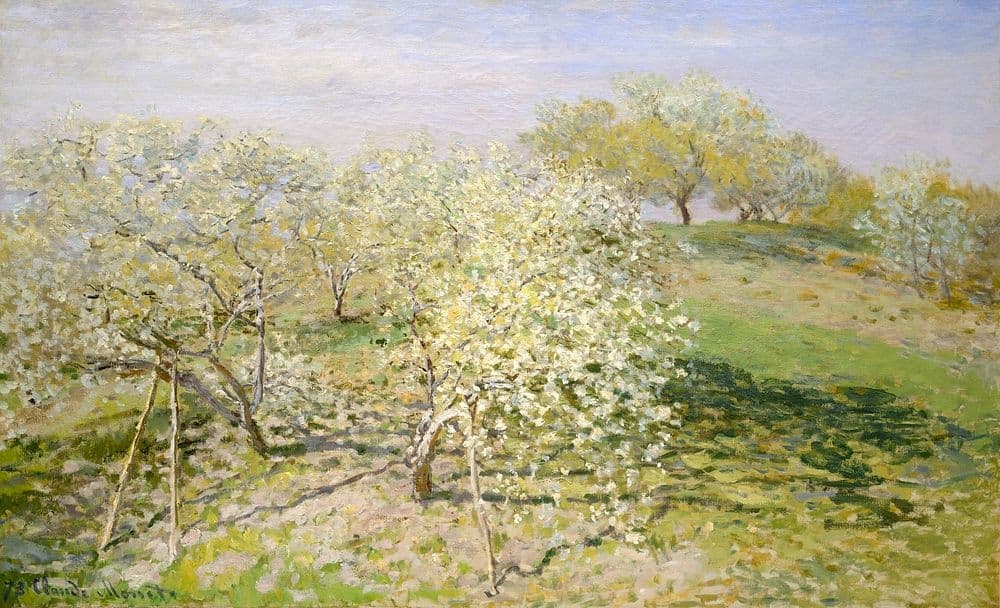
Spring (Fruit Trees in Bloom)
Claude Monet, 1873 • Oil on canvas
Read full analysis of Spring (Fruit Trees in Bloom) →Valuation Analysis
Work: Claude Monet, Spring (Fruit Trees in Bloom), 1873, oil on canvas, 62.2 × 100.6 cm (24 1/2 × 39 5/8 in). Collection of The Metropolitan Museum of Art, New York (accession 26.186.1). The Met documents the painting as an Argenteuil-period canvas and the first Monet to enter its collection via bequest in 1926 [1].
Method: This valuation is derived from a focused comparable analysis of Monet’s early 1870s orchard/blossom subjects and closely positioned non-series landscapes, then cross-checked against premiums paid for named series (Nymphéas, Poplars) to bracket the upper bound.
Direct subject comparable: The closest like-for-like subject is Monet’s Pommiers en fleurs (Apple Trees in Blossom), 1872, which realized about $9.035 million (with fees) at Christie’s New York on November 19, 2024. That canvas is smaller than The Met’s work; its price provides a reliable floor for the orchard motif in the current market [3].
Series premium yardsticks: Recent marquee results reaffirm the premium for named series pictures relative to non-series subjects. Sotheby’s New York sold a late Nymphéas for $65.5 million in November 2024 [4], and Christie’s New York sold a Poplars painting for $42.96 million in May 2025 [5]. Monet’s auction record remains Meules (Haystacks) at $110.7 million (Sotheby’s, 2019), underscoring the ceiling for iconic series trophies [2]. These benchmarks help cap the likely range for an orchard scene, which sits below those series valuations but above mid-tier non-series landscapes when scale and quality are superior.
Positioning this painting: The Met’s canvas is a large-format Argenteuil orchard from 1873, squarely within Monet’s early Impressionist prime. Relative to the 1872 orchard comp (~$9.0m), the substantially larger size (approx. 62 × 101 cm), lyrical complexity, and institutional-grade provenance justify a significant step up. Strong, non-series Monets of comparable desirability have traded in the high single- to low-teens millions in recent seasons, while top named-series works command mid-to-high eight figures. On that basis, a prudent, market-responsive range for Spring (Fruit Trees in Bloom) today is $18–28 million at auction.
Market backdrop and timing: After a 2024 contraction in global auction sales (~–12%), blue-chip Modern/Impressionist has shown resilience, with 2025 marquee weeks reestablishing depth at the high end. The 2026 Monet centenary and sustained institutional programming maintain visibility and collector appetite—supportive for period-strong works, even as buyers remain selective [6].
Insurance/replacement: Museum insurance figures are typically confidential, but replacement should be set above auction value to reflect scarcity, transaction costs, and the difficulty of sourcing an equivalently scaled, early Argenteuil Monet. We recommend $35 million for insurance.
Conclusion: Anchored by a direct orchard/blossom comp, scaled for size and quality, and bounded by series premiums, the evidence supports $18–28 million as a fair current auction range, with $35 million for insurance/replacement.
Key Valuation Factors
Art Historical Significance
High ImpactPainted in 1873 at Argenteuil, this canvas sits at the heart of Monet’s early Impressionist breakthrough. The orchard-in-bloom motif captures core tenets of the movement—fugitive light, seasonal atmosphere, and plein-air immediacy—while anticipating later serial explorations of transient effects. The Met’s documentation and long institutional stewardship further cement its scholarly standing. Within Monet’s oeuvre, Argenteuil landscapes rank among the most studied and exhibited, carrying strong connoisseur and curatorial appeal that reliably supports market demand for high-quality examples from this moment.
Period and Subject Desirability
Medium ImpactWhile orchards in blossom are lyrical and collectible, they are not part of Monet’s market-topping named series (Water Lilies, Haystacks, Rouen, Venice, Poplars). That places the subject below the trophy tier, yet firmly within a desirable early-1870s period. The seasonal specificity, coloristic charm, and recognizably ‘Impressionist’ palette broaden buyer appeal across geographies. Collectors prize Argenteuil-period works for freshness and historical import; this subject sits above generic landscapes but below the most instantly iconic series imagery in price terms.
Scale and Aesthetic Quality
High ImpactAt roughly 62 × 101 cm, the painting is materially larger than many orchard canvases and benefits from a panoramic, horizontal sweep that enhances wall power and marketability. Larger early works with balanced composition, varied brushwork, and luminous color typically command a premium over smaller or more schematic variants. Against the closest orchard comparable (~$9m for a smaller 1872 example), this scale and pictorial ambition justify a meaningful value step-up within the non-series Monet spectrum.
Provenance and Exhibition
Medium ImpactThe work’s presence in The Metropolitan Museum of Art since 1926 confers unimpeachable provenance, publication, and exhibition history—factors that reduce diligence risk and add cachet. While institutional ownership means the painting is not market-available, for valuation purposes museum-grade provenance typically enhances demand and justifies tighter estimate bands if hypothetically offered. Replacement difficulty for an equivalently scaled, early Argenteuil Monet with comparable pedigree supports an elevated insurance figure relative to auction expectations.
Sale History
Spring (Fruit Trees in Bloom) has never been sold at public auction.
Claude Monet's Market
Claude Monet is a blue-chip cornerstone of the Impressionist market with deep global demand and exceptional liquidity. His auction record is $110.7 million for Meules (Haystacks) at Sotheby’s in 2019, and large, high-quality works from named series (Water Lilies, Poplars, Parliament, Venice) regularly achieve mid-to-high eight figures. Non-series but period-strong landscapes commonly transact in the high single to low/mid eight figures, depending on scale, color, condition, and provenance. Supply of top examples remains thin, sustaining competition among private collectors and institutions. Market selectivity has increased since 2023, but best-in-class Monets continue to command confident bidding in New York marquee weeks.
Comparable Sales
Pommiers en fleurs (Apple Trees in Blossom)
Claude Monet
Same artist; direct orchard/blossom subject; Argenteuil-period (1872 vs. 1873); smaller format than the Met work—strong subject-specific benchmark.
$9.0M
2024, Christie's New York
~$9.3M adjusted
Antibes, vue de la Salis
Claude Monet
Same artist; desirable non‑series landscape with strong color; later period (1888) but a good market indicator for non‑series Monet landscapes trading in the mid‑teens.
$14.1M
2024, Sotheby's New York
~$14.5M adjusted
Le Parc Monceau
Claude Monet
Same artist; late‑1870s Paris park scene (close in period and market tier); non‑series subject; illustrates pricing for early works of moderate scale.
$9.0M
2026, Christie's London
~$8.8M adjusted
Maison de jardinier
Claude Monet
Same artist; garden/domestic subject with lush foliage; non‑series; later (1884) but comparable in market positioning and scale.
$11.0M
2026, Sotheby's London
~$10.8M adjusted
Peupliers au bord de l’Epte, automne
Claude Monet
Same artist; celebrated Poplars series (different subject but a key yardstick for premium Monet series versus non‑series); helps bracket the upper bound for non‑series landscapes.
$36.4M
2022, Christie's New York
~$40.8M adjusted
Matinée sur la Seine, temps net
Claude Monet
Same artist; important named river series (1897), later than the Met work; demonstrates the premium for recognized series compared with non‑series subjects like orchards.
$18.4M
2024, Christie's London
~$19.0M adjusted
Current Market Trends
Impressionist and Modern art has proven relatively resilient through the 2024 market slowdown, with 2025 auctions restoring depth at the high end. For Monet specifically, named-series trophies continue to draw robust international demand, while non-series works price more discriminately by period, subject, and scale. The 2026 centenary programs and ongoing museum exhibitions keep Monet at the forefront of curatorial and collector attention, a supportive backdrop for well-documented, visually compelling examples. In this context, early-Argenteuil subjects of substantial size sit in the low-to-mid eight figures, with premiums for superior color, condition, and institutional provenance.
Sources
- The Metropolitan Museum of Art – Object page: Spring (Fruit Trees in Bloom), 1873
- Sotheby’s – Monet’s Meules sells for $110.7m (artist auction record)
- Artprice – The Art Market in 2024 (lists Monet, Pommiers en fleurs, 1872, $9.035m, Christie’s NY, Nov 19, 2024)
- The Art Newspaper – Sotheby’s New York Modern Evening Sale (Monet Nymphéas $65.5m, Nov 18, 2024)
- Christie’s – 20th/21st Century New York, May 12, 2025: Auction results (Poplars $42.96m)
- The Art Newspaper – Global art sales fell 12% in 2024 (market context)