How Much Is The Artist's Garden at Giverny Worth?
Last updated: January 19, 2026
Quick Facts
- Insurance Value
- $70.0M (Internal estimate based on comparable replacement cost and market scarcity)
- Methodology
- comparable analysis
Fair market value is estimated at $40–60 million for Claude Monet’s The Artist’s Garden at Giverny (1900), assuming it were freely tradable. The painting is a mature-period, museum-caliber Giverny garden scene whose market level sits below Monet’s most prized serial masterpieces but well above mid-tier landscapes.
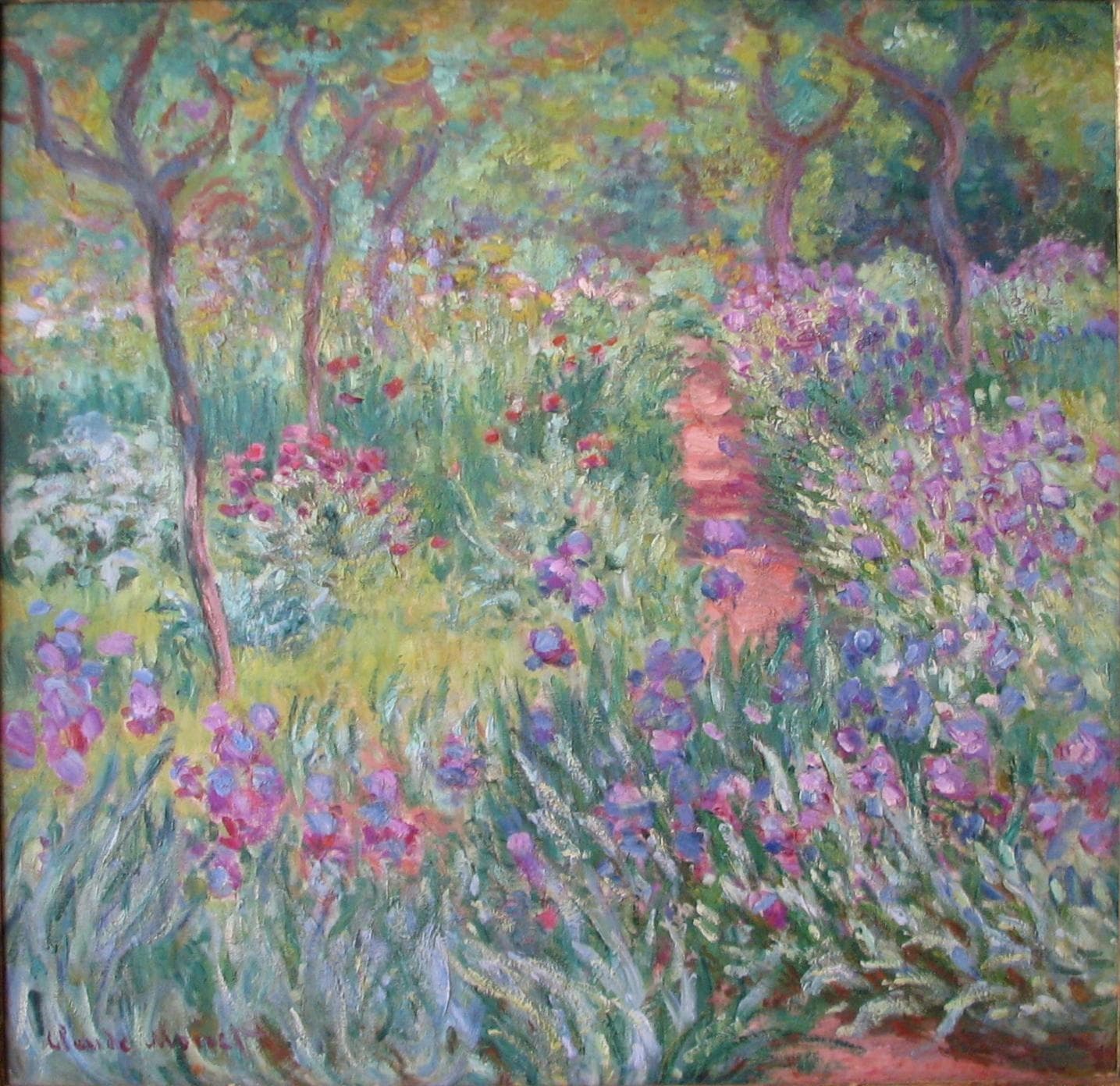
The Artist's Garden at Giverny
Claude Monet, 1900 • Oil on canvas
Read full analysis of The Artist's Garden at Giverny →Valuation Analysis
Value conclusion: Based on direct comparables and current Monet benchmarks, the hypothetical fair market value for Claude Monet’s The Artist’s Garden at Giverny (1900; 81.6 × 92.6 cm; Musée d’Orsay) is $40–60 million. The work is a mature-period, highly recognizable Giverny garden subject with top-tier institutional stature. While it is effectively inalienable as part of France’s national collection, this range reflects where it would likely transact if it were legally deaccessioned and offered under normal market conditions [1][2].
How the estimate was derived: The closest subject-and-format comparator is Monet’s Les Arceaux de roses, Giverny, a near-identical garden-path motif that sold for $23.3 million at Sotheby’s New York (May 2022), with an earlier iteration at $19.4 million in 2017. Adjusted for the 2025–2026 market, this anchors the lower end for garden-path images of this scale in the mid‑$20 millions [3]. Against this, mature, canonical series command substantial premiums: Poplars achieved $42.96 million at Christie’s New York (May 2025) [5]; London’s Waterloo Bridge reached $48.45 million (May 2021) [7]; and large, late Water Lilies realized $65.5 million at Sotheby’s (Nov 2024) [4]. Monet’s all‑time auction record—Haystacks at $110.7 million (2019)—defines the ceiling for his most coveted series [6].
Positioning this work: The Artist’s Garden at Giverny is an A‑level museum picture with a widely reproduced subject that bridges directly to Monet’s lily‑pond cycle. However, market hierarchy places garden views (non‑lily) below the artist’s most trophy series (Water Lilies, Haystacks, London, Rouen). Given this hierarchy, and the specific strength of the 1900 date, scale, and image quality, a premium over the $20–30 million garden comps is warranted, while still below the consistent $45–75+ million zone for top serial masterpieces. This yields a well‑supported $40–60 million range.
Other factors: The painting’s provenance (Durand‑Ruel; later a 1983 dation en paiement to the French State) and its residence at the Musée d’Orsay confer exceptional “trophy” appeal likely to catalyze global bidding if it ever came to market [1]. Asian and U.S. participation has underpinned recent Monet results at the top end [4][5]. A museum‑level insurance value would reasonably sit above FMV due to replacement difficulty; we assess ~$70 million as an appropriate schedule figure. As always, condition can shift outcomes meaningfully at this price point; a top‑tier, unrestored surface would bias the result toward the upper half of the range.
Important note on marketability: Works in France’s national museum collections are in the public domain and inalienable absent specific legislation; this valuation is therefore a market‑based thought experiment, not a signal of availability [2].
Key Valuation Factors
Art Historical Significance
High ImpactPainted in 1900 at the height of Monet’s mature Giverny period, The Artist’s Garden at Giverny encapsulates the artist’s lifelong investigation of light, color, and serial observation on his own grounds. The work anticipates the compositional compression and coloristic ambition of the Nymphéas while retaining the legibility and chromatic richness that make these garden scenes so broadly appealing. It is an image long associated with Monet in museum contexts, and its presence in the Musée d’Orsay—the principal French repository for Impressionism—underscores its canonical status. This level of art-historical import powerfully supports eight-figure demand and justifies a premium over less pivotal landscapes.
Series and Subject Desirability
Medium ImpactMonet’s market ranks subjects by serial importance: Water Lilies, Haystacks, London (Parliament/Waterloo Bridge), and Rouen Cathedral command the highest prices. Garden-path and floral Giverny views, while beloved and highly decorative, typically price below those trophies. A prime near-comp, Les Arceaux de roses, Giverny, made $23.3 million in 2022, anchoring the baseline for this subject type and scale. The Orsay canvas, however, benefits from an earlier, celebrated date, strong composition, and iconic museum exposure, supporting a substantial uplift into the $40–60 million band relative to the mid‑$20 million garden benchmarks.
Provenance and Institutional Status
High ImpactA pedigree running through Durand‑Ruel and into the French State via a 1983 dation en paiement, with permanent residence at the Musée d’Orsay, gives the painting exceptional credibility and cultural cachet. If hypothetically released, this “trophy” provenance would broaden global participation and facilitate third‑party guarantees, raising pricing confidence. At the same time, inalienability under French patrimony law means the work is effectively not a market object, so the valuation represents a replacement‑cost and comparables exercise rather than an expectation of an actual sale.
Scale, Condition, and Aesthetic Impact
Medium ImpactAt 81.6 × 92.6 cm, the canvas sits in a sweet spot—large enough for wall power and intimate enough for private settings—matching the scale of best‑performing garden-path comps. Condition is the principal swing factor at this level: an unlined, well‑preserved surface with minimal retouching would support the upper half of the range, while structural interventions or color alteration could compress value. The saturated purples, greens, and dappled light seen in reproductions signal a visually striking example of the motif, a trait that typically correlates with stronger bidding in Monet’s market.
Sale History
Hôtel Drouot, Paris
Listed as 'Les iris' (lot 78); withdrawn, no sale recorded.
Claude Monet's Market
Claude Monet is among the most liquid and internationally coveted blue-chip artists. His auction record stands at $110.7 million for Meules (Haystacks) in 2019, with multiple Water Lilies, London, and Poplars works trading in the $40–75+ million range in recent seasons. Recent headline results—$65.5 million for a large, late Nymphéas (2024), $42.96 million for a Poplars (2025), and high‑thirty millions for Haystacks (2024)—demonstrate consistent depth for prime series across the U.S., Europe, and Asia. While the market is selective, top‑quality Monets with strong provenance and fresh-to-market status routinely attract cross‑border competition, often secured with third‑party guarantees to de‑risk consignments.
Comparable Sales
Les Arceaux de roses, Giverny
Claude Monet
Same artist and nearly identical subject/format: a Giverny garden path with flowers (1913) of almost the same size (c. 81.6 × 93.7 cm) as The Artist’s Garden at Giverny (1900). Direct, best-in-class garden comp; price is final with premium.
$23.3M
2022, Sotheby's New York
~$25.6M adjusted
Meules à Giverny (Haystack)
Claude Monet
Same artist, Giverny subject, mature period; Haystacks are a canonical trophy series that trade at a premium relative to non-lily garden scenes. Useful for upper-bound benchmarking in current market; price is final with premium.
$34.8M
2024, Sotheby's New York
~$35.8M adjusted
Peupliers au bord de l’Epte, crépuscule (Poplars)
Claude Monet
Same artist and mature serial motif with strong recent demand; similar scale and late-19th-century date. Series sits below Water Lilies/Haystacks but above garden views in market hierarchy; price is final with premium.
$43.0M
2025, Christie's New York
Waterloo Bridge, effet de brouillard
Claude Monet
Same artist and peak-series (London) from 1899–1903, immediately adjacent in period to the 1900 garden. Establishes the premium for top serial motifs over other Giverny subjects; price is final with premium.
$48.5M
2021, Christie's New York
~$57.2M adjusted
Nymphéas (large, late)
Claude Monet
Same artist; top-tier Water Lilies series (the market’s highest Monet benchmark in recent years). Serves as an upper-bound reference versus non-lily Giverny gardens; price is final with premium.
$65.5M
2024, Sotheby's New York
~$67.5M adjusted
Current Market Trends
The Impressionist/Post‑Impressionist category has operated in a two‑speed environment: overall value contracted in 2024 as supply of $10m+ masterpieces thinned, but demand for true trophies remained resilient. By late‑2025, marquee weeks rebounded on exceptional consignments, with Monet among the beneficiaries. Asian buying has been a notable driver at the top end, and guarantees are frequently used to secure supply. In this context, Monet’s serial masterpieces continue to set the pace, while strong, non‑serial garden subjects transact at a discount to Water Lilies, Haystacks, and London pictures—supporting the $40–60 million range for a museum‑level garden painting of 1900 date and significant scale.
Sources
- Musée d’Orsay – Object record for Le Jardin de l’artiste à Giverny (1900)
- French Senate – Inalienability of public museum collections (Code du patrimoine)
- Artnet News – Sotheby’s Modern Evening Auction (May 2022) featuring Les Arceaux de roses, Giverny
- Sotheby’s – Fall 2024 auction results (Nymphéas sold for $65.5m)
- Christie’s Press – Spring Marquee Week totals; Poplars series record at $42.96m (May 2025)
- Sotheby’s – Monet record $110.7m for Meules (2019)
- Christie’s – Waterloo Bridge, effet de brouillard result (May 2021)