How Much Is The Artist's Garden at Vétheuil Worth?
Last updated: January 23, 2026
Quick Facts
- Methodology
- comparable analysis
We estimate Claude Monet’s The Artist’s Garden at Vétheuil (1881) at $65–85 million. The work is the largest and most finished canvas from the celebrated 1881 Vétheuil garden group and a signature image of Monet’s mature Impressionism. This range situates it above the best close subject comp (a smaller 1881 garden-with-figure at $33.7m in 2014) and in line with the lower band of recent A‑tier Monet trophies.
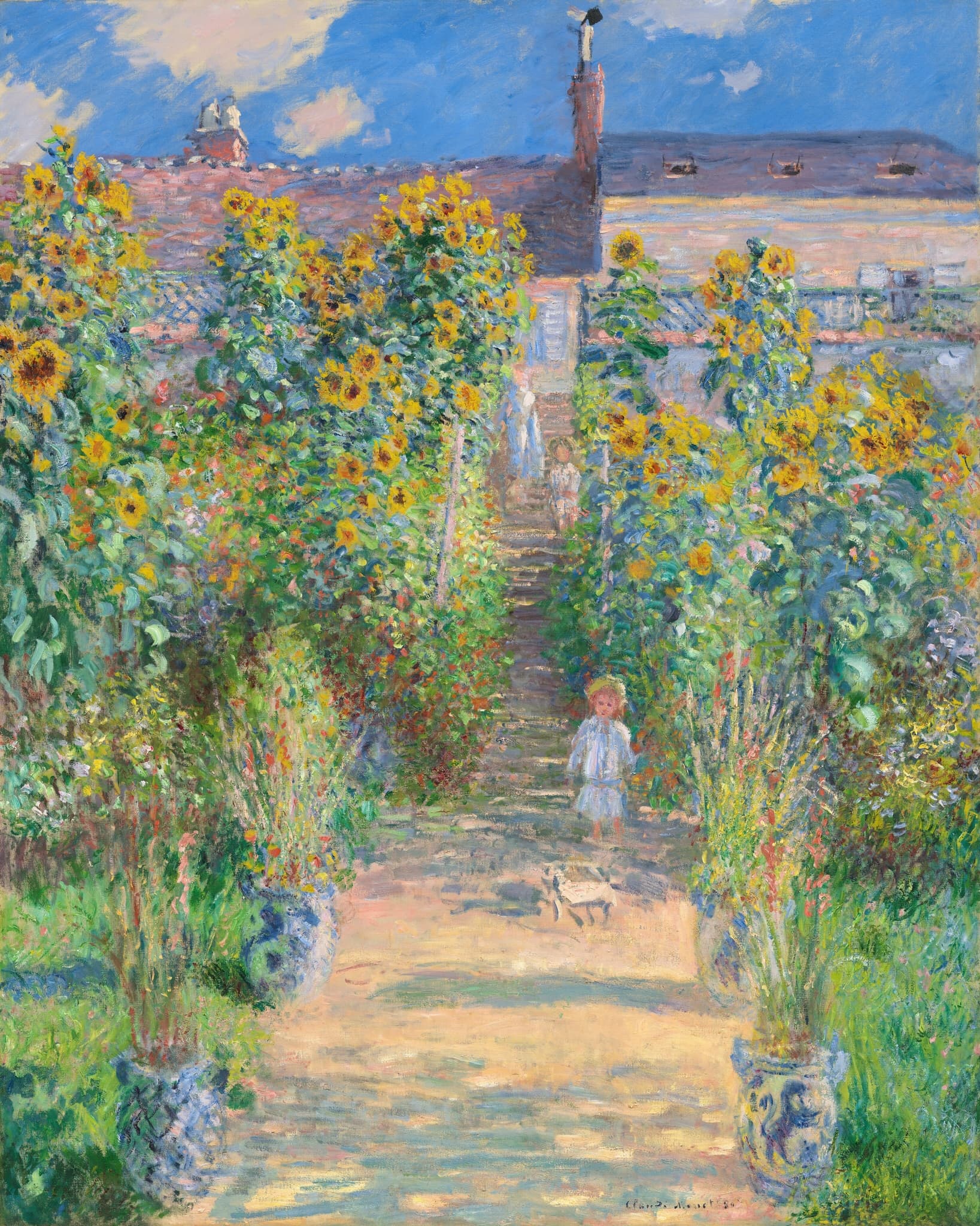
The Artist's Garden at Vétheuil
Claude Monet, 1881 • Oil on canvas
Read full analysis of The Artist's Garden at Vétheuil →Valuation Analysis
Conclusion: The Artist’s Garden at Vétheuil (1881) would command $65–85 million if offered today. The painting is the largest and most finished of Monet’s 1881 Vétheuil garden canvases, richly worked and frequently reproduced, and it resides in the National Gallery of Art—provenance and visibility that place it among the most desirable early garden/figure works by the artist [1].
Anchors and comps: Recent trophy‑level Monets establish the current price band for A‑plus examples. Christie’s sold a major Le bassin aux nymphéas (c. 1917–19) for $74.01 million in November 2023, while Sotheby’s placed another large Nymphéas at $65.5 million in November 2024—both clear, contemporary benchmarks for masterpiece‑caliber Monet pricing [2][3]. The iconic London series also confirms this ceiling: Le Parlement, soleil couchant realized $75.96 million in 2022 [4]. For a subject‑specific proxy, the closest market comp is Alice Hoschedé au jardin (1881), a related Vétheuil garden‑with‑figure motif sold for $33.7 million in 2014 (≈$46 million in 2025 dollars), albeit at a smaller scale and with less finished execution [5].
Positioning this work: The NGA canvas stands materially above the 2014 subject comp on scale, finish, and renown, and within shouting distance of the lower tier of recent Water Lilies and other serial icons. Its 151.5 × 121 cm format and studio completeness, combined with the intimate domestic garden imagery, make it a headline example of Monet’s Vétheuil period—an era increasingly prized for its balance of figuration, floral profusion, and high-key Impressionist touch [1].
Market dynamics: Monet remains an exceptionally liquid blue‑chip market, with multiple eight‑figure sales clearing in a selective 2023–2025 environment and broad bidder participation from the U.S., Europe, and Asia (the $65.5m Nymphéas was won by an Asian phone bidder) [3]. Against this backdrop, a museum‑caliber, widely published Vétheuil garden masterpiece would attract deep global demand.
Assumptions: This estimate assumes sound, unproblematic condition and full confirmation of provenance and literature. Under those typical trophy‑sale conditions, the work should transact in the $65–85 million range, with the upper bound justified by its scale, finish, and institutional stature; any material condition compromises would warrant downward adjustments, while peak-season offering with competitive guarantees could support the top of the range [1][2][3].
Key Valuation Factors
Art Historical Significance
High ImpactPainted during Monet’s pivotal Vétheuil period (1878–1883), this canvas synthesizes the domestic garden theme with figures from the artist’s household, capturing an intimate, biographically resonant subject at full Impressionist maturity. The 1881 Vétheuil garden group is recognized for its tapestry-like, high-key treatment of flowers and light, and this example is widely considered the culminating, studio-finished version among the related canvases. Its frequent reproduction, prominent exhibition history, and inclusion in a leading U.S. museum have cemented it as a landmark image for the period. Within Monet’s hierarchy, it sits just below serial icons (Haystacks, Parliament, Water Lilies) yet above typical landscapes of the era, giving it genuine ‘headline’ status in the early 1880s oeuvre.
Scale and Composition
High ImpactAt 151.5 × 121 cm (59 5/8 × 47 5/8 in.), the painting has commanding scale and a deliberately resolved finish. The structured central path flanked by dense floral passages and animated by household figures provides both optical richness and narrative appeal—elements that expand the buyer pool beyond strictly landscape collectors. Compared with the smaller 1881 Vétheuil variants, this canvas reads as the most ambitious and complete statement, with more developed paint handling and a compositional clarity that reproduces exceptionally well. Large, museum-ready Monets with compelling figure-and-garden interplay are rare in private hands, and the combination of size, finish, and subject matter directly supports valuation in the lower band of recent Monet trophy pricing.
Provenance and Visibility
High ImpactLong-term placement in the National Gallery of Art (Ailsa Mellon Bruce Collection) confers exceptional provenance and scholarly visibility. Works that have been anchor images in premier institutions tend to achieve a premium when market-accessible parallels appear, as they benefit from decades of publication, exhibition, and public familiarity. While the NGA picture is not for sale, its museum stature elevates perceived value for the composition relative to smaller or less documented variants. If an equivalent-quality canvas from the same 1881 group were to surface with similarly strong provenance and exhibition history, the institutional cachet and brand recognition of this image would materially influence bidder confidence and pricing power at the point of sale.
Market Liquidity and Demand
High ImpactMonet remains among the most liquid names in the global blue‑chip market. Multiple eight‑figure results since 2023—including $74.0m and $65.5m Water Lilies and $75.96m for a London Parliament—demonstrate a resilient, well-capitalized bidder base across regions. Demand is especially strong for large, highly finished canvases with iconic subject matter and best-in-class provenance. While the absolute price apex is reserved for the top serial subjects, masterworks from key periods with distinctive imagery (like Vétheuil gardens with figures) trade comfortably within the $40–$75m trophy band today, with additional upside for rarity and fame. This liquidity profile underwrites the $65–85m range assigned to this composition and scale.
Sale History
The Artist's Garden at Vétheuil has never been sold at public auction.
Claude Monet's Market
Claude Monet is a perennial market bellwether whose top works routinely achieve eight figures and whose auction record stands at $110.7 million for Meules (2019). The current trophy band for major Monets is defined by large Water Lilies and iconic series pictures: Christie’s sold Le bassin aux nymphéas for $74.01m in 2023, Sotheby’s placed another Nymphéas at $65.5m in 2024, and Christie’s set the series record for a London Parliament at $75.96m in 2022. Even outside those canonical series, prime subjects like Poplars have cleared in the low‑$40m range (Christie’s, 2025). Demand is deep and international, with significant participation from Asia and the U.S.; supply, not appetite, typically dictates price velocity at the very top end.
Comparable Sales
Alice Hoschedé au jardin
Claude Monet
Closest subject and date: Vétheuil garden with figure (1881). Same domestic garden theme and period; smaller scale and less 'studio-finished' than the NGA canvas.
$33.7M
2014, Sotheby's New York
~$46.2M adjusted
Le bassin aux nymphéas (c. 1917–19)
Claude Monet
Top-tier, large Water Lilies—benchmark for A+ Monet pricing. While later in date and different in subject, it matches the NGA work in ambition and museum caliber.
$74.0M
2023, Christie's New York
~$78.7M adjusted
Nymphéas (1914–17)
Claude Monet
Another marquee Water Lilies result establishing the current trophy band for Monet; helpful for anchoring the high end for museum-level works.
$65.5M
2024, Sotheby's New York
~$67.1M adjusted
Le Parlement, soleil couchant (1900–03)
Claude Monet
Iconic London series; record-setting example from a blue-chip subject. Comparable in scale, finish, and rarity of motif within Monet’s oeuvre.
$76.0M
2022, Christie's New York
~$84.5M adjusted
Waterloo Bridge, effet de brume
Claude Monet
From the same London campaign as the Parliament pictures but a step down in iconicity; shows robust liquidity for top-series Monets below peak tier.
$36.8M
2022, Christie's London
~$40.9M adjusted
Peupliers au bord de l’Epte, crépuscule (1891)
Claude Monet
Blue‑chip serial subject (Poplars), large and highly finished; demonstrates where prime but non‑trophy series currently clear in New York.
$43.0M
2025, Christie's New York
Current Market Trends
Impressionist and Post‑Impressionist auctions softened in 2024 as supply of nine‑figure trophies thinned and buyers became more selective; however, blue‑chip Modern masters with museum‑level provenance continued to find ready demand. By late 2025, marquee evening sales showed a selective rebound, with strong competition for high‑quality consignments. Within this context, Monet remains a standout for liquidity and cross‑regional appeal, and recent results in the $65–75m range for top examples reinforce pricing discipline near the apex. The net effect is a stable but supply‑sensitive market in which exceptional, large‑scale Monets can still command premium prices, especially when offered fresh and supported by robust pre‑sale strategies.
Sources
- National Gallery of Art – Collection page: The Artist’s Garden at Vétheuil
- Christie’s – 20th Century Evening Sale (Nov 9, 2023) press results
- Wall Street Journal – Monet Water Lilies sold for $65.5m (Nov 18, 2024)
- Christie’s – Anne H. Bass Collection results (May 12, 2022)
- Art Observed – Sotheby’s Impressionist & Modern Evening Sale recap (Nov 4, 2014)
- Art Basel & UBS – The Art Market report (Auctions section)
- Business Standard – Monet record: Meules sells for $110.7m (May 2019)
- Christie’s – Walk the Auction (May 2025) highlights