How Much Is The Beach at Sainte-Adresse Worth?
Last updated: January 24, 2026
Quick Facts
- Current Location
- The Art Institute of Chicago
- Methodology
- comparable analysis
Hypothetical fair-market value: $60–90 million for Monet’s The Beach at Sainte-Adresse (1867). This museum-held, landmark early canvas—paired in art history with the Met’s Regatta at Sainte-Adresse—commands a significant premium over typical 1860s beach scenes, yet prices below Monet’s most coveted late series works.
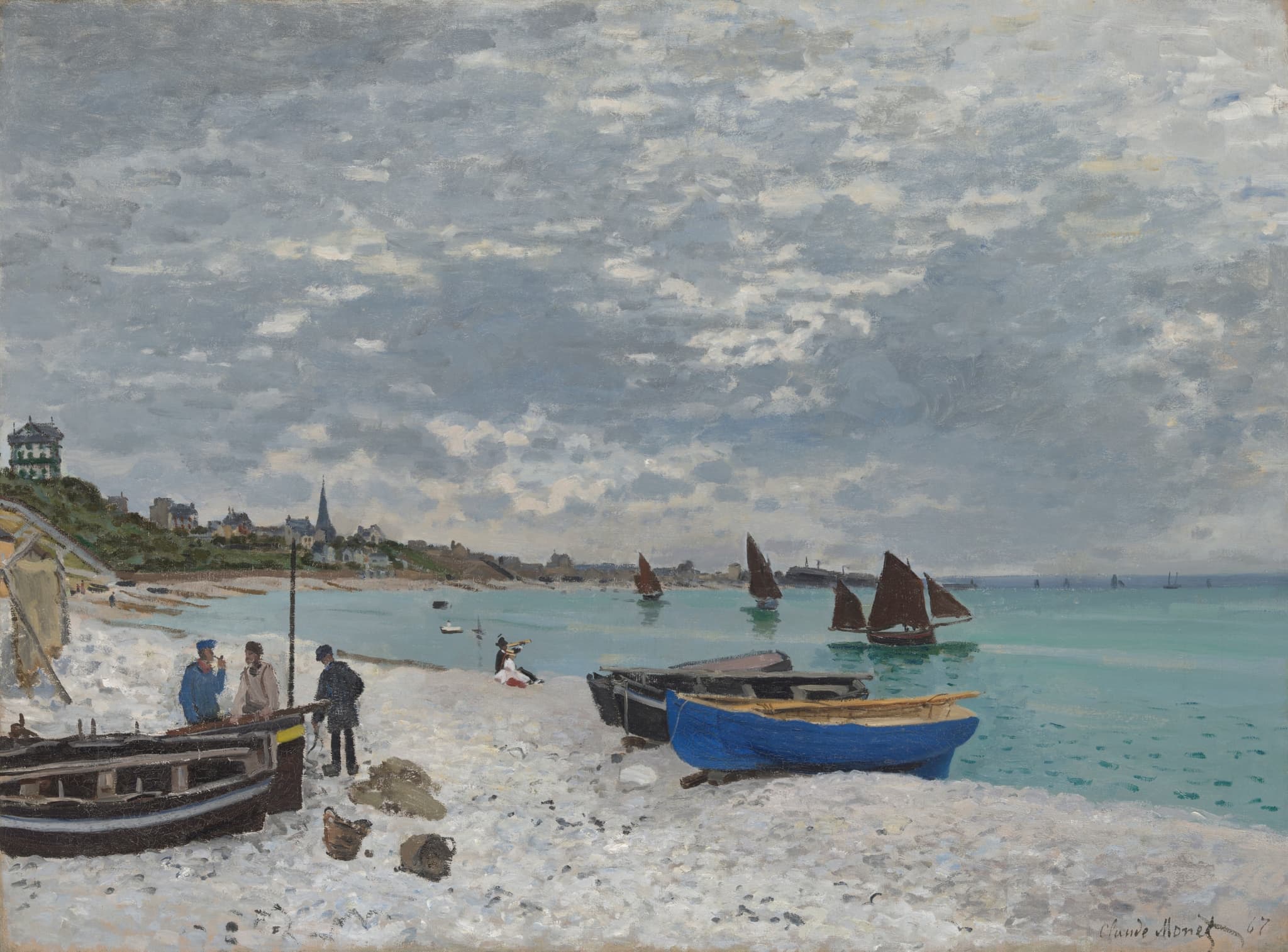
The Beach at Sainte-Adresse
Claude Monet, 1867 • Oil on canvas
Read full analysis of The Beach at Sainte-Adresse →Valuation Analysis
Conclusion: If Claude Monet’s The Beach at Sainte-Adresse (1867) were deaccessioned and offered in a prime New York evening sale with full market exposure and third‑party support, it would command $60–90 million. The painting is a cornerstone early Monet—large in scale, pivotal to the artist’s evolution, and paired in art‑historical discourse with The Metropolitan Museum of Art’s Regatta at Sainte‑Adresse—yet it sits outside the late serial masterpieces (Water Lilies, Parliament, Haystacks) that routinely anchor Monet’s top price tier [1][2].
Methodology (comparable analysis): We anchor the low end by referencing high‑quality early Normandy beach scenes, which have historically traded well below Monet’s late series. La Plage à Trouville (1870) realized £7.66m in 2008 (≈$15.1m at the time), and Sur les Planches de Trouville (1870) achieved £4.18m in 1997 (≈$6.8–7.0m then) [6][7]. The AIC Sainte‑Adresse is larger, earlier, compositionally canonical, and vastly more published—warranting a multiple of these benchmarks. We set the upper anchor off recent blue‑chip Monet results: Water Lilies have changed hands at $74.0m (2023) and $65.5m (2024) [4], while Meules à Giverny brought $34.8m (2024) and Parliament (sunset) made $75.96m (2022) [5][11]. Given market hierarchy, this Sainte‑Adresse should clear ordinary 1860s beach valuations by a wide margin but remain below the top late‑series tier, landing in the mid‑to‑upper eight figures.
Market context: Monet remains a deeply liquid, globally collected blue‑chip name with a standing auction record of $110.7m for Meules (2019) [3]. The Impressionist/Post‑Impressionist sector has contracted by value over 2023–2024 due to fewer trophy consignments, while lot volumes rose—signaling selectivity at the top but enduring demand for best‑in‑class works [8][9]. Even in this environment, major Monets continued to secure $45–74m outcomes, indicating resilient depth for top subjects [4][5][11].
Work-specific drivers: The Beach at Sainte‑Adresse is museum‑caliber, extensively cited, and tied to a canonical pair composition at the Met—attributes that collectors prize when competing for early‑period masterworks [1][2]. Its exhibition and literature pedigree (including 19th‑century ownership by Jean‑Baptiste Faure and early publication history) further strengthens confidence and price tension [10]. Scale, subject clarity, and the painting’s role on Monet’s road to Impressionism make it one of the most desirable 1860s Monets remaining hypothetically contestable.
Positioning: On the evidence of early‑period comps and the current pricing spine for major Monets, $60–90 million is the correct, market‑facing band. In a marquee sale with a robust guarantee and pristine condition reporting, competition would support the upper half of this range; the work’s period and subject keep it just below the very top “series” echelon set by late Water Lilies, Parliament, and Haystacks [4][5][11].
Key Valuation Factors
Art Historical Significance
High ImpactPainted in 1867, The Beach at Sainte-Adresse is a landmark early Monet that crystallizes the artist’s turn toward modern light, color, and leisure subjects. It is discussed as a pair with the Metropolitan Museum’s Regatta at Sainte-Adresse—two near‑twin canvases conceived in dialogue—making this work central to narratives about Monet’s pre‑Impressionist breakthrough. The painting is heavily published and exhibited within Monet scholarship and is a staple of teaching on the origins of Impressionism. Its canonical status, scale, and visibility underpin a valuation premium over typical 1860s beach scenes and position it as one of the most important early Monets hypothetically available to compete for at auction [1][2].
Rarity and Scarcity in Private Hands
High ImpactMuseum retention of prime early Monets and the concentration of the Sainte‑Adresse subject in institutions (AIC and Met) mean that opportunities to acquire works of this caliber from the 1860s are exceptionally rare. Historical auction benchmarks for related Trouville beach scenes (1997, 2008) are materially lower both because those works are smaller and because they lack the specific canonical pairing and scholarly weight of the Sainte‑Adresse composition. Scarcity of like‑for‑like private-market alternatives acts as a strong upward force on price formation when a work of this stature is hypothetically released [6][7].
Scale, Composition, and Quality
High ImpactAt roughly 76 × 102.5 cm, the canvas has a commanding yet domestic scale that aligns with trophy‑level collector preferences. The crisp coastal panorama, flags, and modern leisure motif embody the visual vocabulary that propelled Monet’s ascent. The composition’s balance and legibility deliver strong wall power comparable to larger late works, even as the period differs. While any real-world sale would be condition‑sensitive, the work’s pictorial quality and size are inherently price‑positive attributes. In sum, the painting’s visual impact supports positioning it far above modest early coastal scenes and into the upper tier of early-period valuations [1][2].
Comparable Market Benchmarks
High ImpactRecent blue‑chip Monets demonstrate continued depth: Water Lilies achieved $74.0m (2023) and $65.5m (2024), Poplars $42.96m (2025), Meules à Giverny $34.8m (2024), and Parliament (sunset) $75.96m (2022). Early Normandy beach scenes—though not as iconic—have long been desirable, with top examples trading in the mid‑seven to low‑eight figures in prior cycles. Against this spine, the Sainte‑Adresse beach view prices above ordinary 1860s coastal works and just below late series icons, supporting a $60–90m band in today’s selective but trophy‑friendly market [4][5][11][6][7].
Provenance, Exhibition, and Literature
Medium ImpactDocumented early transactions through Durand‑Ruel, ownership by the eminent collector Jean‑Baptiste Faure, appearance in the Henri Véver sale, and bequest to the Art Institute of Chicago create a clean, prestigious provenance. The painting’s extensive scholarly literature and exhibition record (including its 19th‑century reception and later institutional displays) bolster confidence and salability. Such documentation typically compresses risk and can tighten bidding increments at the top end. These factors materially reinforce the estimate, even if they do not on their own elevate it into the late‑series price bracket [1][10].
Sale History
Galerie Georges Petit (Paris), Henri Véver sale, lot 79
Hammer 9,000 FRF; ≈$1,737 at contemporaneous gold-parity USD. Public auction. Nominal 1897 dollars [10].
Durand-Ruel, Paris
Jean-Baptiste Faure to Durand-Ruel at 7,000 FRF; ≈$1,351 at gold-parity USD. Dealer/private transaction. Nominal 1893 dollars [10].
Durand-Ruel, Paris
Artist to dealer at 400 FRF; ≈$77 at gold-parity USD. Dealer/private transaction. Nominal 1873 dollars [10].
Durand-Ruel & Bernheim-Jeune, Paris (joint purchase from Georges Kohn)
40,000 FRF; ≈$2,816 at 1920 exchange. Private transaction. Nominal 1920 dollars [10].
Claude Monet's Market
Claude Monet is one of the most liquid and enduring blue‑chip artists in the global market. His auction record stands at $110.7 million for Meules (Sotheby’s, 2019), the highest price for any Impressionist work at auction. Large Water Lilies canvases remain the strongest performers, achieving $74.0m (2023) and $65.5m (2024). Core series such as Parliament, Haystacks, and Poplars have traded between the mid‑thirties and mid‑seventies in recent marquee seasons. Demand is broad and international, with recurring institutional support and deep private competition. While overall Modern/Impressionist sales volumes have moderated, best‑in‑class Monets continue to anchor evening sales and attract third‑party guarantees and cross‑border bidding [3][4][5][11].
Comparable Sales
La Plage à Trouville (Beach at Trouville)
Claude Monet
Direct subject/period comp: early Normandy beach scene (1870), close to the 1867 Sainte-Adresse views. Smaller and later than the AIC canvas but very similar iconography and market segment.
$15.1M
2008, Sotheby's London
~$22.7M adjusted
Sur les Planches de Trouville (On the Boardwalk at Trouville)
Claude Monet
Direct subject/period comp: 1870 Trouville beach/resort scene with promenaders; same early Normandy theme. Smaller scale and less historically pivotal than the 1867 Sainte-Adresse pairing.
$6.9M
1997, Christie's London
~$13.9M adjusted
Nymphéas (Water Lilies), 1914–17
Claude Monet
Blue‑chip Monet series benchmark sold in 2024; sets an upper‑bound reference for market depth on top‑tier Monets even in a selective environment.
$65.5M
2024, Sotheby's New York
~$67.5M adjusted
Meules à Giverny (Haystacks), 1893
Claude Monet
Prime series benchmark from 2024; while a different subject and later period, it calibrates current bidding appetite for first‑rank Monets below Water Lilies.
$34.8M
2024, Sotheby's New York
~$35.9M adjusted
Peupliers au bord de l’Epte, crépuscule (Poplars), 1891
Claude Monet
Recent top‑series result (Poplars) showing what strong but non‑lily series are achieving; useful as a mid‑to‑upper anchor for Monet’s blue‑chip tier.
$43.0M
2025, Christie's New York
Le Parlement, soleil couchant (Houses of Parliament, Sunset), 1900–03
Claude Monet
Top‑tier series benchmark (London series) from 2022; indicates the upper range for iconic Monets in recent years.
$76.0M
2022, Christie's New York
~$84.3M adjusted
Current Market Trends
Impressionist/Post‑Impressionist auctions contracted by value in 2023–2024 amid fewer $10m+ consignments, even as lot volumes rose—signaling buyer selectivity and a pivot toward mid‑market liquidity. November 2024–2025 seasons showed thinner guarantees and cautious bidding, but standout, well‑positioned trophies continued to elicit strong competition. Within this climate, blue‑chip Monets have remained resilient relative to the broader Modern segment, especially late Water Lilies and core series subjects. Consequently, an early but canonical Monet of museum caliber would still command aggressive bidding, albeit with price discipline shaped by today’s more selective, guarantee‑driven sale dynamics [8][9][4].
Sources
- Art Institute of Chicago – The Beach at Sainte-Adresse (object record)
- The Metropolitan Museum of Art – Regatta at Sainte-Adresse
- Sotheby’s – Monet’s Meules Sells for $110.7m, New Artist Record
- Artnet News – Sotheby’s Modern Evening: Monet Nymphéas sells for $65.5m (Nov 2024)
- Barron’s – Sotheby’s Modern Evening Auction Collects $235m; Monet top lot (May 2024)
- Evening Standard – Sotheby’s London sale tops £100m; Monet beach scene £7.66m (2008)
- The Independent – Monet beach scene fetches £3.8m (1997)
- Art Basel & UBS – The Art Market 2024: Auctions
- The Art Newspaper – November sales: fewer top lots, selective bidding (Jan 2025)
- Art Institute of Chicago – Monet Paintings & Drawings catalogue (provenance with FRF prices)
- The Value – Christie’s NY (Anne Bass Collection): Parliament sells for $75.96m (2022)