How Much Is The Cliff, Etretat Worth?
Last updated: January 31, 2026
Quick Facts
- Insurance Value
- $30.0M (Analyst estimate based on comparable analysis and institutional norms)
- Methodology
- comparable analysis
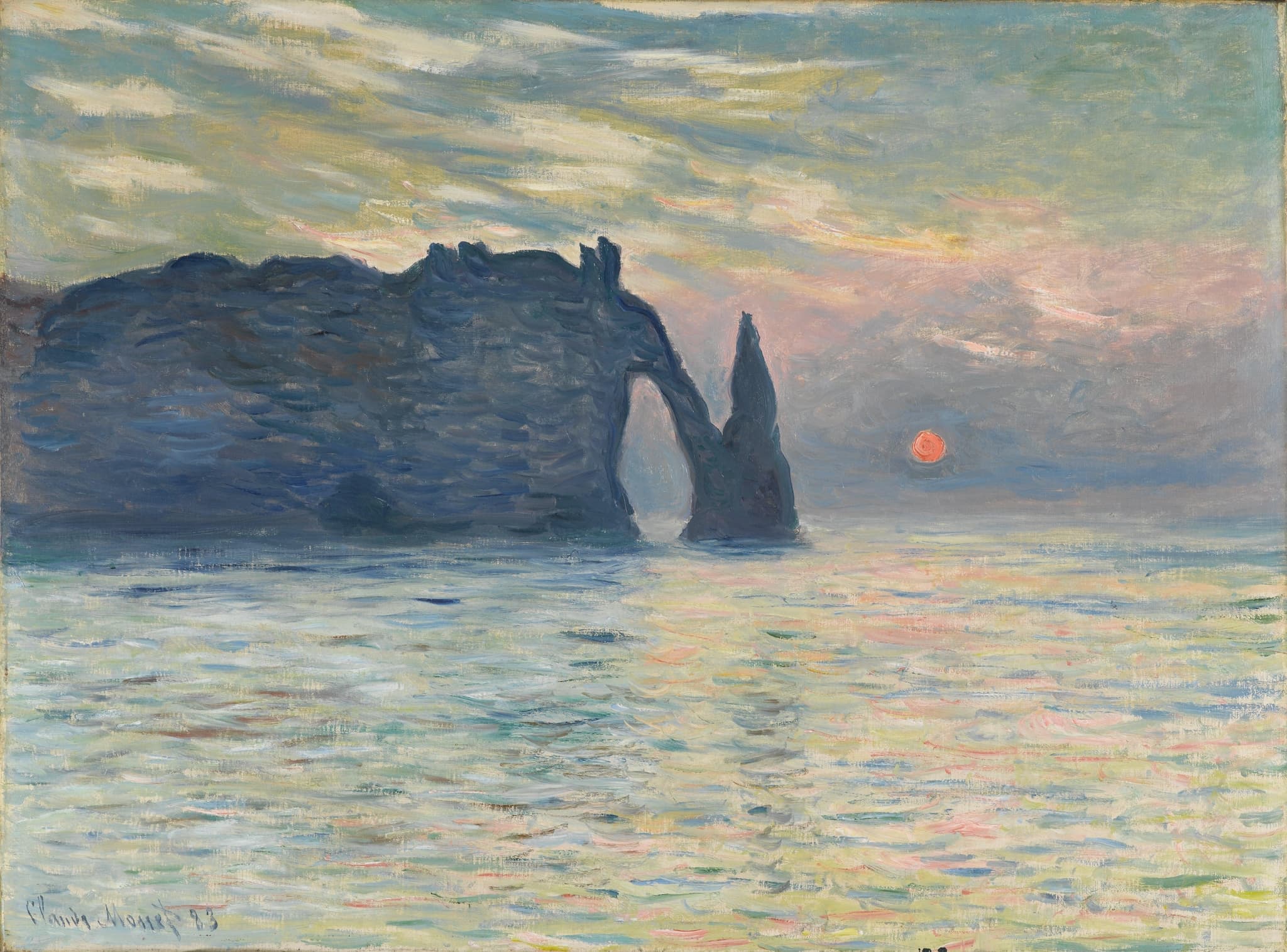
Based on direct comparables for Monet’s Normandy coastal series and current demand for prime 1880s paintings, The Cliff, Étretat, Sunset (1882–83; 60.5 × 81.8 cm, NCMA) is valued at $12–20 million. The dramatic sunset motif, Durand‑Ruel provenance, and museum‑level stature support pricing well above routine cliff scenes yet below Monet’s top series (Nymphéas, Poplars, London views).
Valuation Analysis
Work and context. The Cliff, Étretat, Sunset (1882–83; 60.5 × 81.8 cm) is a mid‑size, prime‑period oil from Monet’s celebrated Normandy campaigns, held by the North Carolina Museum of Art and acquired in 1967 after a succession of noted owners and sales dating back to Durand‑Ruel in 1883 [1]. Monet’s market is among the deepest in blue‑chip art, anchored by the $110.7 million record for Meules (Haystacks) at Sotheby’s in 2019 [2] and reinforced by recent marquee outcomes for late Nymphéas and other prime series [3][4][5].
Comparable analysis and range. Direct cliff/coastal comparables of similar date/scale show a clear band for non‑trophy examples: La Falaise d’Amont (Étretat) made $3.615 million at Sotheby’s in 2018 [6], and the closely related Normandy cliff subject Falaise des Petites‑Dalles, 1881, realized $3.25 million at Christie’s in 2025 [7]. By contrast, high‑caliber late‑1880s Monet landscapes of comparable size with stronger subject prestige (e.g., The Mill at Limetz, ex‑Nelson‑Atkins) have achieved $21.69 million (Sotheby’s, 2024) [8]. Monet’s top‑tier series continue to transact between roughly $35–75+ million (Poplars at $42.96m in 2025; late Nymphéas at $74.0m in 2023) [3][5], establishing a ceiling far above coastal works. Positioning this canvas within that spectrum—prime 1882–83 date, sought‑after Étretat motif, and the added desirability of a sunset effect—supports a confident $12–20 million market range.
Why this premium vs. typical cliff scenes. Within the Étretat group, value is highly sensitive to pictorial drama (light/weather effects, surf, and inclusion of signature formations), size, period, and provenance. The NCMA painting’s sunset effect and prime‑period date justify a material premium over generic cliff views that dominate the sub‑$5 million cohort, while its mid‑size format and subject hierarchy place it below late Water Lilies, Poplars, and London views, which command the highest Monet prices [3][4][5][6][7]. The Durand‑Ruel provenance and long museum stewardship further enhance confidence and salability [1].
Market setting. The top end of the auction market has been selective since 2023–2024, but high‑quality, historically central works by Monet continue to clear with depth, with strong private‑sale support and guarantees for best‑in‑class examples [3][4][5][8]. Broader auction values above $10 million contracted in recent seasons, emphasizing quality, subject, and condition as decisive drivers [8]. Against this backdrop, a museum‑level Étretat sunset firmly merits the $12–20 million range; insurance indications are typically set higher for institutional risk management.
Key Valuation Factors
Art Historical Significance
High ImpactÉtretat is among Monet’s most pivotal early‑1880s campaigns, marking his pursuit of serial motifs and changing atmospheres that culminate in the great series of the 1890s and beyond. A sunset effect heightens the perceptual stakes—color temperature shifts, low‑angle light, and the interplay of sea and sky—turning a coastal view into a study of optical phenomena. While the late Nymphéas, Poplars, and London views dominate the very top of Monet’s market, strong Étretat canvases remain highly desirable as they anticipate the serial rigor of his mature masterpieces. The work’s placement in a museum collection underscores its scholarly and cultural weight, and its Durand‑Ruel connection ties it directly to the dealer who shaped Monet’s international reputation.
Subject and Composition Quality
High ImpactWithin the Étretat corpus, value is most sensitive to the presence of signature landforms (arches/needles), dramatic surf, and distinctive light effects. A sunset palette introduces expressive chromatic contrasts and atmospheric depth that collectors prize for wall power and for dialogue with modern and contemporary abstraction. Works with richer skies, dynamic water, and crisply articulated cliff silhouettes command premiums over flatter midday views. The title’s explicit sunset emphasis signals a more dramatic variant of the motif—positioning this canvas well above routine cliff scenes and in a tier where competition from both Impressionist specialists and broader modern collections is strongest.
Provenance and Collection Standing
Medium ImpactA chain that runs Monet → Durand‑Ruel → major American ownership, followed by multiple early 20th‑century auctions and, ultimately, acquisition by the North Carolina Museum of Art confers robust legitimacy and visibility. Durand‑Ruel provenance is a positive market signal, and museum custody often implies careful conservation and broad scholarly exposure. While museums rarely deaccession, the institutional context enhances perceived quality and can contribute to competitive bidding or private‑sale confidence if the work were hypothetically offered. The absence of a recent public price does not diminish value; instead, it highlights its long‑term institutional status and rarity in the marketplace.
Market Positioning and Liquidity
Medium ImpactMonet is a durable, globally distributed market with deep collector pools in the U.S., Europe, and Asia. Recent sales confirm continued appetite for best‑in‑class works across his series spectrum, with late Nymphéas, Poplars, and London views establishing upper benchmarks and 1880s landscapes providing mid‑ to high‑eight‑figure anchors. Within this framework, a prime‑period Étretat with a dramatic light effect sits between commodity coastal views and marquee series trophies—liquid, financeable, and suitable for guarantees in a balanced sale. Current selectivity favors works with strong subject hierarchies; this painting’s sunset motif and provenance profile match that buyer preference.
Sale History
Durand‑Ruel, Paris (acquired from Monet; sold to William H. Fuller by 1899)
Dealer acquisition/sale; price not published on public records cited
American Art Association, New York (William H. Fuller sale), lot 148
Public auction; priced result not located in open sources
American Art Association, Plaza Hotel, New York (Reisinger sale), lot 73
Public auction; priced result not located in open sources
Parke‑Bernet Galleries, New York, lot 69
Public auction; price not found in open sources; check priced catalogues
Marlborough‑Gerson Gallery, New York (sold to North Carolina Museum of Art)
Gallery sale; NCMA accession 1967 (object no. 67.24.1); price not public
Claude Monet's Market
Claude Monet remains a cornerstone of the blue‑chip market, combining art‑historical primacy with broad global demand. His auction record stands at $110.7 million for Meules (Haystacks) at Sotheby’s in 2019, the benchmark for any Impressionist work. Since 2023, Monet has led multiple marquee auctions, including a late Nymphéas at $74.0 million (Christie’s, 2023) and a Poplars at $42.96 million (Christie’s, 2025). Additional results in the $30–45 million range for key series (Waterloo Bridge, Poplars, Nymphéas) underscore depth and consistency. While pricing is most elevated for late, large-scale works, strong early‑ to mid‑career paintings with distinctive light effects and selective series prestige continue to command robust competition in both public and private channels.
Comparable Sales
La Falaise d’Amont (Étretat)
Claude Monet
Same artist; Étretat cliff motif; early 1880s; oil; mid-size (slightly smaller) — closest subject/period match to NCMA canvas.
$3.6M
2018, Sotheby's New York
~$4.5M adjusted
Falaise des Petites-Dalles
Claude Monet
Same artist; closely related Normandy cliff subject (Petites-Dalles), 1881; similar size to NCMA canvas; strong direct landscape/cliff comp.
$3.3M
2025, Christie's New York
Le Moulin à Limetz (The Mill at Limetz)
Claude Monet
Same artist; late‑1880s, mid-size oil; strong benchmark for high-quality 1880s Monet landscape (not cliffs) — useful market anchor for period/scale.
$21.7M
2024, Sotheby's New York
~$22.3M adjusted
Peupliers au bord de l’Epte, crépuscule
Claude Monet
Same artist; 1891 Poplars series (prime, highly sought), broadly comparable size and late-1880s/early-1890s importance — sets upper-tier Monet benchmark.
$43.0M
2025, Christie's New York
Waterloo Bridge, effet de brume
Claude Monet
Same artist; iconic London series; similar scale prestige but different subject — serves as a top-of-market yardstick for Monet’s most coveted series.
$36.8M
2022, Christie's London
~$40.5M adjusted
Current Market Trends
The top end of the auction market has been selective since 2023, with fewer ultra‑trophy consignments and a measurable contraction in >$10m transactions. Nevertheless, blue‑chip Impressionism remains active: best‑in‑class Monets continue to draw guarantees and strong private interest, while mid‑tier works trade reliably when subject, scale, and condition align. As supply normalizes, bidding has polarized toward culturally central series, clear provenance, and visually compelling compositions. In this environment, prime 1880s Monet landscapes—especially those with dramatic light effects—are well positioned, sitting below record‑level late works but commanding meaningful premiums over routine examples in the category.
Sources
- North Carolina Museum of Art – Collection entry
- Sotheby’s – Monet’s Meules sells for $110.7m (artist record)
- Christie’s Press – 20th Century Evening Sale totals; Monet at $74.01m
- Barron’s – Sotheby’s Modern Evening Auction (Monet $34.8m)
- HENI News – Poplars sells for $42.96m (Christie’s, 2025)
- Sotheby’s – La Falaise d’Amont (Étretat), $3.615m (2018)
- HENI News – Falaise des Petites‑Dalles, $3.25m (2025)
- Art Basel & UBS – The Art Market Report 2025 (Auctions)