How Much Is The Gare Saint-Lazare: Arrival of a Train Worth?
Last updated: February 2, 2026
Quick Facts
- Methodology
- comparable analysis
A blue-chip, museum-grade Monet from the pivotal 1877 Gare Saint-Lazare cycle, Harvard’s canvas is the largest of the twelve and was shown at the Third Impressionist Exhibition. Anchored by direct series comparables (~$33m for exterior variants in 2018) and recent apex Monet benchmarks ($65m–$76m), the fair-market value today is $80–120 million.
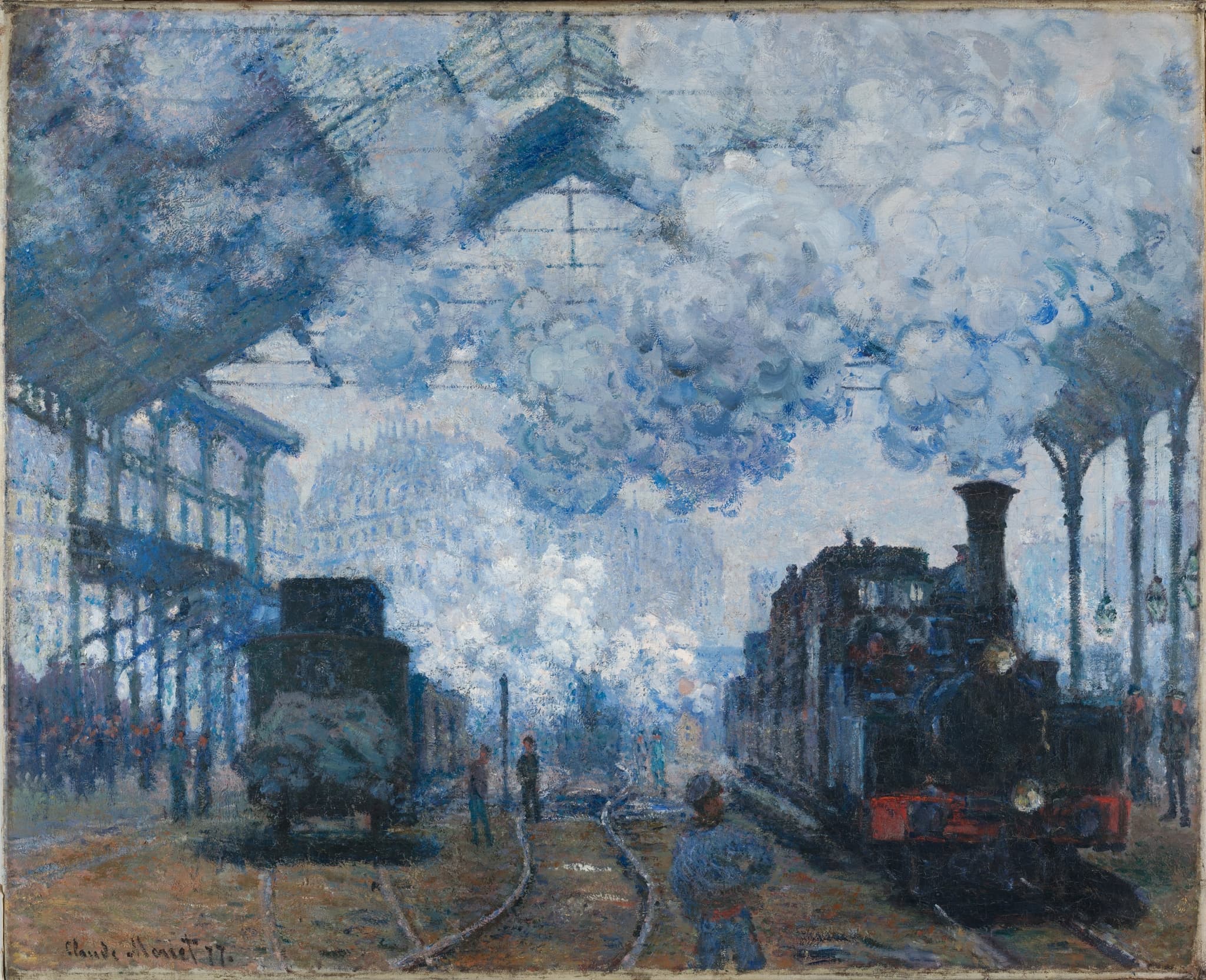
The Gare Saint-Lazare: Arrival of a Train
Claude Monet, 1877 • Oil on canvas
Read full analysis of The Gare Saint-Lazare: Arrival of a Train →Valuation Analysis
Conclusion: We value Claude Monet’s The Gare Saint-Lazare: Arrival of a Train at $80–120 million. This is a top-tier, museum-grade picture from Monet’s landmark 1877 Paris series, identified by Harvard as the largest of the twelve and documented as having been exhibited at the Third Impressionist Exhibition—attributes that materially elevate scarcity, art-historical weight, and commercial appeal [1].
Series comparables and scarcity: The strongest direct market anchors are the two exterior Saint-Lazare canvases that sold at Christie’s in 2018 at approximately $33 million each (prices with premium). Both were smaller outside views; by contrast, Harvard’s painting is a steam-filled interior under the iron-and-glass shed—a rarer and more coveted subject within the cycle [2][3]. Interior station views from 1877 are concentrated in major museums and almost never reach the market, so the 2018 exterior results establish a pricing floor rather than a ceiling for a prime interior.
Broader Monet benchmarks: Monet’s auction record remains $110.7 million for Meules (2019), defining the artist’s modern ceiling [4]. In the current cycle, top works across Monet’s apex series have repeatedly achieved $65–$76 million, including a large Water Lilies at $74.0 million (2023) and a Nymphéas at $65.5 million (2024), while the Houses of Parliament series reached $75.96 million in 2022—evidence of deep, global demand for A-level subjects with scale and prestige [5][6]. Against these benchmarks, a prime Saint-Lazare interior—arguably on par in importance with Monet’s great urban and serial masterpieces—supports a valuation advancing meaningfully beyond the $60–70 million band.
Derivation of the $80–120 million range: We step up from the ~$33 million exterior results to reflect (1) the superior desirability and rarity of the interior shed compositions, (2) the exceptional scale—largest in the cycle—(3) the 1877 exhibition pedigree, and (4) Harvard’s long, blue-chip provenance, all of which command premiums versus standard series examples [1][2][3]. At the same time, we position the estimate below Monet’s $110.7 million record to acknowledge the current, selective (but strong) trophy market. In a well-marketed sale with strong condition and museum-level presentation, competitive bidding could plausibly test the upper end of this band.
Positioning: Within Monet’s oeuvre, this painting sits at the intersection of modern-life subject, serial ambition, and technical innovation—precisely the attributes that drive nine-figure interest. Its scale, visibility, and rarity would make it a marquee lot in any season, bridging the price continuum between today’s $65–$76 million apex results and Monet’s record. On balance, $80–120 million best reflects its fair-market value today [1][4][5][6].
Key Valuation Factors
Art Historical Significance
High ImpactPainted and exhibited in 1877, this canvas anchors Monet’s seminal Gare Saint-Lazare cycle—an audacious engagement with modern Paris, steam, and transient light that helped define Impressionism’s dialogue with the industrial age. Harvard documents that this is the largest of the twelve and that it was shown at the Third Impressionist Exhibition, giving it first-rank scholarly and exhibition pedigree. Within Monet’s 1870s output, the steam-filled station interiors are considered the most innovative and visually dramatic variants, with the series long recognized in major retrospectives and literature. Works of this caliber sit beside Haystacks, Rouen Cathedral, Water Lilies, and the London series as apex categories, supporting trophy pricing and exceptional institutional and private demand.
Rarity and Market Supply
High ImpactInterior Saint-Lazare compositions of this quality are almost entirely in museum collections (e.g., Musée d’Orsay, National Gallery London, Art Institute of Chicago, Harvard), and very few comparable examples have come to auction in recent decades. The two most recent public tests (both exterior views) realized about $33 million each in 2018, establishing a strong baseline but not capturing the scarcity premium for an interior shed view. Because true supply of comparable interior canvases is effectively nil, competitive tension among top collectors would likely be intense if one surfaced, magnifying the rarity premium. This structural scarcity is a primary driver of the step-up to an $80–120 million valuation.
Scale and Composition
High ImpactAt approximately 83 × 101.3 cm, Harvard’s canvas is the largest in the Saint-Lazare cycle, a tangible value driver at the top of the market where scale correlates strongly with impact and price. The enveloping, steam-laden interior under the iron-and-glass canopy is among the most theatrically modern images Monet produced in the 1870s. This format offers superior wall power compared with the smaller exterior variants that have sold, and the composition’s complexity—locomotive, canopy architecture, diffused steam and light—encapsulates the series’ central thesis. In market terms, large, iconic compositions consistently command significant premiums over smaller, less immersive views.
Provenance and Exhibition History
High ImpactThe painting’s chain of ownership—early collectors such as Ernest Hoschedé and Charles Deudon, leading dealers (Paul Rosenberg, Wildenstein), and the respected American collector Maurice Wertheim—culminates in its long tenure at the Harvard Art Museums. Harvard further records the work’s inclusion in the 1877 Impressionist exhibition, the definitive debut for the series. Such transparent, blue-chip provenance and exhibition pedigree minimize transactional friction, enhance buyer confidence, and often translate into a pricing premium at the very top end. In any marquee sale, this provenance would resonate with both institutions and private collectors seeking best-of-category works.
Sale History
The Gare Saint-Lazare: Arrival of a Train has never been sold at public auction.
Claude Monet's Market
Claude Monet is a cornerstone of the global blue-chip market with exceptionally deep demand across regions. His auction record stands at $110.7 million for Meules (2019), while multiple apex-series works have realized $65–$76 million since 2021, including major Water Lilies and London pictures. Liquidity is robust from mid-market works through to trophies, with consistent bidding from U.S., European, and Asian collectors. Series identity, scale, condition, and provenance are the principal determinants of outlier pricing. In this context, top-tier, iconic subjects—Haystacks, Nymphéas, London, Rouen, and prime Saint-Lazare—attract the broadest competition and can command eight- to nine-figure prices when presented with museum-level scholarship and marketing.
Comparable Sales
Extérieur de la gare Saint-Lazare, effet de soleil (Rockefeller Collection)
Claude Monet
Direct series comparable: 1877 Gare Saint-Lazare, exterior variant; smaller format than Harvard’s interior (60.4 × 80.2 cm vs 83 × 101.3 cm); one of two recent market tests for the series.
$32.9M
2018, Christie's New York
~$41.8M adjusted
Extérieur de la gare Saint-Lazare, effet de soleil (Bass Collection)
Claude Monet
Direct series comparable: 1877 Gare Saint-Lazare, exterior view; closely related subject and date; smaller than Harvard work; establishes recent pricing floor for Saint‑Lazare canvases.
$32.8M
2018, Christie's London
~$41.7M adjusted
Le Parlement, soleil couchant
Claude Monet
Apex series benchmark from Monet’s iconic cityscape cycles; signals top‑tier Monet demand in the current cycle and provides an upper‑tier pricing analogue.
$76.0M
2022, Christie's New York
~$82.8M adjusted
Le bassin aux nymphéas (c. 1917–19)
Claude Monet
Top Water Lilies result from 2023; a blue‑chip Monet series used to gauge trophy‑level pricing for works of comparable stature and market depth.
$74.0M
2023, Christie's New York
~$77.7M adjusted
Nymphéas (1914–17)
Claude Monet
Recent marquee Monet sale (late 2024) demonstrating current appetite and pricing range for premier series paintings in a moderated but active market.
$65.5M
2024, Sotheby's New York
~$66.8M adjusted
Waterloo Bridge, effet de brouillard
Claude Monet
Apex London series benchmark from 2021; helps bracket pricing for iconic Monet urban/industrial subjects with deep global demand.
$48.5M
2021, Christie's New York
~$57.2M adjusted
Current Market Trends
The Impressionist and Modern segment has been selective but sturdy at the top, with fewer nine-figure trophies on offer but strong outcomes for best-of-category material. Monet’s recent marquee results have clustered between roughly $65 million and $76 million, while his 2019 record defines the upper bound. In 2023–2025, guarantees and pre-sale placement have supported sell-throughs, and demand remains global, notably with renewed energy from Asia on blue-chip names. In this environment, rarity and narrative matter: a prime, exhibition-pedigreed series work can break above the prevailing band, while secondary examples track estimates. Supply quality, not demand, is the primary constraint.
Sources
- Harvard Art Museums – Object: The Gare Saint-Lazare: Arrival of a Train
- Christie’s – The Collection of Peggy and David Rockefeller: Monet, Extérieur de la gare Saint-Lazare, effet de soleil (2018)
- The Value – Christie’s London 2018 Impressionist & Modern Evening Sale Results
- Sotheby’s – Monet’s Meules sells for $110.7 million (2019, artist record)
- Christie’s – Marquee Week New York Results, November 2023
- Sotheby’s – Fall 2024 Auction Results (Modern Evening Sale)