How Much Is The Japanese Bridge Worth?
Last updated: February 1, 2026
Quick Facts
- Current Location
- Musée Marmottan Monet
- Methodology
- comparable analysis
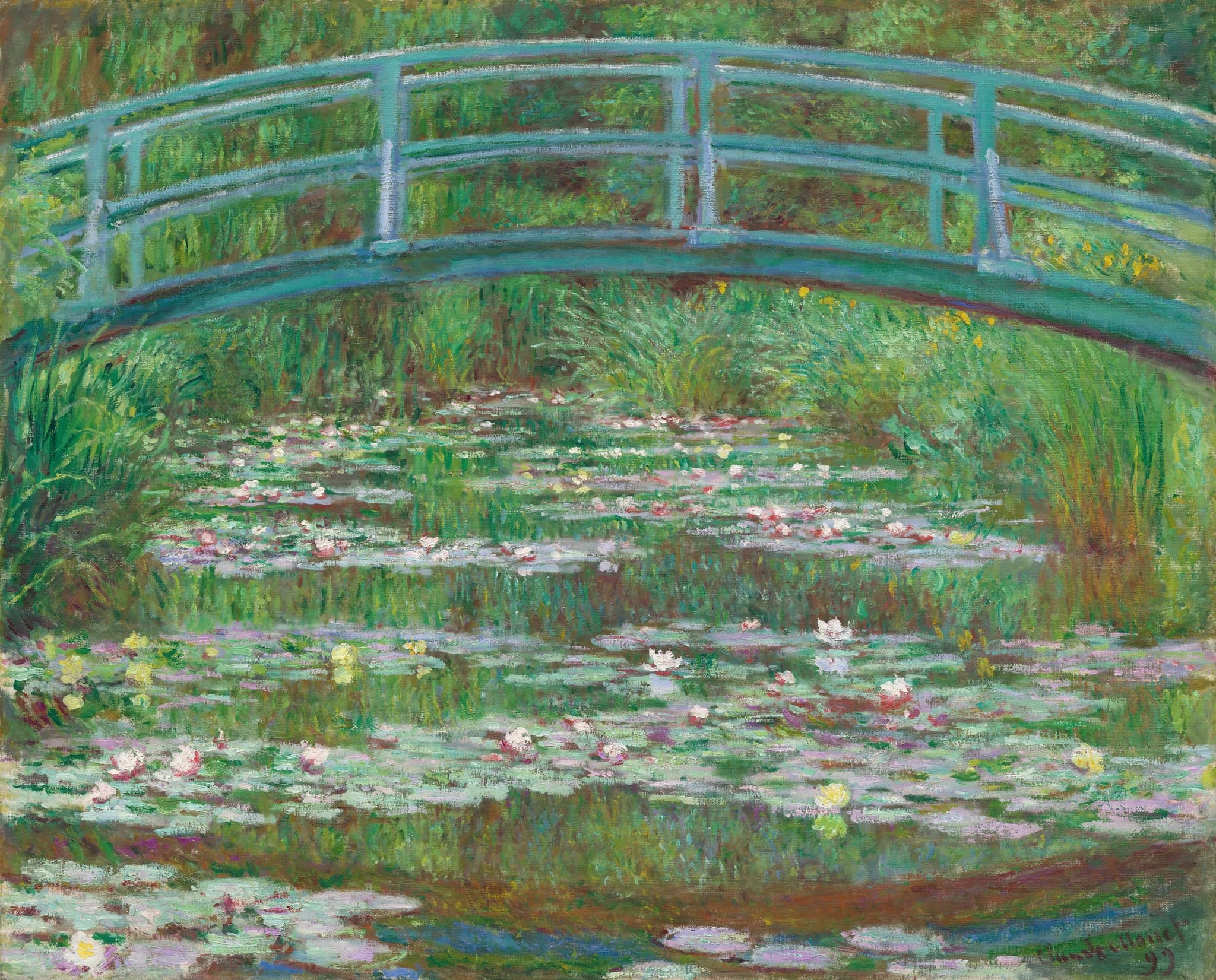
On a hypothetical open-market sale today, Claude Monet’s 1899 The Japanese Bridge at the National Gallery of Art would command $100–150 million. This estimate sits just below Monet’s $110.7 million auction record and is supported by recent $65–76 million results for top-tier Water Lilies and Houses of Parliament canvases, plus the extreme scarcity and canonical status of early Japanese Bridge works.
Valuation Analysis
Headline valuation: $100–150 million. Monet’s The Japanese Bridge (1899, National Gallery of Art) is a canonical, museum‑grade painting from the inaugural year of the water‑garden series. At 32 x 40 in., the format is market‑favored, and the image is among the most reproduced motifs in Impressionism. On a fully marketed sale with global competition, the work would justifiably achieve nine figures today.
Comparable analysis: Recent blue‑chip Monet trophies continue to transact at very high levels. A monumental Water Lilies realized $74.01 million at Christie’s in 2023, and another major lily sold for $65.5 million at Sotheby’s in 2024 [3][4]. Monet’s Houses of Parliament, a peer series in ambition and period, brought $75.96 million in 2022 [5]. These results calibrate where top works cluster. Monet’s auction record remains $110.7 million for Meules (Haystacks) in 2019, establishing the upper bound for the artist’s most coveted subjects [2]. Within the exact motif, an early Japanese Bridge made $33 million (1998), an anchor price that, inflation‑adjusted and quality‑adjusted, supports a substantially higher level for a prime 1899 example today; later, heavily worked bridge variants have traded at $12–16 million, underscoring the premium for the earliest, most harmonious compositions [6][7].
Subject hierarchy and scarcity: The 1899 bridge pictures mark the genesis of Monet’s Giverny pond cycle—the painter’s defining late project. Many of the finest 1899 bridges reside in institutions, sharply limiting supply. The National Gallery’s canvas is an emblematic, balanced composition with the arched span and reflective lily pond that epitomize Monet’s late vision, placing it at the apex of market desirability for the motif [1].
Provenance and institutional standing: The NGA painting was acquired by Durand‑Ruel directly from Monet in 1900, passed through the Carnegie Institute, the dealer Sam Salz, and Henry T. Mudd, and entered the National Gallery by gift (1992). This unassailable provenance and deep exhibition/literature history amplify confidence and value. Museum stewardship further signals quality and condition standards commensurate with trophy‑level expectations [1].
Positioning of the estimate: Given the recent $65–76 million band for prime series works, the artist’s $110.7 million record, and the scarcity premium attached to early Japanese Bridge canvases, a $100–150 million range is warranted. In optimal circumstances—outstanding color, pristine condition, and broad international bidding—the work could challenge record territory. The estimate reflects how this painting integrates art‑historical primacy, subject iconography, impeccable pedigree, and proven market depth for Monet trophies [2][3][4][5][6][7].
Key Valuation Factors
Art Historical Significance
High ImpactPainted in 1899, The Japanese Bridge inaugurates Monet’s water‑garden cycle at Giverny, a touchstone of late Impressionism and a cornerstone of the artist’s legacy. The bridge motif fuses architecture, water, and horticulture into a modern meditation on perception, and it underpins the vast Water Lilies enterprise that followed. This specific composition—with its arched span over the reflective lily pond—is one of the most widely reproduced images in art history. Works that launch a major series typically command a premium because they embody the breakthrough moment, and this canvas clearly occupies that role within Monet’s oeuvre, placing it on par with the artist’s most coveted themes such as Haystacks, Rouen, and the London views.
Subject Scarcity and Series Importance
High ImpactEarly Japanese Bridge paintings from 1899 are tightly held by museums and top collections, creating a severe supply shortage for the highest‑quality examples. Only a handful of closely dated bridges have surfaced publicly in the last few decades; many of the best are institutionalized, including the National Gallery of Art’s canvas. This scarcity compounds the motif’s centrality to Monet’s late project, where the bridge serves as the emblematic gateway to the Water Lilies. When a best‑of‑series work does appear, the confluence of iconic subject, immediate recognizability, and rarity induces aggressive bidding from global buyers, justifying a distinct scarcity premium relative to other strong, but less iconic, Monet subjects.
Provenance and Institutional Standing
High ImpactThe painting’s chain of ownership is exemplary: acquired from Monet by Durand‑Ruel, sold to the Carnegie Institute, then via dealer Sam Salz to Henry T. Mudd, and ultimately gifted to the National Gallery of Art. Such a pedigree reduces risk, enhances scholarly confidence, and is a meaningful value driver at the nine‑figure level. Long museum stewardship implies rigorous care, technical study, and exhibition history—attributes that play directly into valuation for trophies. Buyers place a measurable premium on works with transparent, published provenance and institutional validation; this canvas’s documented history and placement in a leading U.S. museum fortify its price potential and market positioning.
Market Benchmarks for Monet Trophies
High ImpactRecent marquee results show consistent depth for best‑in‑class Monets: a monumental Water Lilies at $74.01m (2023), another at $65.5m (2024), and a Houses of Parliament at $75.96m (2022). The artist’s record stands at $110.7m for Meules (2019). Within the exact motif, an early Japanese Bridge brought $33m in 1998, and later bridge versions have traded around $12–16m, illustrating the premium for early, harmoniously painted examples. Against this backdrop, an iconic, 1899 Japanese Bridge with museum‑level quality, scale, and provenance justifies nine figures. The $100–150m band situates the work near record territory while remaining grounded in observable, recent pricing for truly trophy Monets.
Sale History
The Japanese Bridge has never been sold at public auction. It has been held by Musée Marmottan Monet.
Claude Monet's Market
Claude Monet remains one of the most liquid and globally coveted artists in the auction market. His top series—Haystacks, Water Lilies, Rouen Cathedral, London views, Poplars, and Japanese Bridge—command sustained institutional and private demand. The artist’s auction record is $110.7 million for Meules (2019), with multiple major results between roughly $65 million and $76 million since 2022 for prime Water Lilies and Houses of Parliament canvases. Fresh-to-market, large-scale works with strong color and impeccable provenance are aggressively contested and often guaranteed. Even as broader market conditions have oscillated, Monet’s blue‑chip status has proved resilient, with deep participation from U.S., European, and Asian buyers and consistent performance for the most iconic subjects.
Comparable Sales
Japanese Bridge (1900)
Claude Monet
Direct subject match (Japanese Bridge), closely dated to the NGA’s 1899 canvas and similar scale; rare early bridge painting to appear at auction and an anchor for the motif.
$33.0M
1998, Sotheby's London
~$65.8M adjusted
Le pont japonais (1918–1924)
Claude Monet
Same subject (Japanese Bridge) from Monet’s late, heavily worked series; tests demand for the motif though from a later period than 1899.
$15.8M
2014, Sotheby's New York
~$21.7M adjusted
Le pont japonais (1918–1924)
Claude Monet
Same subject (Japanese Bridge); late series variant. Price noted at hammer level, still a useful marker for the motif’s lower band in recent years.
$12.0M
2019, Christie's New York
~$15.3M adjusted
Le bassin aux nymphéas (c.1917–1919)
Claude Monet
Monumental, trophy Water Lilies from Monet’s Giverny pond—core subject family to the Japanese Bridge; calibrates current top-tier pricing for prime late pond works.
$74.0M
2023, Christie's New York
~$78.7M adjusted
Le Parlement, soleil couchant (1900–1903)
Claude Monet
Another top-tier, iconic series of similar date and ambition; establishes what best-of-series Monets near 1900 can fetch in the current market.
$76.0M
2022, Christie's New York
~$84.4M adjusted
Meules (Haystacks) (1890)
Claude Monet
Artist’s auction record and benchmark for Monet trophies; while a different motif, it frames the upper bound for canonical subjects with stellar quality and provenance.
$110.7M
2019, Sotheby's New York
~$140.8M adjusted
Current Market Trends
The Impressionist/Post‑Impressionist segment cooled in 2023–2024 amid fewer $10m+ consignments, but marquee seasons in 2025 showed renewed strength when true trophies surfaced. Selectivity is elevated: buyers pay premiums for canonical subjects, scale, top condition, and pedigreed provenance, while mid‑tier works must be priced realistically. Cross‑border demand remains robust, with strong Asian participation at evening sales. Within this context, Monet is a safe‑harbor name; recent $65–76m results for major series pieces confirm stable depth near the top. An early, museum‑grade Japanese Bridge sits squarely in this high‑confidence tier, warranting a nine‑figure estimate supported by scarcity and art‑historical primacy.
Sources
- National Gallery of Art (NGA) – Object page and provenance
- Sotheby’s – Monet’s Meules achieves $110.7m (artist record)
- Christie’s – Marquee Week results (includes $74.01m Water Lilies, Nov 2023)
- The Art Newspaper – Sotheby’s NY: $65.5m Monet Nymphéas (Nov 2024)
- TheValue – Christie’s NY: Houses of Parliament sells for $75.96m (May 2022)
- Washington Post – Monet’s Japanese Bridge fetches $33m (June 1998)
- The Art Newspaper – Christie’s NY: late Le pont japonais hammers at $12m (May 2019)