How Much Is The Red Boats, Argenteuil Worth?
Last updated: January 31, 2026
Quick Facts
- Methodology
- comparable analysis
Fair‑market value for Claude Monet’s The Red Boats, Argenteuil (1875) is estimated at $25–45 million. The work is a prime Argenteuil‑period canvas—museum‑caliber, widely published, and exhibited since 1876—positioned to attract deep bidding in a marquee evening sale assuming excellent condition.
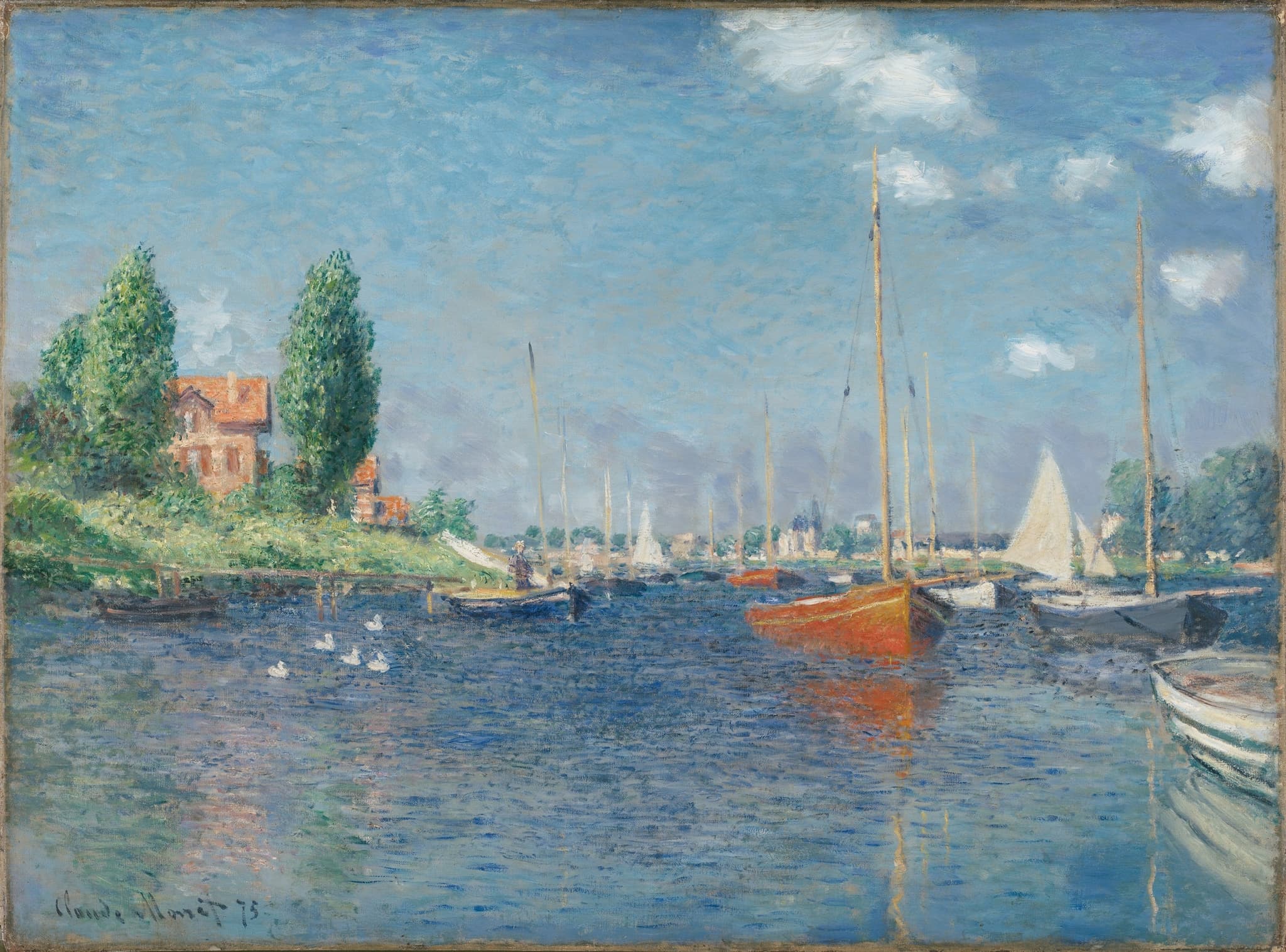
The Red Boats, Argenteuil
Claude Monet, 1875 • Oil on canvas
Read full analysis of The Red Boats, Argenteuil →Valuation Analysis
Conclusion: We estimate Claude Monet’s The Red Boats, Argenteuil (1875; oil on canvas, 61.8 × 82.5 cm; Wildenstein W369; Harvard Art Museums/Fogg Museum) at $25–45 million fair‑market value. This mid‑format, signature Argenteuil subject is a recognized image from Monet’s most coveted early Impressionist phase and has been widely exhibited since the 2nd Impressionist exhibition in 1876, conferring exceptional art‑historical stature and demand [1].
Methodology and comps: Our range is anchored by directly relevant and recent Monet benchmarks. Among closely related subjects, Le Pont du chemin de fer à Argenteuil (1873) achieved $41.5 million at Christie’s New York in 2008, demonstrating the market’s long‑standing premium for prime Argenteuil paintings with boats, bridges, and Seine reflections [4]. More broadly, best‑in‑class series works continue to command the top prices—e.g., the artist’s record $110.7 million for Meules (2019) [2] and $74.0 million for a large Nymphéas in 2023 [3]—while strong, mid‑scale masterpieces in celebrated series have transacted in the mid‑to‑high eight figures (e.g., Meules à Giverny at $34.8 million in 2024) [5]. The Red Boats, Argenteuil sits between these poles: it is not a late, monumental Nymphéas, but it is a museum‑caliber, instantly legible Argenteuil icon—one of Monet’s most commercially favored early subjects.
Positioning within Monet’s market: The 1872–1876 Argenteuil years are a “sweet spot” for collectors: modern leisure on the Seine, brilliant color, and crystalline reflections—motifs that epitomize early Impressionism. The Red Boats’ distinctive vermilion hulls, crisp rigging, and reflective water create a high‑impact composition at the classic 60 × 80 cm scale, ideal for both private and institutional buyers. Works of this type are exceptionally scarce in today’s market; when they appear, they benefit from trophy‑level attention even amid cyclical selectivity.
Key adjustments: We weight upward for (i) prime date and subject; (ii) celebrated image with deep exhibition and publication history (since 1876); and (iii) museum‑caliber quality and visibility [1]. We temper relative to Monet’s absolute peak series premiums (late Nymphéas, London bridges) by benchmarking to the $41.5 million 2008 Argenteuil result and to recent mid‑scale series outcomes in the $30–40 million band [4][5]. Condition can shift results materially: pristine or minimally restored surfaces, unified impasto, and no structural concerns would support the upper half of the range; visible condition complexities could compress it.
Practical note: This painting is a bequest to the Harvard Art Museums and is not realistically available for sale; the valuation presented is a market‑oriented, hypothetical fair‑market range rather than an insurance appraisal or deaccession recommendation [1]. Within a top evening sale, under normal market conditions and with competitive guarantee structuring, we would expect bidding depth consistent with the $25–45 million conclusion.
Key Valuation Factors
Art Historical Significance
High ImpactPainted in 1875 during Monet’s Argenteuil years (1872–1876), The Red Boats, Argenteuil epitomizes early Impressionism’s treatment of modern leisure and light on the Seine. It was shown in the landmark 2nd Impressionist exhibition in 1876 and has been heavily published and exhibited since, cementing it as a canonical image within Monet’s oeuvre. Works from this phase, particularly with boats, reflections, and saturated color accents, are foundational to Monet’s reputation and to the development of the Impressionist movement. This deep art‑historical resonance expands the global buyer pool beyond Monet specialists to institutions and cross‑category collectors, which is a key driver of eight‑figure demand.
Period and Subject Desirability
High ImpactArgenteuil boat and regatta scenes are among Monet’s most sought‑after non‑series subjects. The distinctive red hulls and mirrored water create an instantly legible, high‑impact composition at the classic 60 × 80 cm format, a size that balances wall power with placement flexibility. Collectors prize the Argenteuil pictures for their chromatic brilliance, accessible subject, and their role in crystallizing the artist’s mature Impressionist language. Compared with later, non‑series landscapes, Argenteuil canvases typically command a premium; while they do not reach the nine‑figure territory of the most monumental Nymphéas, they routinely perform at the strong end of the mid‑ to high eight‑figure spectrum when quality and condition align.
Provenance and Exhibition History
High ImpactThe painting’s distinguished chain of ownership (including Durand‑Ruel, Paul Rosenberg, and the Maurice Wertheim bequest) and its long residence at the Harvard Art Museums provide exceptional scholarly pedigree and public visibility. Its inclusion in the 1876 Impressionist exhibition adds unique historical weight. Such provenance reduces transactional risk, bolsters buyer confidence, and can catalyze bidding beyond price‑history extrapolations. While museum ownership implies the work is unlikely to come to market, the same institutional pedigree would amplify demand if a closely comparable Argenteuil painting were offered, supporting the higher end of the estimate under strong promotional and guarantee conditions.
Market Liquidity and Comparables
High ImpactHard comps frame the estimate: an Argenteuil masterwork (Railway Bridge, 1873) fetched $41.5m in 2008; late‑series trophies have commanded $74.0m (Nymphéas, 2023) and $110.7m (Meules, 2019); and a mid‑scale Haystack achieved $34.8m in 2024. These data points show a resilient high end for blue‑chip Monet, with premiums for prime subjects and series. Red Boats’ art‑historical cachet and visual punch justify a range that overlaps the $30–40m “sweet spot” for mid‑format masterpieces while leaving room up to $45m in a competitive setting. Conversely, a softer macro tone or condition caveats would pull results toward the mid‑$20m level.
Sale History
The Red Boats, Argenteuil has never been sold at public auction.
Claude Monet's Market
Claude Monet remains one of the most liquid and globally collected names in the market. His top auction record is $110.7 million for Meules (Haystacks) at Sotheby’s New York in 2019, with multiple subsequent sales above $60 million for large‑scale Nymphéas canvases. Demand concentrates in iconic series (Water Lilies, Haystacks, London/Parliament, Poplars) and in prime early works from the 1870s, especially Argenteuil and Seine views. Mid‑ to large‑scale masterpieces routinely achieve mid‑to‑high eight figures in marquee evening sales, usually supported by guarantees. Monet’s broad collector base spans private, institutional, and cross‑category buyers, ensuring deep bidding for best‑in‑class works even in selective market cycles.
Comparable Sales
Le Pont du chemin de fer à Argenteuil
Claude Monet
Direct Argenteuil subject (1873) from the same prime early-Impressionist period; closely comparable mid-format river/boats composition and market appeal.
$41.5M
2008, Christie's New York
~$60.1M adjusted
Moulin de Limetz
Claude Monet
Strong 1888 Seine‑region landscape of comparable scale; museum deaccession; a solid mid‑eight‑figure Monet landscape benchmark in today’s market.
$21.7M
2024, Christie's New York
~$22.3M adjusted
Antibes vue de la Salis
Claude Monet
Highly appealing 1888 Mediterranean coastal view; similar market tier and format, useful for gauging demand for luminous non‑series landscapes.
$14.1M
2024, Sotheby's New York
~$14.5M adjusted
Bennecourt
Claude Monet
Seine view (1887) with riverbank/boats adjacency; later than Argenteuil but subject‑relevant and helpful as a lower‑bound indicator.
$6.9M
2024, Sotheby's New York
~$7.1M adjusted
Waterloo Bridge, effet de brume
Claude Monet
Top‑tier series work (London bridges, 1899–1904); establishes pricing for instantly recognizable, mid‑scale Monets in recent marquee sales.
$36.8M
2022, Christie's London
~$39.4M adjusted
Meules à Giverny
Claude Monet
Iconic Haystacks series (1893); a strong, recent mid‑scale Monet benchmark in the mid‑to‑high eight figures.
$34.8M
2024, Sotheby's New York
~$35.8M adjusted
Current Market Trends
The Impressionist and broader Modern categories have cooled from 2022 peaks, with fewer nine‑figure consignments and more selective bidding. Yet blue‑chip masterpieces continue to perform strongly when presented with compelling narratives and guarantees. Recent seasons show a K‑shaped dynamic: trophy works by canonical names still attract global competition, while mid‑tier lots face price discipline. Within this context, prime Monet pictures remain highly liquid, particularly late Nymphéas and core 1870s subjects. For a museum‑caliber Argenteuil canvas of strong condition, the buyer pool remains deep, and pricing gravitates toward mid‑ to high‑eight figures, provided the sale is positioned in a major evening auction with robust pre‑sale marketing.
Sources
- Harvard Art Museums – The Red Boats, Argenteuil (object page)
- Sotheby’s – Monet’s Meules Sells for $110.7 Million (2019)
- Christie’s – 20th Century Evening Sale Results (Monet, Le bassin aux nymphéas, $74,010,000, 2023)
- CBS News – Monet painting sells for $41.4 million (2008)
- Sotheby’s – New York Sales May 2024 Highlights (Meules à Giverny, $34,804,500)