How Much Is Water Lilies (triptych) Worth?
Last updated: March 16, 2026
Quick Facts
- Methodology
- extrapolation
Monet’s monumental Water Lilies (triptych) at MoMA is a pinnacle work from the Grandes Décorations, with no modern public sale history. Extrapolating from the strongest late single‑panel Water Lilies results ($65.5m–$74.0m) and Monet’s $110.7m record, a complete, iconic triptych warrants a substantial scarcity/scale/trophy premium, supporting a $200–350 million indication.
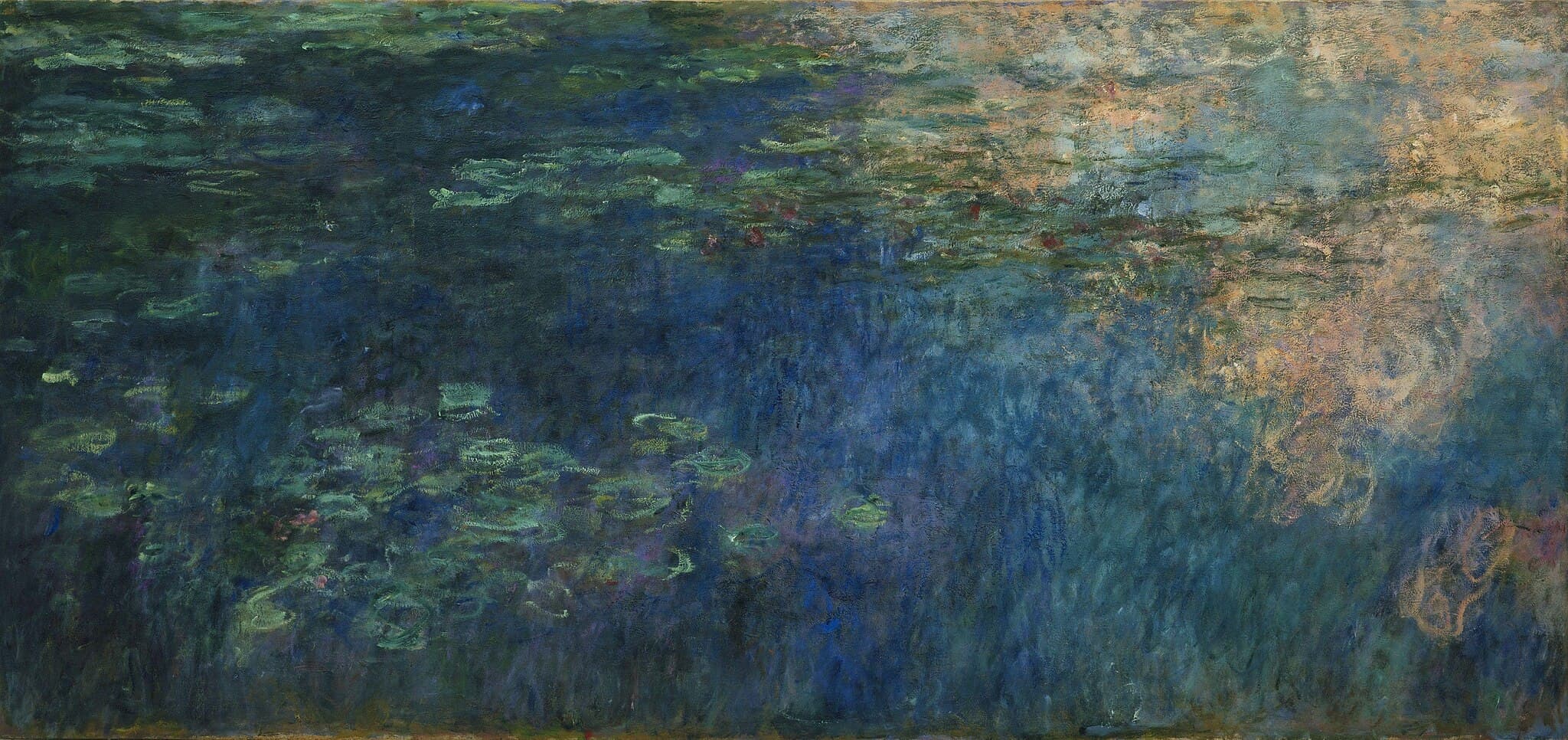
Water Lilies (triptych)
Claude Monet, 1914–1926 • Oil on canvas
Read full analysis of Water Lilies (triptych) →Valuation Analysis
Conclusion: Monet’s Water Lilies (triptych), 1914–26, at MoMA is a canonical, mural‑scale ensemble from the Grandes Décorations and one of the most visible Monets in the U.S. It has no modern public sale history and is unlikely ever to be deaccessioned, but if it were to be priced for a private transaction or insurance, a defensible fair‑market indication is $200–350 million. This range reflects the confluence of art‑historical primacy, extreme scale, complete multi‑panel configuration, institutional provenance, and deep global demand for top‑tier Monets [1].
Anchor comparables: Recent market benchmarks for late, large Water Lilies single panels cluster in the $65–75 million band: Christie’s New York, Nov 2023, Le bassin aux nymphéas, $74.01m; Sotheby’s New York, Nov 2024, Nymphéas, $65.5m. Earlier bellwethers include Sotheby’s New York, May 2021, Le Bassin aux nymphéas at ~$70.4m, and the Rockefeller Nymphéas en fleur at $84.69m (2018)—still the strongest late‑lilies result. Monet’s overall auction record remains $110.7m for Meules (2019) [2][3][4][5]. These are all single‑panel works.
Extrapolation to a complete triptych: MoMA’s work is a monumental, three‑panel ensemble (approx. 42 feet wide) from the same late cycle that underpins the Orangerie murals. Complete, museum‑grade triptychs of this ambition are virtually absent from the market. The scarcity/scale premium over a prime single panel is therefore material: beyond the literal increase in size, the intact multi‑panel configuration, immersive viewing experience, and centrality to Monet’s late vision support a multiple of the best single‑panel prices. Applying a reasoned 2.5x–4x uplift to the recent $65–85m single‑panel range yields approximately $160–340m; given this work’s fame and MoMA‑level validation, $200–350m is appropriate [1][5].
Provenance, visibility, and replacement risk: The triptych descends from the artist to Michel Monet and was acquired by MoMA in 1959; it has been widely exhibited, reproduced, and remains a signature gallery anchor. In insurance contexts, near‑zero substitutability often necessitates schedules above auction comparables. Notably, MoMA’s 1958 fire and the related insurance settlement helped fund the acquisition of this very triptych—an instructive historical reminder of replacement dynamics for iconic works [1][6].
Market context: Despite a softer auction climate in 2024, apex Impressionist material continued to clear ambitious estimates, and the sector rebounded in 2025, with strong New York marquee results and renewed depth at the top end. Against this backdrop, demand for late Water Lilies remains robust among global buyers and institutions, particularly for works with bullet‑proof provenance and museum‑level exhibition histories [3][4][7][8].
Positioning: Within Monet’s oeuvre, the MoMA triptych sits just below the Orangerie murals in stature and above nearly all single‑panel lilies that reach the market. That hierarchy, coupled with immaculate institutional provenance and international recognition, supports a confident $200–350 million indication for private‑sale or insurance purposes.
Key Valuation Factors
Art Historical Significance
High ImpactWater Lilies (triptych) is a culminating expression of Monet’s late Grandes Décorations, the mural‑scale project that redefined immersive modern painting and directly influenced later abstraction. Executed 1914–26, it synthesizes decades of optical study into an enveloping spatial field, and sits just below the Orangerie murals in importance. Few Monets combine this period, ambition, and completeness. Its scholarly visibility and continuous display at MoMA have cemented it as a touchstone for Impressionism and modern art broadly, elevating it far above the many single‑panel lilies that circulate. This primacy commands a premium that cannot be replicated by scale or date alone, and is foundational to the valuation.
Scale and Completeness (Triptych Configuration)
High ImpactAt roughly 42 feet wide, the triptych’s physical and experiential amplitude exceeds any single‑panel lily. Crucially, it survives as an intact, three‑panel ensemble—extraordinarily scarce outside the Orangerie context. Market supply of multi‑panel late lilies is effectively nil, so pricing must account for a scarcity multiple over even the best single panels. The complete configuration also carries compositional and historical integrity that magnifies impact beyond a sum‑of‑parts. This scarcity/scale effect is a central driver of the 2.5x–4x uplift over recent $65–85m single‑panel results, supporting a nine‑figure valuation with room for competitive upside if ever contested by top collectors or institutions.
Provenance, Visibility, and Institutional Validation
High ImpactOwned by the Museum of Modern Art since 1959 (Mrs. Simon Guggenheim Fund), the triptych benefits from unimpeachable provenance, continuous public exposure, and extensive literature and exhibition history. Works that function as museum icons command a trophy premium because they are globally recognized, constantly reproduced, and essentially irreplaceable. The MoMA platform also implies rigorous conservation stewardship and best‑practice scholarship, further de‑risking acquisition or underwriting. In practical terms, this level of institutional validation reduces uncertainty for potential buyers and insurers and supports a value well above isolated private‑collection comparables—even before accounting for the multi‑panel rarity factor.
Comparable Market Evidence and Trophy Premium
High ImpactRecent auction evidence for late Water Lilies single panels ($65.5m–$74.0m since 2021) and the Rockefeller canvas at $84.7m (2018) establishes a robust baseline for first‑tier lilies. Monet’s overall artist record is $110.7m (Meules, 2019), indicating the category can clear nine‑figure thresholds for top material. A complete, museum‑grade triptych reasonably commands a multiple of those single‑panel results, reflecting scarcity, scale, and iconicity. Even in selective markets, apex works continue to attract deep global capital, suggesting competitive tension would be strong. This evidence, combined with the work’s MoMA stature, supports the $200–350 million range as an informed, defensible indication.
Sale History
Water Lilies (triptych) has never been sold at public auction.
Claude Monet's Market
Claude Monet remains one of the most liquid and globally collected blue‑chip artists. His auction record is $110.7 million for Meules (Sotheby’s New York, 2019), and late Water Lilies of strong scale and condition regularly achieve $65–75 million, with the Rockefeller Nymphéas en fleur at $84.7 million (2018) as a notable high. Demand is anchored by global museums and seasoned private collectors, with bidding depth in the U.S., Europe, and Asia. Supply is selective but consistent, and the market distinguishes sharply between prime series exemplars (late Water Lilies, Haystacks, Poplars) and lesser works. Freshness, provenance, scale, and date remain the key price drivers.
Comparable Sales
Nymphéas en fleur (c. 1914–17)
Claude Monet
Closest high-water mark for a large, late Water Lilies canvas from the same late Giverny period and mural conception; trophy provenance (Rockefeller).
$84.7M
2018, Christie's New York
~$108.9M adjusted
Le Bassin aux nymphéas (1917–19)
Claude Monet
Late, large Water Lilies single panel from the 1917–19 phase—very close in period and aesthetic to the Grandes Décorations cycle.
$70.4M
2021, Sotheby's New York
~$83.8M adjusted
Le bassin aux nymphéas (c. 1917–19)
Claude Monet
Top 2023 late Water Lilies single-panel result; same late period, strong scale and market freshness.
$74.0M
2023, Christie's New York
~$78.5M adjusted
Nymphéas (1914–17)
Claude Monet
Major late Water Lilies single panel from 1914–17 (Sydell Miller collection); near in date and character to the triptych’s cycle.
$65.5M
2024, Sotheby's New York
~$67.1M adjusted
Nymphéas (1907)
Claude Monet
Earlier Water Lilies variant (smaller and pre‑Grandes Décorations) that benchmarks demand for the motif across periods; useful lower‑bound context.
$45.5M
2025, Christie's New York
Le Parlement, soleil couchant (1900–03)
Claude Monet
Not a lilies subject but a blue‑chip, marquee Monet series result in the recent market—shows the ceiling for major Monets beyond the lilies.
$76.0M
2022, Christie's New York
~$83.6M adjusted
Current Market Trends
After a contraction in 2024, the art market rebounded in 2025, with resilience concentrated at the top end. Impressionist/Post‑Impressionist masterpieces—especially by Monet—continued to command strong results, as evidenced by recent $65–74 million late Water Lilies sales. Buyers favor A‑plus works with museum‑level provenance and exhibition history, while mid‑tier material is more price‑sensitive. With heightened institutional programming around Impressionism and Monet’s centenary, visibility remains high, and trophy‑level demand appears intact. In this context, a complete, iconic Monet triptych would likely inspire intense competition and clear well into the nine figures.
Sources
- MoMA Collection: Claude Monet, Water Lilies (triptych), 1914–26
- Sotheby’s: Monet’s Meules sells for $110.7m (artist record)
- Christie’s: 20th Century Evening Sale, Nov 9, 2023 (Le bassin aux nymphéas $74.01m)
- Artnet News: Sotheby’s Modern sale, Nov 2024 (Nymphéas $65.5m)
- Christie’s: Rockefeller Sale Results (Nymphéas en fleur $84,687,500)
- Artnet News: MoMA’s 1958 fire and Monet insurance payout
- The Art Newspaper: Global art sales fell 12% in 2024 (Art Basel & UBS report)
- The Art Newspaper: 2025 auction growth and market rebound