How Much Is La Rue Mosnier aux drapeaux (Rue Mosnier with Flags) Worth?
Last updated: March 13, 2026
Quick Facts
- Last Sale
- $26.4M (1989, Christie's New York (evening sale))
- Methodology
- comparable analysis
La Rue Mosnier aux drapeaux (1878) is a museum‑quality late Manet now in the J. Paul Getty Museum; its last public sale was Christie’s New York (1989) for $26.4M. If hypothetically offered today, a reasoned comparable‑based range is $30–80M, with placement within that band driven by condition, provenance depth, size and sale placement.
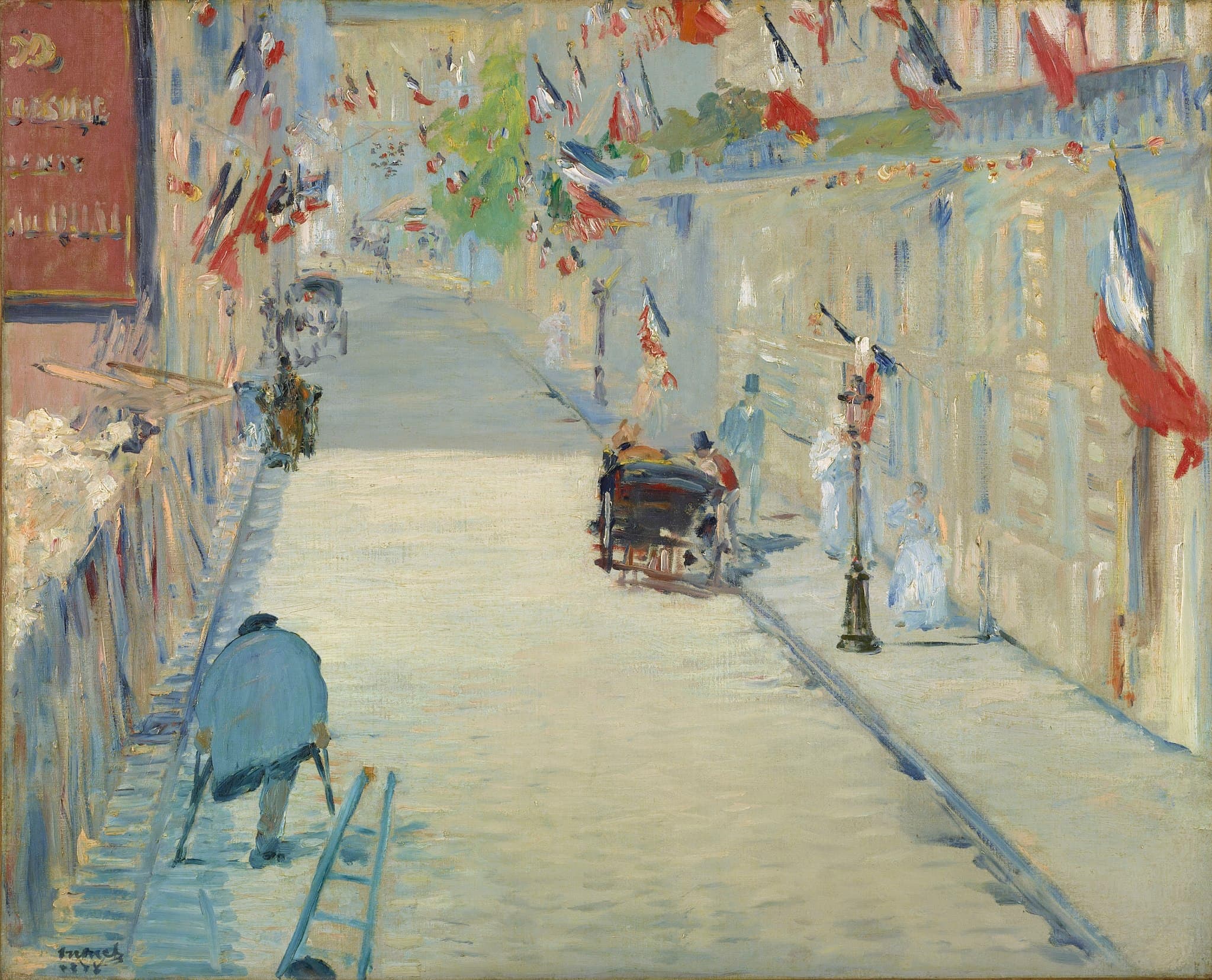
La Rue Mosnier aux drapeaux (Rue Mosnier with Flags)
Édouard Manet, 1878 • Oil on canvas
Read full analysis of La Rue Mosnier aux drapeaux (Rue Mosnier with Flags) →Valuation Analysis
La Rue Mosnier aux drapeaux (1878) by Édouard Manet is a documented, late‑career Paris street scene that was sold at Christie’s New York on 14 November 1989 and acquired by the J. Paul Getty Museum for $26,400,000 — the primary market anchor for this specific canvas [1]. Because the work is institutional, any present‑day figure is hypothetical, but the 1989 sale gives a concrete datum from which to perform a contemporary comparable analysis.
I have anchored the present estimate to that 1989 realisation and compared it with later, high‑profile Manet outcomes and close subject‑family comparables. Manet’s modern auction ceiling (Le Printemps, Christie’s 2014) established a new benchmark for top‑tier late oils, and more recent late Manet sales in the $8–15M band demonstrate liquidity in the mid‑market; together these datapoints frame where a museum‑quality Rue Mosnier would sit against both the trophy and the mid tiers of the market [2].
Applying those comparables and accounting for art‑market appreciation, provenance strength and the painting’s relative place in Manet’s oeuvre, I place a defensible hypothetical market range at $30,000,000–$80,000,000. The lower bound assumes adverse factors (small format, significant condition issues, weak documentation or limited exhibition history) that materially reduce buyer confidence; the upper bound assumes original scale, excellent condition, uninterrupted provenance, important scholarly citations and a marquee evening‑sale placement that draws museums and global private collectors. Key value drivers are: technical/authenticity confirmation, completeness of provenance and exhibition/literature history, physical condition and the chosen sale vehicle and timing.
Practically, to refine this range or prepare the work for sale you should: assemble recto/verso high‑resolution photography and current conservation documentation; commission infrared/x‑ray/pigment analysis if needed; compile a complete provenance and exhibition bibliography; and obtain pre‑sale opinion from Impressionist specialists at Christie’s, Sotheby’s and Phillips. If this is the Getty canvas, note institutional ownership precludes market availability absent an exceptional and legally vetted deaccession.[1][2]
Key Valuation Factors
Art Historical Significance
High ImpactManet is a foundational figure in modern French painting and his late‑period Paris street scenes document the artist’s mature handling of modern life, light and urban spectacle. While La Rue Mosnier aux drapeaux is not typically ranked with Manet’s canonical salon provocations (e.g., Olympia or Le Déjeuner sur l’herbe), it remains a well‑regarded late work that shows his painterly approach to cityscapes and public ritual. That combination of recognized authorship, late‑period refinement and subject‑appeal gives the canvas strong curatorial and institutional interest. Because museums prioritize complete artistic narratives, works of this type can command premium attention when they surface, making historical significance a high‑impact value driver.
Provenance & Exhibition History
High ImpactThis painting’s provenance is well documented through a series of major European and American collections (contemporary Paris purchaser → Jean‑Baptiste Faure → Auguste Pellerin → Marcell Nemes → Baron Herzog → Jakob Goldschmidt → Paul Mellon → sale at Christie’s 1989 → J. Paul Getty Museum). Continuous, high‑quality provenance and museum ownership markedly reduce attribution risk and enhance institutional desirability and buyer confidence at auction. Extensive exhibition and literature presence would further lift the work toward the top of the stated range; conversely, gaps or disputed provenance would materially depress realizable value. For this canvas the existing chain is a strong positive.
Condition & Conservation
High ImpactCondition is decisive for 19th‑century oils. Key issues to verify include original paint surface stability, varnish discolouration, evidence of relining or heavy overpainting, structurally compromising canvass treatment, and extent of inpainting/restorations. A well‑conserved original surface with minimal intrusive retouching supports the upper estimate; conversely, a heavily relined, overcleaned or extensively restored canvas can reduce market value sharply (often tens of percent or more) because buyers discount the loss of visual authenticity. A full conservator’s report, UV imaging and X‑ray documentation are essential before marketing and materially affect positioning within the $30–80M band.
Market Scarcity & Demand
High ImpactMuseum‑calibre Manet oils are rare in the market; most canonical examples are retained by major institutions, which creates a scarcity premium when significant works appear. Demand is concentrated among museums, major private collectors and specialist dealers—a relatively small but well‑funded buyer pool capable of driving prices to the tens of millions. Market appetite fluctuates with the macro art cycle and the presence of single‑owner dispersals; when supply of top Manets is constrained, the price sensitivity to quality increases. Therefore scarcity and concentrated demand are high‑impact forces shaping the estimate.
Sale History
Christie's New York (evening sale)
J. Paul Getty Museum
Édouard Manet's Market
Édouard Manet occupies a top tier among 19th‑century French masters: his major oils are sought after by museums and blue‑chip collectors. Auction outcomes range from mid‑seven figures for studies to many tens of millions for museum‑grade masterpieces; the artist’s modern public auction record (Le Printemps, 2014) demonstrates the ceiling for his most important late works. Supply of top Manets is limited (many are already institutional), which supports strong pricing for the rare, high‑quality canvases that do appear. Mid‑market Manet works (still lifes, portraits and late scenes) continue to find buyers in the $1–15M band depending on condition and provenance.
Comparable Sales
La Rue Mosnier aux drapeaux (Rue Mosnier with Flags)
Édouard Manet
This is the exact canvas — the primary anchor: same artist, same composition and provenance (sold to the J. Paul Getty Museum).
$26.4M
1989, Christie's New York (evening sale)
~$69.0M adjusted
Le Printemps (Spring, Jeanne Demarsy)
Édouard Manet
Manet's auction record and a late-period, large-scale figure work; serves as the top-tier market anchor for the artist and sets the ceiling for comparable masterpieces.
$65.1M
2014, Christie's New York
~$89.1M adjusted
La rue Mosnier aux paveurs (variant Rue Mosnier composition)
Édouard Manet
Close subject/subject-variant of the Rue Mosnier theme; similar date and compositional family but historically sold at a lower level — a direct thematic comparator.
$11.1M
1986, Christie's (reported, 1986)
~$32.8M adjusted
Vase de Fleurs, Roses et Lilas (1882)
Édouard Manet
Late Manet oil (still life) sold in the recent market — useful to gauge buyer demand and pricing for high-quality late Manet works outside the very top‑tier masterpieces.
$10.1M
2024, Sotheby's New York (May 2024 sale)
~$10.4M adjusted
Current Market Trends
Since 2023 the Impressionist and 19th‑century market has shown a selective contraction: fewer mega‑sales and muted activity above $10M, but a persistent "flight to quality" where museum‑calibre works still attract strong bids. Major exhibitions and single‑owner dispersals drive episodic spikes in demand. For Manet, scarcity of high‑quality oils means well‑provenanced, well‑conditioned canvases remain collectible and can command premium prices when presented at marquee evening sales.
Sources
- Suzanne Muchnic, 'Getty Purchases 1878 Manet Work for $26.4 Million,' Los Angeles Times, Nov 15, 1989
- Bloomberg / Christie’s coverage, 'Manet’s Le Printemps leads Christie’s,' Nov 2014 (auction benchmark)
- Artnet News, Sotheby’s May 2024 sale recap (late Manet still life example)
- Wikipedia, 'The Rue Mosnier Dressed with Flags' (provenance and exhibition summary)