How Much Is Le Printemps (Spring / Jeanne Demarsy) Worth?
Last updated: March 13, 2026
Quick Facts
- Last Sale
- $65.1M (2014, Christie's, New York)
- Methodology
- extrapolation
Based on extrapolation from the confirmed Christie’s sale (Nov 5, 2014) and current market dynamics, a realistic fair‑market range for Édouard Manet’s Le Printemps (Jeanne Demarsy) in 2026 is $85–$120 million. The range reflects an inflation/CPI adjustment to the 2014 benchmark plus a premium for scarcity, provenance and renewed institutional interest.
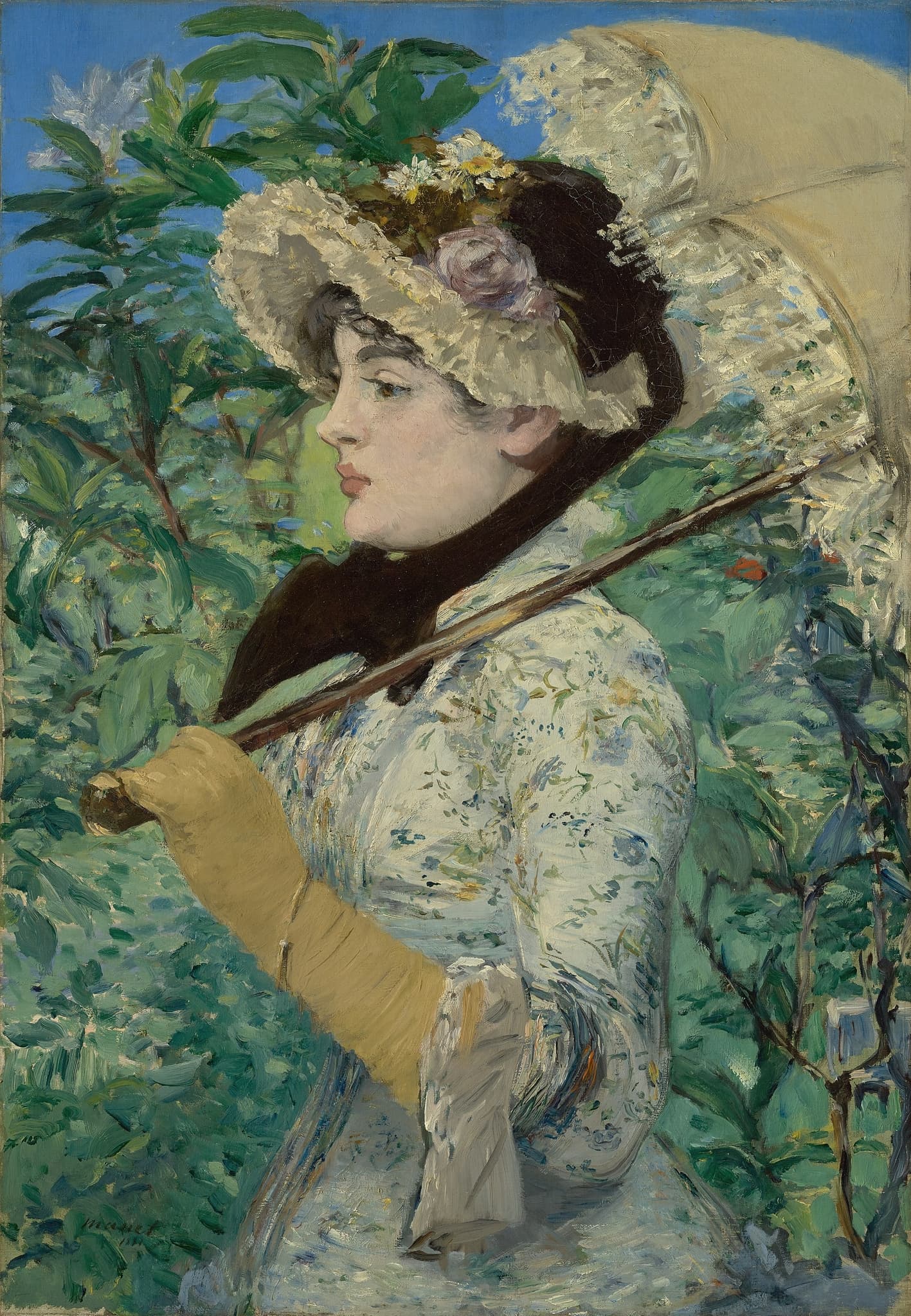
Le Printemps (Spring / Jeanne Demarsy)
Édouard Manet, 1881 • Oil on canvas
Read full analysis of Le Printemps (Spring / Jeanne Demarsy) →Valuation Analysis
Valuation conclusion: I derive a recommended fair‑market range of $85–120 million for an open‑market sale of Édouard Manet’s Le Printemps (Jeanne Demarsy) as of early 2026. This recommendation is anchored to the public Christie’s Nov 5, 2014 sale (price realized $65,125,000), which remains the primary market datum for this exact work [1], and to the painting’s subsequent accession to the J. Paul Getty Museum [2].
The methodology begins with the 2014 hammer+premium figure and applies a CPI‑based inflation uplift (bringing the 2014 result into late‑2025/early‑2026 dollars, roughly to the high‑eighties million range), then layers market adjustments. These adjustments reflect (a) the structural scarcity of top‑tier Manet salon portraits since few museum‑quality canvases appear on the market, (b) the demonstrable effect of strong published provenance and long museum/loan history in pushing competitive bidding, and (c) recent market dynamics—after a 2023–24 softening the high end of the Impressionist/Modern market showed selective recovery in late‑2025—supporting a modest premium above inflation‑adjusted historic sale values [3].
Comparable sales reinforce the tiering used here: Le Printemps itself remains the single best direct comparator (it set the artist auction record in 2014) [1]; other high‑quality Manet portraits and large oils have sold in the mid‑single to low‑double‑digit millions (for example, notable late‑period portraits and still lifes in the $10M–$35M band), which underscores how exceptional provenance, scale and museum quality are required to reach the top of the range. The low end of the $85M range effectively represents an inflation‑adjusted recoup of the 2014 price with conservative market risk applied; the $120M high end is a realizable upside in a robust trophy‑level sale environment (guarantee/private‑treaty interest, multiple institutional bidders, or a competitive evening‑sale bidding war).
Key risks and adjustments: Le Printemps is in a major museum collection (Getty), which reduces the likelihood of an imminent market appearance and therefore practical realizability; should it be offered the sale route (likely via a deaccession or a private treaty), house guarantees, market timing and exhibition lead‑up would materially affect final outcome. Condition and technical findings from Getty conservation reports (not publicly detailed) could either sustain or modestly reduce this range; absent negative condition notes, I assume museum‑level conservation and presentation. Market cyclicality and the limited pool of ultra‑high‑net‑worth buyers for a single‑artist trophy are the principal downside constraints.
Practical advice: For a formal insured or sale estimate: obtain a Getty conservation/condition statement, commission a technical/photo dossier, and engage Christie’s or Sotheby’s Impressionist & Modern desk to solicit pre‑sale interest and guarantee options. The range $85–120M represents a reasoned, evidence‑based band for an open‑market sale in current conditions (early 2026), with the most probable realized figure toward the mid‑to‑upper portion of that band if marketed with institutional backing, published scholarship and a pre‑sale guarantee. [1][2][3]
Key Valuation Factors
Art Historical Significance
High ImpactLe Printemps (1881) is a late‑period Manet salon portrait of the actress Jeanne Demarsy and exemplifies Manet’s mature handling of portraiture and fashionable subject matter. While not at the level of Olympia or Le Déjeuner sur l'herbe in canonical notoriety, it is nonetheless a museum‑quality work by Manet with strong aesthetic and scholarly interest. Works that pair technical quality, an identifiable sitter with cultural relevance, and the artist’s late‑period facture occupy the top tier of the Manet market. That art‑historical status directly elevates buyer competition and supports a trophy‑level valuation relative to the broader field of 19th‑century works.
Provenance & Exhibition History
High ImpactThis painting benefits from a documented, high‑quality provenance: directly from Manet to Antonin Proust, through important early 20th‑century collections and the Durand‑Ruel dealing network, then long private ownership with extended public loan (including long‑term display at the National Gallery of Art) before the Christie’s sale and acquisition by the J. Paul Getty Museum. That unbroken and prestigious chain reduces attribution and title risk, increases institutional confidence and is a material reason the work achieved record pricing in 2014. Provenance of this caliber is a decisive value multiplier at the top of the market.
Condition & Technical Quality
High ImpactCondition and the painting’s technical integrity are central to premium pricing. Le Printemps, having passed through museum hands and the Getty’s acquisition process, is assumed to be in conserved, exhibition‑ready condition unless otherwise noted. Surface preservation, stability of the paint layer, and any historic restoration all materially affect buyer confidence and final bids. A clean condition report (and published technical analysis showing original paint and documented conservation) supports the upper half of the valuation band; any evidence of significant overpaint, instability or invasive restoration would compel downward adjustment.
Market Scarcity & Rarity
High ImpactTop‑quality Manet oils that are large, well‑provenanced and fresh to the market are very rare. Scarcity of comparable museum‑quality works concentrates demand among institutions and private collectors and amplifies competitive bidding when such works appear. Le Printemps’s uniqueness as a museum‑grade late portrait that had not been widely available for decades was a decisive factor in its 2014 record result; that scarcity remains a dominant upward pressure on valuation should the work ever be marketed again.
Supply/Demand and Market Momentum
Medium ImpactThe wider Impressionist/Modern market has experienced cycles: a contraction in 2023–24 followed by selective recovery in late‑2025. Buyer appetite for blue‑chip trophies is resilient but cautious; houses increasingly use guarantees and private‑treaty placements to manage risk. Market momentum can therefore create effective upside (competitive bidding/guarantees) or cap outcomes (reduced appetite in weak cycles). Timing, marketing with scholarly context, and guarantee availability will materially influence the likely result within the $85–120M band.
Sale History
Christie's, New York
Édouard Manet's Market
Édouard Manet is a blue‑chip, canonical 19th‑century modernist whose best oils command the highest prices in the Impressionist/Modern category. Market outcomes are highly stratified: a handful of museum‑quality portraits and major salon works (like Le Printemps) sit at the trophy level and can reach tens of millions, while more frequent, smaller or less‑important canvases trade in the low‑ to mid‑seven figures. The scarcity of top Manet canvases and strong institutional demand sustain a high ceiling; provenance, condition and exhibition history remain decisive for accessing that ceiling.
Comparable Sales
Le Printemps (Spring / Jeanne Demarsy)
Édouard Manet
Primary market benchmark — same work. Museum-quality late Manet salon portrait that set the artist auction record in 2014 after long private ownership/loan.
$65.1M
2014, Christie's, New York
~$88.9M adjusted
Self-Portrait with Palette (Autoportrait à la palette)
Édouard Manet
Major late-period Manet portrait; was the auction record for the artist prior to Le Printemps and is a useful upper-tier portrait comparable (museum quality).
$33.2M
2010, Sotheby's, London
~$49.1M adjusted
Vase de fleurs, roses et lilas
Édouard Manet
Recent sale (2024) of a museum-quality Manet oil in New York; indicates mid-market interest for high-quality Manet oils (~$10M) though different subject and scale than Le Printemps.
$10.1M
2024, Sotheby's, New York
~$10.3M adjusted
Portrait of Ambroise Adam (in the garden of Pressagny)
Édouard Manet
Small plein-air portrait sold in Paris (2025) at a low seven-figure level; useful as a lower-end portrait comparable showing the breadth of market outcomes for Manet portraits.
$1.0M
2025, Christie's, Paris
Current Market Trends
Since 2023 the Impressionist/Modern market softened, with buyers more selective and fewer trophy consignments. Late‑2025 showed signs of renewed appetite for blue‑chip works, favoring high‑quality, well‑provenanced paintings and prompting more guarantees/private placements for top lots. Overall the market favors a ‘flight to quality’—museum‑grade works outperform middling material, but cyclical risk and a limited buyer pool constrain upside without exceptional sale conditions.