The Bathing Woman in Luncheon on the Grass
A closer look at this element in Édouard Manet's 1863 masterpiece
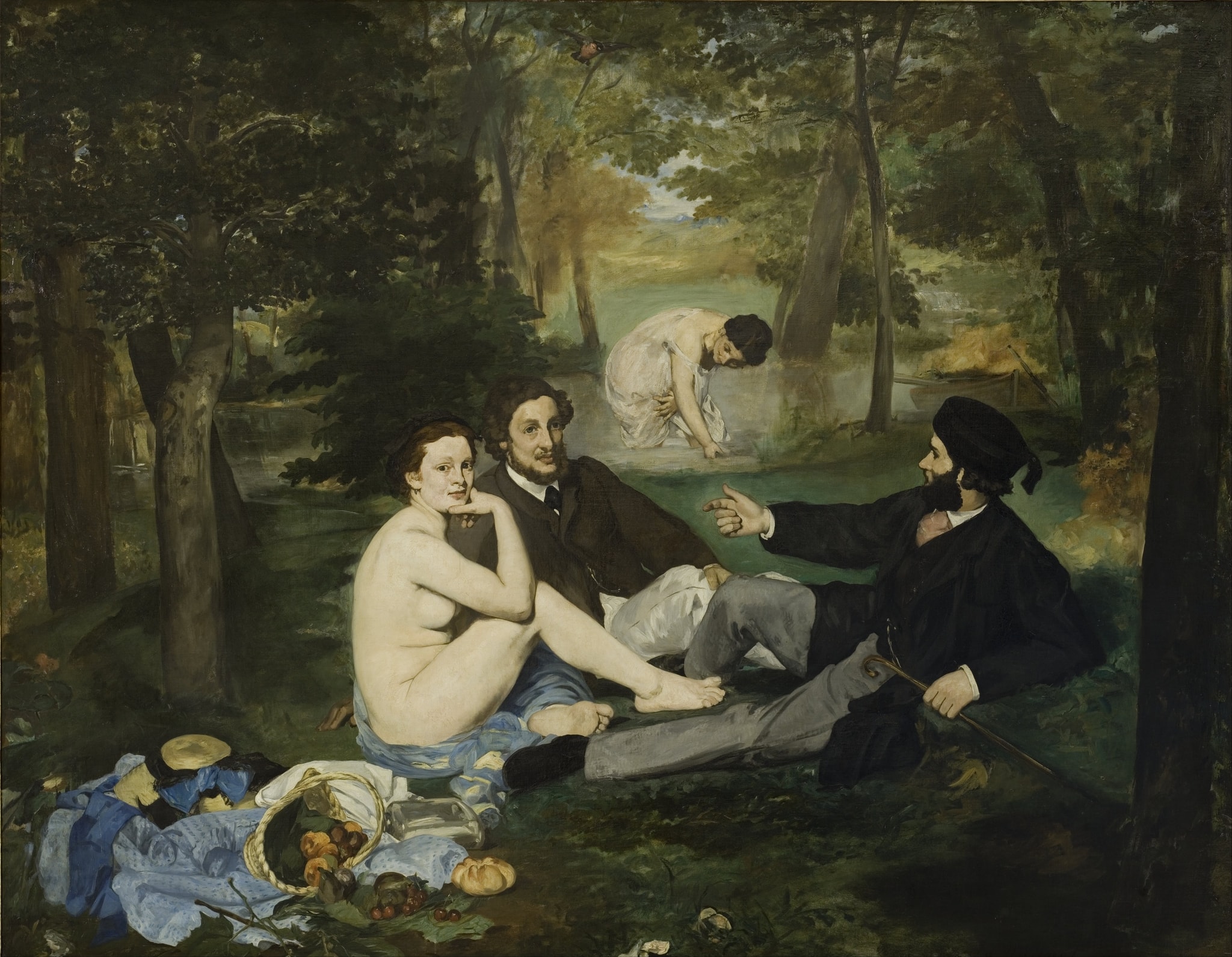
Manet’s Bathing Woman—knee‑deep in a pond, lifting her white chemise—turns a classical bather into a contemporary Parisian. That bright “white patch” anchors the composition and declares the painting’s modern program: quoting the Old Masters while insisting on the present.
Historical Context
Édouard Manet unveiled the painting at the Salon des Refusés in 1863 under the title Le Bain, foregrounding the presence of a bather within a modern picnic scene. Museums and state collections describe her as a woman in a chemise standing mid‑calf in water—a contemporary figure, not a mythological nymph. French scholarship often identifies the model as Alexandrine‑Gabrielle Meley (later Mme Zola), while museum labels keep to the neutral “la baigneuse.” The contemporaneity of the figure—dress, action, and setting—signals Manet’s determination to stage modern life using grand‑manner scale and ambition 12.
Manet built this modern subject on Renaissance scaffolding. The Musée d’Orsay highlights Titian/Giorgione’s Pastoral Concert for the pastoral premise and Marcantonio Raimondi’s engraving after Raphael’s Judgment of Paris for the grouping. By retaining a back‑placed bather yet putting her in a chemise, Manet made the Old Master convention legible while overturning its mythic pretense. The work’s refusal by the Salon only sharpened its claim to novelty: a contemporary “bath” framed as high art, at once citation and rupture 12.
Symbolic Meaning
The Bathing Woman functions as a deliberate modernization of the classical bather. Manet adapts the Renaissance “river nymph” type—identified in scholarship as a source in Raimondi’s engravings after Raphael—and relocates it to a Paris‑now pond, replacing divine nudity with a practical white chemise. She is the hinge between quotation and actuality, fusing canonical pose with contemporary mores and thereby enacting Manet’s program of a “painting of modern life” within a learned frame 362.
Her whiteness reads as both purity and artifice: a flashing sign on the picture plane that reminds viewers they are looking at paint as much as at narrative. Émile Zola seized on exactly this, praising “this delicious silhouette of a woman in a chemise” that makes an “adorable white patch” amid the greens—an optical beacon that asserts modern sensation over mythic storytelling 4. Histoire par l’image characterizes the canvas as a manifesto that “lays bare painting,” inviting viewers to decode its sources; the chemise‑clad bather literalizes that collision of antique model and urban present, transforming the venerable bather into a witty emblem of seeing, citation, and modernity itself 2.
Artistic Technique
Manet renders the bather with brisk, unmodulated paint. The Musée d’Orsay notes his abandonment of smooth gradations, preference for stark value contrasts, and a background that is “more sketched than painted.” The figure’s scale is conspicuously “wrong” for deep space, flattening depth and pushing attention to the surface—an affront to academic perspective that heightens modern immediacy 1.
Her white chemise is a high‑value accent pitched against greens and browns, echoing the picnic cloth’s brightness and catching the eye at distance; Zola singled out precisely this optical pleasure. Edges dissolve in the misted woodland, while the chemise’s crisp lights pop forward, establishing a visual rhythm that moves from foreground still life to nude flesh to the distant bather’s flare of white 41.
Connection to the Whole
Formally, the Bathing Woman is a counter‑light that stabilizes the canvas: her chemise answers the pale nude and the picnic cloth, triangulating the composition with bright anchors amid deep greens. This relay of whites guides the gaze through Manet’s intentionally shallow space, making the background figure a keystone in the painting’s optical design 41.
Conceptually, she clarifies the work’s original title—Le Bain—and makes plain that Luncheon on the Grass is less a genre anecdote than a meditation on looking, quotation, and modern experience. A classically positioned bather, rendered as a contemporary woman and painted with anti‑perspectival bravura, she encapsulates the painting’s core strategy: to confront the past while asserting the present, turning pastoral tradition into urban modernism 21.
Explore the Full Painting
This is just one fascinating element of Luncheon on the Grass. Discover the complete interpretation, symbolism, and hidden meanings throughout the entire work.
← View full analysis of Luncheon on the GrassSources
- Musée d’Orsay — Le Déjeuner sur l’herbe (object entry, sources, facture, perspective, Salon des Refusés)
- Histoire par l’image (Ministère de la Culture) — analysis of Déjeuner sur l’herbe and the bather in chemise; identification of model; quotation/modernity frame
- The Metropolitan Museum of Art Journal — “Manet’s Espada and Marcantonio” (Raimondi/Raphael sources; river nymph connection)
- Émile Zola, “Édouard Manet: étude biographique et critique,” Revue du XIXe siècle (1867) — praise of the white‑chemise silhouette
- Louvre — Titian/Giorgione, Pastoral Concert (source for pastoral subject)
- Louvre — Marcantonio Raimondi, Judgment of Paris (engraving after Raphael; source for figure types and bather placement)
- Courtauld Gallery — Study for Le Déjeuner sur l’herbe (evidence of the bather’s persistence in Manet’s planning)
- Le Figaro — coverage noting identification of the bather as Alexandrine‑Gabrielle Meley in French scholarship