The Nude Woman's Gaze in Luncheon on the Grass
A closer look at this element in Édouard Manet's 1863 masterpiece
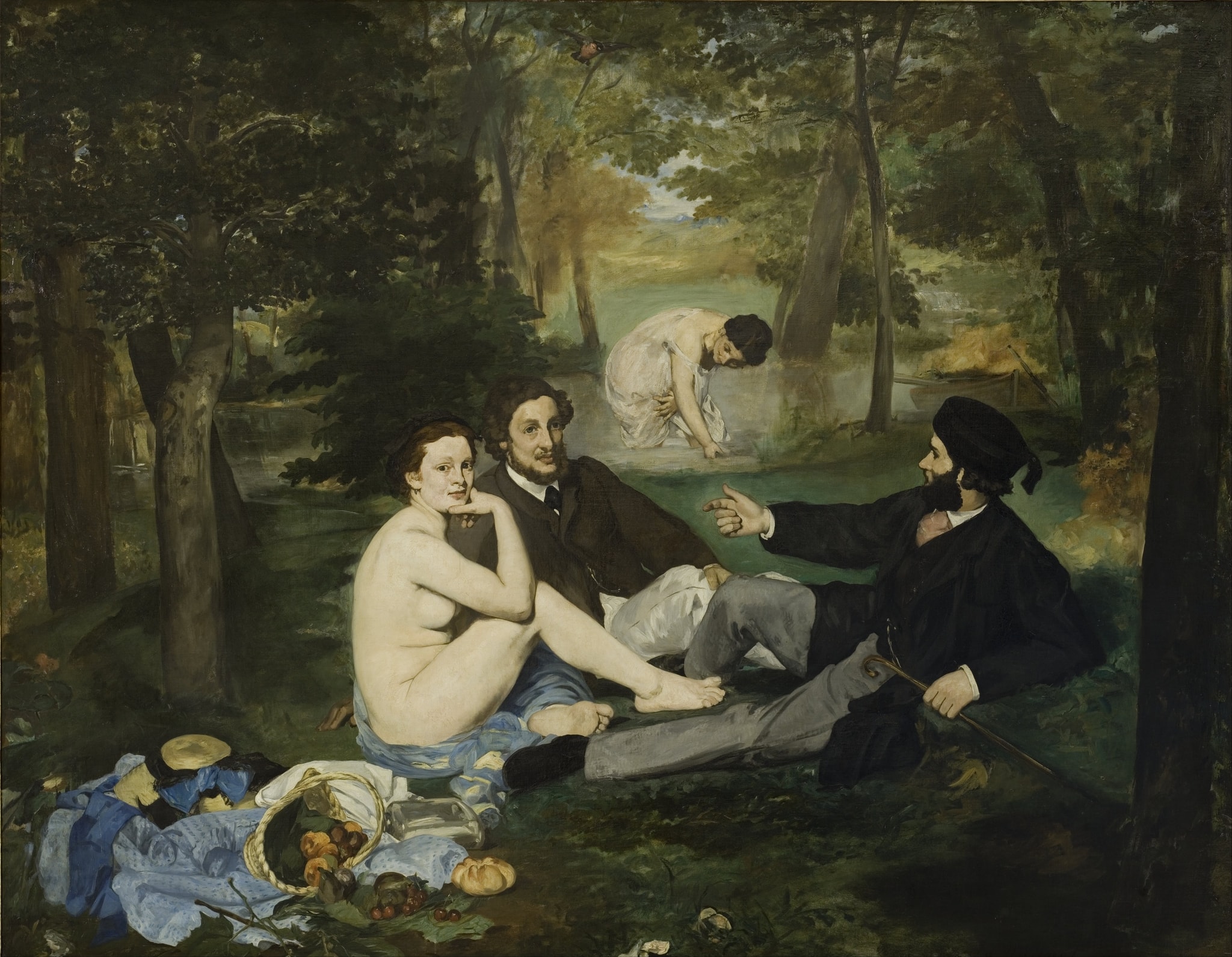
The nude woman’s calm, unswerving gaze in Manet’s Luncheon on the Grass meets ours head‑on, replacing myth with modern, present-tense encounter. By addressing the beholder directly, she collapses the safe distance of academic nudes and turns a picnic into a confrontation—one of the shocks that made 1863 a watershed for modern art.
Historical Context
Shown in 1863 at the new Salon des Refusés under the title Le Bain, Manet’s canvas scandalized viewers because it presented a contemporary nude among clothed men without mythological pretext. The central figure was modeled by Victorine Meurent, while the men drew on real sitters, underscoring the work’s modernity and immediacy. Her direct look outward—neither coy nor apologetic—was read as a frank, face‑to‑face address that broke with academic decorum 1.
Manet built this provocation on revered precedents while stripping them of allegory. He recalled Titian/Giorgione’s pastoral nudes and adapted the grouping from Marcantonio Raimondi’s engraving after Raphael’s Judgment of Paris, yet recast the scene in contemporary terms. The nude’s unblinking gaze helps declare this anti‑mythological stance, intensifying the sense that a modern person confronts us from the canvas. Smarthistory emphasizes how this very direct, nonchalant gaze disorients the viewer and makes the painting’s affront not only a matter of subject but of address 2.
Symbolic Meaning
The outward look embodies a new, modern mode of pictorial address. Michael Fried has described Manet’s modernism as a turn to facingness—figures that openly acknowledge and engage the beholder. In Déjeuner, the nude’s gaze functions as that acknowledgment, pulling us into a present-tense exchange and dissolving the fiction of a self-contained world. Rather than a timeless ideal, she appears as a contemporary subject who sees—and makes us feel seen 3.
Marilyn R. Brown characterizes Victorine Meurent’s look as “knowing (yet somehow alienated),” a formulation that captures the painting’s deliberate ambiguity of motive and story. Nineteenth‑century viewers often read the scene as a mix of male students and prostitutes; the nude’s unapologetic, returned gaze fed that social provocation while refusing a single moral or narrative key 4. Manet’s refusal of a mythological alibi, underscored by this direct address, became a lightning rod at the Salon des Refusés and a marker of modernity in both subject and stance 12. The gaze also anticipates the even more confrontational address of Olympia, establishing a continuum in which Manet compels viewers to reckon with their own position before the picture—no longer spectators of a fable, but participants in a modern exchange of looks 5.
Artistic Technique
Manet renders the gaze with abrupt contrasts and a pared-down facture: sharp lights and darks, minimal mid‑tones, and an almost cut‑out contour around the head and shoulders heighten the immediacy of her eyes meeting ours 2. The lighting compounds that effect. As Foucault observed, Manet introduces a light that seems to emanate from the viewer’s side, depriving the body of conventional modeling and intensifying its frontal presence—so the look feels squarely addressed to us 6. Compositionally, the central trio adapts a Raphael-derived scheme, but Manet flattens depth and places the nude close to the picture plane, tightening the distance across which her gaze travels 1.
Connection to the Whole
The woman’s gaze is the painting’s hinge: it anchors the foreground group and establishes the conduit between the fictive picnic and the real spectator. Because Manet withholds a stable narrative while flaunting Old Master quotations, this direct look becomes the key through-line, transforming us from distant observers into implicated interlocutors 2. In declaring contemporary life—and looking back at us to insist on it—the gaze crystallizes the canvas’s modern ambition, the very quality the Musée d’Orsay identifies as a point of departure for modern art 1. As Olympia would soon confirm, Manet’s strategy of confrontational address begins here, charging the entire composition with a reciprocal, modern encounter of looking 5.
Explore the Full Painting
This is just one fascinating element of Luncheon on the Grass. Discover the complete interpretation, symbolism, and hidden meanings throughout the entire work.
← View full analysis of Luncheon on the GrassSources
- Musée d’Orsay – Le Déjeuner sur l’herbe (collection entry)
- Smarthistory – Édouard Manet, Le déjeuner sur l’herbe
- TandF Online – On Michael Fried’s account of Manet’s modernism (“facingness”)
- caa.reviews – Marilyn R. Brown on Manet’s Le Déjeuner sur l’herbe
- The Met – Manet/Degas exhibition guide (on direct, confrontational gazes; link to Olympia)
- artcritical – John Rapko on Michel Foucault’s reading of Manet’s lighting