The Picnic Still Life in Luncheon on the Grass
A closer look at this element in Édouard Manet's 1863 masterpiece
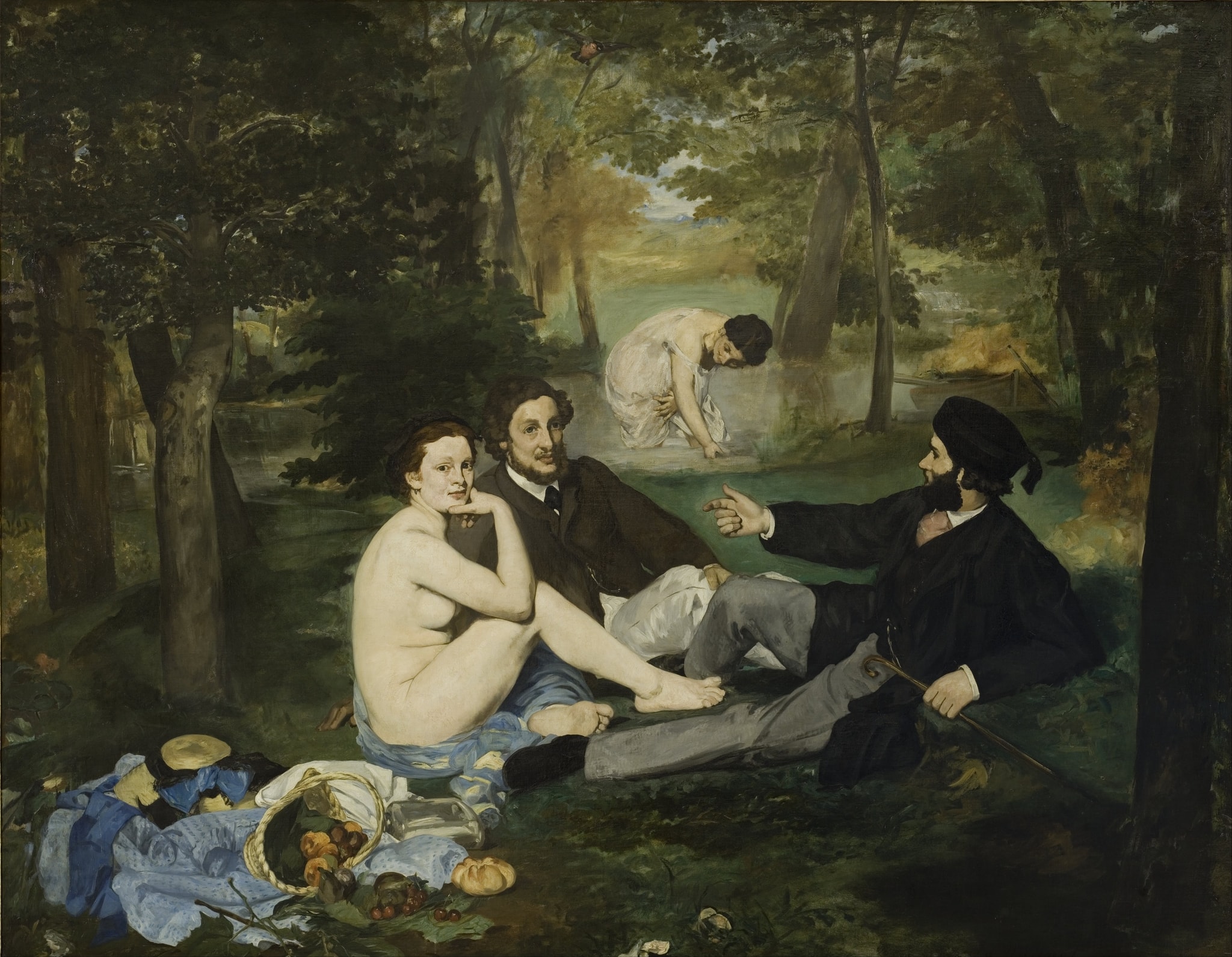
Manet plants a dazzling still-life vignette at the lower left of Luncheon on the Grass: an overturned wicker basket, cherries and stone fruit, a round loaf, and the nude’s polka‑dot dress and hat. This compact cluster is both a bravura display of touch and a modern quotation of Old Master still life, sharpening the painting’s charge of contemporary leisure and erotic candor.
Historical Context
Painted in 1863, Luncheon on the Grass fuses the scale of a history canvas with an urban, contemporary outing. Manet stages a genre-mixing manifesto: Old Master quotations from Titian/Giorgione and a Raphael engraving underpin a resolutely modern scene, while the picnic things are composed "as in a still life." The Musée d’Orsay, which holds the painting, highlights the artist’s calculated borrowings and his radical flattening and contrasts—formal decisions that thrust the foreground into our space 1.
Within this program, the foreground still life declares Manet’s command over a prestigious painter’s genre. The Met’s overview of Manet stresses how still life served nineteenth‑century artists as a proving ground for surface, texture, and light; Manet repeatedly inserted such passages into figure compositions to assert authority while dialoguing with Spanish and earlier European masters 2. The result in Le Déjeuner is not an incidental picnic but a deliberate quotation of tradition, staged at the viewer’s feet to announce the painting’s blend of past and present 12.
Symbolic Meaning
Seen up close, the basket tipped on its side, the glossy cherries, peaches and plums, the brioche‑like loaf, and the nude’s discarded garments read as an autonomous quotation of still-life tradition inside a modern park. Smarthistory’s account identifies the fruit-and-roll ensemble as a conscious still-life passage; the Orsay further frames the painting as a witty “la partie carrée” (a foursome), tying the picnic props to the work’s erotic modernity 36.
In European still-life conventions—codified above all in Dutch and Spanish painting—arranged food evokes appetite, pleasure, and reflections on consumption and transience (vanitas). Manet taps this vocabulary to charge the scene with desire: the food lies untouched, the basket spills open, and clothing lies abandoned, redirecting appetite from luncheon to looking 48. Descriptive histories repeatedly note that the items are displayed “as in a still life,” underscoring artifice and quotation rather than anecdotal narrative 11.
Scholarly debate has mapped this corner as a node of meanings—sexual frankness, modern leisure, and self‑conscious pictorial staging—yet consensus holds that the still life intensifies the painting’s play between cultivated taste and bodily immediacy. The anthology on Manet’s Déjeuner surveys these readings and situates the motif as a fulcrum where traditional symbolism meets avant‑garde provocation 10.
Artistic Technique
Manet renders the cluster with tactile precision: the cherries catch hard highlights, the stone fruit carry warm, satiny bloom, and the round loaf is modeled with crisp, bready crust. Smarthistory points to the conspicuous fruit and roll as a virtuoso passage; its finish contrasts with the painting’s broader, more summary handling elsewhere—an intentional play of polish and “anti‑finish” 3.
Formally, the still life is anchored at the lower left, just below the nude—an inventory position recognized in academic cataloguing—and its cut‑out clarity locks to the picture plane 5. The Orsay emphasizes Manet’s “brutal” tonal contrasts and compressed depth; those choices make the basket, bread, and blue printed dress pop forward like studio props, turning the corner into a bright, tactile hinge for the whole composition 1.
Connection to the Whole
The picnic still life functions as the painting’s entry point and anchor. Its low placement and concentrated detail pull the viewer in, then propel the eye from objects to figures and back into the staged grove—a compositional engine that stabilizes Manet’s large, theater‑like field 13.
Because the items are arranged “as in a still life,” they foreground artifice inside “nature,” aligning with the canvas’s larger project of collapsing hierarchies—Old Masters versus modern life, history scale versus everyday subject. The Orsay underscores how Manet builds the picture on a few essential elements; the still life is one of those structural components, balancing the bold nude and seated men while amplifying the work’s witty, sexual contemporaneity 61.
Explore the Full Painting
This is just one fascinating element of Luncheon on the Grass. Discover the complete interpretation, symbolism, and hidden meanings throughout the entire work.
← View full analysis of Luncheon on the GrassSources
- Musée d’Orsay — Object record: Le Déjeuner sur l’herbe
- The Met, Heilbrunn Timeline — Édouard Manet overview
- Smarthistory — Édouard Manet, Le Déjeuner sur l’herbe
- The Met, Heilbrunn Timeline — Still-Life Painting in Northern Europe, 1600–1800
- University of Michigan VRC — Catalog entry noting the lower-left still life
- Musée d’Orsay — Picasso/Manet exhibition page (structural elements; “la partie carrée”)
- Apollo Magazine — Descriptive account of the spilled fruit on the dress
- Artsy Editorial — On the untouched picnic and erotic priority
- Web Gallery of Art — Note on still-life and Courbet connections
- CAA Reviews — Manet’s Le Déjeuner sur l’Herbe (ed. Paul Hayes Tucker)
- Wikipedia — Le Déjeuner sur l’herbe (descriptive baseline: still-life staging)