How Much Is Self-Portrait with Palette Worth?
Last updated: March 13, 2026
Quick Facts
- Last Sale
- $33.1M (2010, Sotheby's, London)
- Methodology
- comparable analysis
Anchored to the painting’s 22 June 2010 Sotheby’s London sale (realized ~US$33.1M) and calibrated against subsequent trophy Manet results, a defensible present market window for an authenticated, museum‑quality Self‑Portrait with Palette in good condition and with intact provenance is approximately US$30–65 million. Attribution, condition, catalogue‑raisonné acceptance, or provenance issues would materially reduce this range.
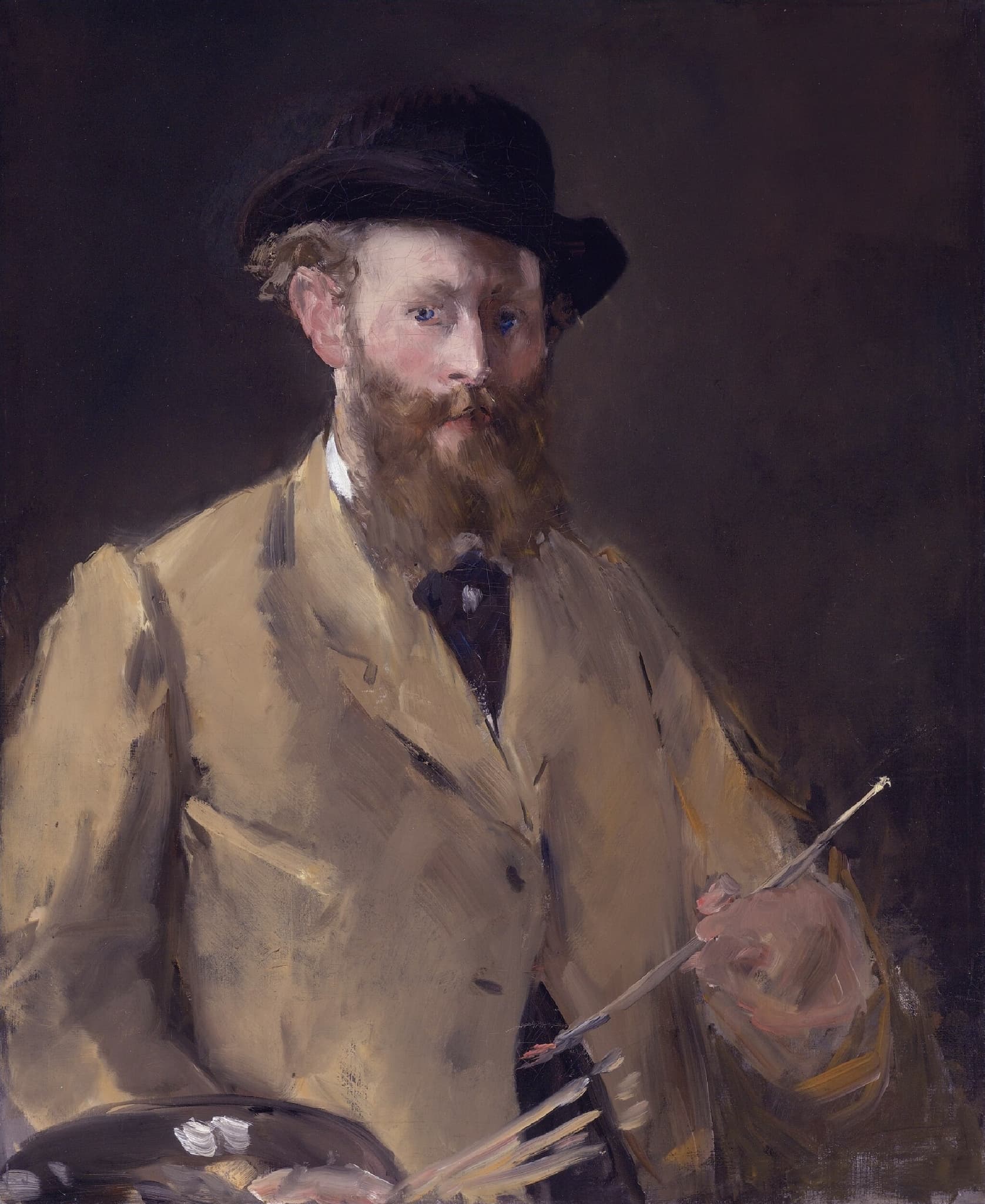
Self-Portrait with Palette
Édouard Manet • Oil on canvas
Read full analysis of Self-Portrait with Palette →Valuation Analysis
Primary anchor and context: The strongest single market datum is the painting’s 22 June 2010 sale at Sotheby’s London, when Autoportrait à la palette (1878–79) realized GBP £22,441,250 (reported ≈ US$33.1M) — this lot is the primary anchor for a current valuation of the same autograph canvas [1]. That result reflected a rare combination of autograph status, strong provenance and literature/exhibition history, and therefore functions as the baseline for a current market synthesis.
Comparables and market ceiling: For the top end of the range we rely on trophy Manet results that set the market envelope: Le Printemps (2014) established the artist auction record (US$65.125M) and Le Grand Canal (Paul G. Allen sale, 2022) realized US$51.915M — both demonstrate what a prime, museum‑quality Manet can achieve in peak sales conditions [2][3]. At the other end, high‑quality but non‑trophy authenticated Manets and still lifes have traded in the low double‑digit millions (for example a Sotheby’s New York still life in 2024 at c. US$10.1M), which helps define the lower bound for market‑grade works [4].
Adjustments and market environment: A straight inflation adjustment places the 2010 sale into the high‑$40M band in present dollars; however, auction house pricing discipline and a measured contraction in aggregate high‑end turnover (2023–24) counsel prudence. In practice this produces a workable auction estimate window that brackets the inflation‑adjusted anchor while allowing for market variability, condition differences and promotional execution (season, guaranteed sale, private‑treaty interest).
Key contingencies: The single greatest drivers that will move the painting toward the top or bottom of the stated range are (1) unequivocal catalogue‑raisonné acceptance and leading‑scholar endorsements, (2) a clean, documented provenance with no WWII‑era gaps, and (3) technical/condition condition consistent with the 2010 lot (the 2010 Sotheby’s note described a lined canvas with limited retouching). Any unresolved attribution, conservation or title concerns will prompt steep buyer discounts.
Conclusion and recommended sale route: Synthesis of the direct 2010 anchor and later trophy comparables supports a present market valuation of roughly US$30,000,000–US$65,000,000 for the autograph Self‑Portrait with Palette in comparable condition and provenance. To maximize value, secure a current technical and conservation report, confirm catalogue‑raisonné status and major‑museum exhibition/citation, and present the work in a marquee Impressionist sale (London or New York) with the option of a guarantee or controlled private‑treaty placement to stimulate competitive bidding [1][2][5].
Key Valuation Factors
Art Historical Significance
High ImpactManet painted relatively few self‑portraits and late, mature self‑representations are particularly prized by institutions and collectors because they illuminate the artist’s technique and persona at a consequential moment in his career. A securely attributed, museum‑quality Self‑Portrait with Palette occupies an important place in Manet’s oeuvre and is therefore collectible beyond ordinary portrait practice. Scholarly attention, catalogue‑raisonné entry and inclusion in major retrospectives enhance both cultural significance and market value. In short, art historical importance for this subject is high and directly supports a multi‑million‑dollar valuation premium.
Provenance & Exhibition/Literature
High ImpactThis painting benefits from an exceptionally strong and traceable provenance (Suzanne Manet → Hermann Paechter → Auguste Pellerin → Marquise de Ganay → Jakob Goldschmidt → John & Frances Loeb → subsequent private collectors) and a documented exhibition and bibliography record. Those elements materially reduce buyer risk and command price premiums at auction. Works lacking continuous, credible provenance or absent from catalogue raisonnés and major exhibitions suffer heavy discounts; conversely, the intact chain here is a major value driver and central to realizing the upper end of the estimate range.
Condition & Technical State
High ImpactCondition is decisive for late‑19th‑century oil paintings. The 2010 lot was described as a lined canvas with limited retouching; any subsequent relining, overcleaning, or extensive inpainting will be scrutinized and can depress market value. A current, professional conservation report (X‑radiography, infrared reflectography, varnish and pigment analysis, canvas weave assessment) is essential to confirm the painting’s physical state. Buyers pay a premium for original, stable paint and minimal historical restoration; condition uncertainties translate directly into lower realized prices and wider bid‑ask spreads.
Market Comparables & Pricing
High ImpactDirect comparables anchor the valuation: the same canvas’ 2010 Sotheby’s result is the principal datum, while trophy sales (2014 Le Printemps, 2022 Le Grand Canal) establish the high‑end envelope. Recent authenticated mid‑tier Manet sales show the market’s lower thresholds. These realized prices, adjusted for inflation and market cycle effects, provide the framework for the US$30–65M range. The execution (season, house, guarantee) and macro conditions at the moment of sale determine where within that band the work will realistically land.
Rarity & Supply
Medium ImpactMany of Manet’s most important canvases are held in major museums, creating a structural scarcity of top‑quality works in the market. A rare autograph self‑portrait that comes to market benefits from this tight supply. However, scarcity alone does not guarantee top prices; it must be coupled with condition, provenance and market timing. The rarity factor supports a premium but is moderated by buyer depth and competing trophy offerings in any given season.
Sale History
Sotheby's, London (Jakob Goldschmidt sale)
Christie's, New York (John & Frances L. Loeb sale)
Private transfer (reported)
Sotheby's, London (Impressionist & Modern Evening Sale, Lot 9)
Édouard Manet's Market
Édouard Manet is a blue‑chip, canonical 19th‑century French artist and a market leader within the Impressionist/Post‑Impressionist category. His canonical works are concentrated in museums, which restricts supply and elevates the market value of rare private examples. Auction records (notably Le Printemps at US$65.125M) show that exceptional Manets can command trophy prices; mid‑tier authenticated oils typically trade in the single to low double‑digit millions. Collectors and institutions prize quality, provenance and scholarly endorsement, making top‑quality Manets highly liquid among established buyers.
Comparable Sales
Self-Portrait with Palette (Autoportrait à la palette)
Édouard Manet
Direct prior auction of the exact painting (Sotheby’s 2010) — the single best market anchor for valuation.
$33.1M
2010, Sotheby's, London
~$48.0M adjusted
Self-Portrait with Palette (Autoportrait à la palette)
Édouard Manet
Earlier public sale of the same canvas (Loeb sale) showing historical price progression and prior market recognition.
$18.7M
1997, Christie's, New York
~$36.5M adjusted
Le Printemps (Spring / Jeanne Demarsy)
Édouard Manet
Artist auction record and a trophy Manet figure/portrait — sets the top-end market ceiling for best-in-class Manets.
$65.1M
2014, Christie's, New York
~$87.9M adjusted
Le Grand Canal à Venise (1874)
Édouard Manet
Recent high‑end Manet sale (2022) for a museum‑quality canvas — a strong recent comparable for market demand at the top end.
$51.9M
2022, Christie's, New York (Paul G. Allen sale)
~$56.1M adjusted
Vase de fleurs, roses et lilas (1882)
Édouard Manet
Recent authenticated Manet sale (still life) illustrating demand/pricing for high-quality but non‑trophy Manet works — useful for lower-bound context.
$10.1M
2024, Sotheby's, New York (Modern Evening Sale)
~$10.4M adjusted
Current Market Trends
Since 2023 the high‑end Impressionist and 19th‑century market has seen more conservative pricing and fewer blockbuster consignments; however, scarcity keeps demand robust for best‑in‑class works. Auction houses increasingly use guarantees and private treaty options to manage risk. In this environment, museum‑quality Manets still attract strong interest but execution and timing (season, exhibition tie‑ins) are critical to achieving top results.
Sources
- Sotheby’s: Impressionist & Modern Art Evening Sale, Lot 9 (2010) — Autoportrait à la palette
- Christie's: Impressionist & Modern Art Evening Sale results (Le Printemps, 2014 record)
- Christie's: The Collection of Paul G. Allen press materials (includes Le Grand Canal sale, 2022)
- Artnet News: Sotheby's Modern Evening Sale coverage (2024) — comparable mid/high‑tier Manet sale
- Art Basel / UBS Global Art Market reporting (2024) — market trend context