How Much Is A Cotton Office in New Orleans (Cotton Merchants in New Orleans) Worth?
Last updated: March 8, 2026
Quick Facts
- Methodology
- comparable analysis
Estimated market value if offered: USD 15–40 million. This range is derived from comparable sales of high‑quality Degas two‑dimensional works and sculptures, adjusted for the painting’s continuous museum ownership, historical importance as an early New Orleans subject, condition uncertainty, and deaccession/legal constraints.
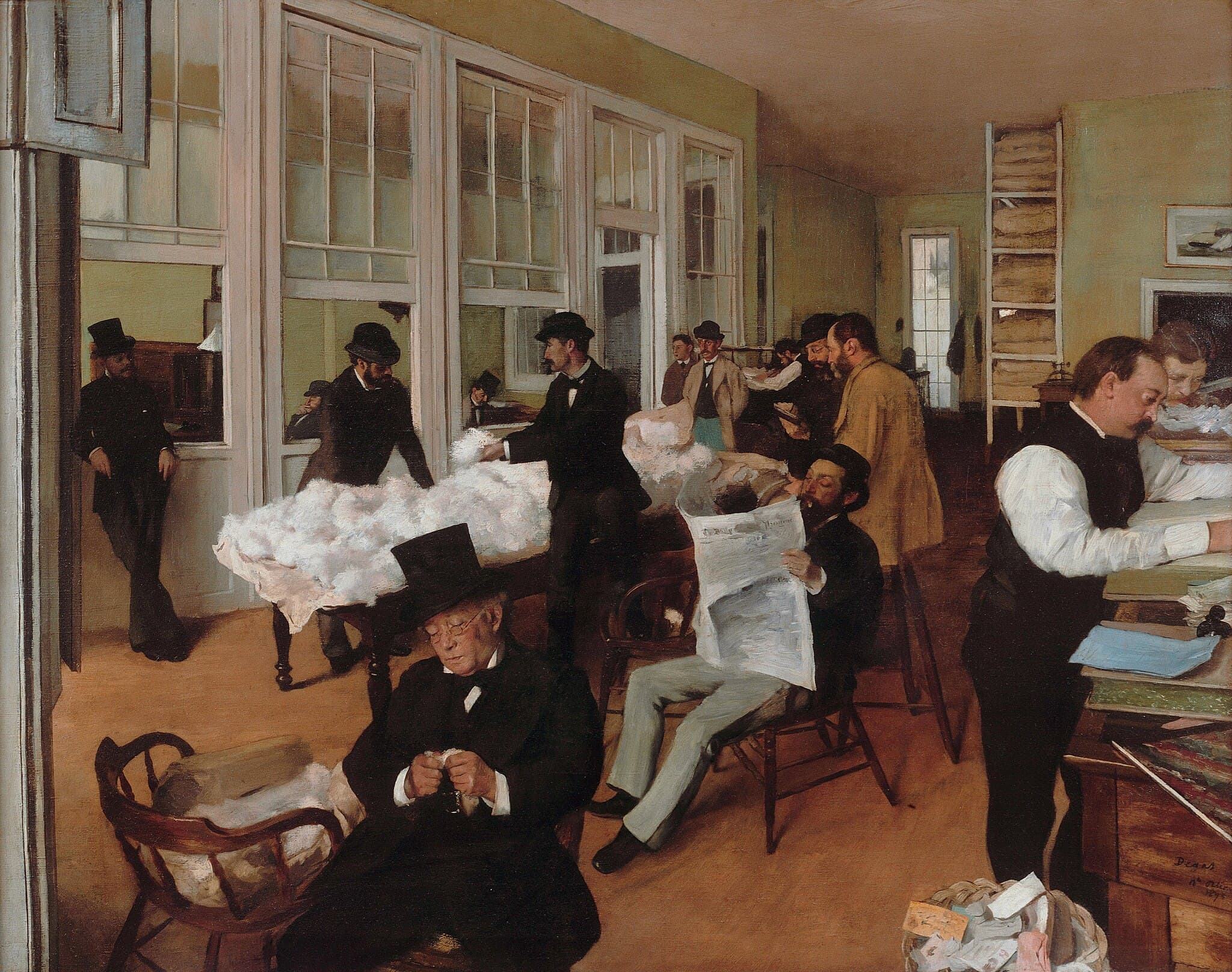
A Cotton Office in New Orleans (Cotton Merchants in New Orleans)
Edgar Degas, 1873 • Oil on canvas
Read full analysis of A Cotton Office in New Orleans (Cotton Merchants in New Orleans) →Valuation Analysis
Scope and premise. This valuation assumes a hypothetical market offering of Edgar Degas's A Cotton Office in New Orleans (1873). The work is recorded as a long‑term municipal/museum holding (Musée des Beaux‑Arts, Pau) with acquisition in 1878 and no modern public auction record, which materially affects liquidity and sale mechanics [1][2].
Methodology. I used a comparable‑analysis approach: anchoring to both the artist’s auction ceiling for iconic works and to realized prices for high‑quality two‑dimensional Degas pieces sold in the last two decades. Relevant anchors include the artist’s sculpture ceiling (Little Dancer, Christie’s 2022) and the top two‑dimensional result (Danseuse au repos, Sotheby’s 2008), together with more recent mid‑market oil/pastel results in the $6.8M–$12M band [3][4]. Those comparables establish a market context in which a museum‑quality, historically important oil could trade in the low‑to‑mid tens of millions if brought to market.
Upward drivers. The painting’s importance as an early Degas oil documenting his only U.S. visit, its family/social connections, and a long exhibition/bibliographic trail increase desirability and can justify a significant premium over run‑of‑the‑mill Degas oils. Institutional provenance also reduces attribution risk for collectors and institutions, supporting higher bids from well‑capitalized buyers who prize museum‑grade provenance [2].
Downward/limiting factors. Continuous museum ownership since 1878 makes a sale unlikely and introduces deaccession procedures, legal/municipal constraints and reputational friction that can reduce buyer depth. The subject — a cotton office interior — is historically important but less widely iconic than Degas’s ballet repertoire, so the pool of enthusiastic bidders is narrower. Crucially, I have not seen a current condition report; conservation issues or heavy restoration would materially lower realizable price.
Valuation mapping and final position. Balancing these forces yields the stated range of USD 15–40 million. The lower bound reflects a premium above recent mid‑market Degas oils/pastels (which frequently transact in the single‑ to low‑seven‑figure band) to account for museum provenance and historical importance. The upper bound approaches the ceilings set by the artist’s finest two‑dimensional works and by major bronze results, recognizing that this canvas is unlikely to eclipse Degas’s most iconic dancer images but could attract deep institutional/private interest if marketed effectively [3][4].
Next steps to firm the estimate. Confirm written ownership and any deaccession restrictions with Musée des Beaux‑Arts, Pau; obtain a full catalogue‑raisonné entry and bibliography; request a high‑resolution condition/conservation report and technical imaging; then solicit formal pre‑sale estimates from major Impressionist specialists at Christie’s and Sotheby’s. A formal, sale‑ready valuation requires those inputs and market testing.
Key Valuation Factors
Art Historical Significance
High ImpactA Cotton Office in New Orleans is an early, finished Degas oil dating to 1873 that documents the artist’s only American subject matter and his family connections in New Orleans. The work sits at an important moment in Degas’s development — a genre scene demonstrating his compositional and figural interests before his mature ballet and studio subjects. That provenance in art‑historical terms increases scholarly demand and curatorial value, making it materially more desirable than a routine study or print. Collectors and institutions pay premiums for works that materially advance scholarship or fill gaps in public collections, and this painting fits that profile.
Provenance & Institutional Ownership
High ImpactRecorded municipal acquisition by the Musée des Beaux‑Arts, Pau in 1878 gives this canvas exceptionally secure provenance and a long public exhibition history. Institutional ownership reduces attribution and authenticity risk, typically supporting higher valuations. At the same time, long‑term museum holdings are rarely sold; deaccession processes, legal covenants and public scrutiny create practical and reputational frictions that reduce liquidity and can suppress competitive bidding. If the museum were to deaccession, those constraints often lengthen the marketing timeline and limit buyer categories (institutional buyers and high‑net‑worth collectors comfortable with public provenance).
Rarity & Market Demand
Medium ImpactHigh‑quality, finished early Degas oils with secure provenance are uncommon on the market. Limited supply can push competitive bidding when similar works become available. However, demand is concentrated: Degas’s highest buyer interest centers on dancer imagery, major pastels and the Little Dancer bronzes. A New Orleans office interior is historically significant but appeals to a narrower collector base, tempering demand. Therefore rarity supports a premium, but subject‑specific demand constraints moderate the ceiling relative to the artist’s most iconic works.
Condition & Technical Authentication
Medium ImpactNo public, recent condition report was available for this painting. Condition, restoration history, and technical findings (pigment analysis, infra‑red/x‑ray) materially influence realizable value. Excellent original surface and documented conservation history would support the high end of the estimate. Conversely, major conservation interventions, unstable paint layers or heavy overpainting would reduce marketability and could lower the price significantly. Prior to sale or a binding valuation, a full technical examination is essential to quantify restoration risk and insurance requirements.
Exhibition & Bibliographic History
High ImpactThis work’s long presence in public collections and citation in catalogues raisonnés and exhibition catalogues strengthens buyer confidence and marketability. Well‑documented exhibition history increases institutional interest and can materially raise the price because museums and major collectors prize works with established scholarly records. Being published and exhibited reduces research risk, shortens due diligence timelines for buyers, and often attracts competitive bidding from institutions and deep‑pocketed private collectors when the opportunity arises.
Sale History
A Cotton Office in New Orleans (Cotton Merchants in New Orleans) has never been sold at public auction.
Edgar Degas's Market
Edgar Degas is a blue‑chip, blue‑ribbon artist within the Impressionist/19th‑century market. His auction record includes single‑figure and low‑double‑figure millions for high‑quality oils and pastels, and an overall auction ceiling above $40M (Little Dancer bronze, 2022). Two‑dimensional works can range from mid six‑figures to tens of millions depending on subject and provenance; dancer imagery and iconic pastels typically command the highest prices. Demand is steady but selective, with works that are fresh to market and museum‑grade attracting the strongest bids.
Comparable Sales
Danseuse au repos
Edgar Degas
Top two‑dimensional auction result for Degas (pastel). Anchors the ceiling for important Degas two‑dimensional works; while the medium (pastel) and subject (ballet) differ from the 1873 New Orleans office interior, this sale demonstrates the market's top willingness to pay for museum‑quality, well‑provenanced Degas works.
$37.0M
2008, Sotheby's New York
~$53.7M adjusted
Danseuse (1887)
Edgar Degas
Two‑dimensional Degas work (dancer subject) sold in 2021 — a contemporary mid‑market anchor for high‑quality canvases/pastels. Useful to gauge buyer appetite for important non‑sculptural Degas pieces even though the subject (dance) differs from the New Orleans office interior.
$11.8M
2021, Sotheby's New York
~$13.2M adjusted
La Coiffure
Edgar Degas
Interior/domestic subject (figure at toilette/combing hair) in two‑dimensional medium; closer in genre to an office interior than dancer imagery. Acts as a practical mid‑tier comparable for an interior oil by Degas offered in the modern market.
$7.0M
2021, Christie's New York
~$7.8M adjusted
Danseuses (Les coulisses de l'Opéra)
Edgar Degas
Backstage/opera (dancer) subject sold in 2022; another recent market data point for two‑dimensional Degas works in the single‑ to low‑seven‑figure band, useful as a lower‑mid anchor when valuing non‑sculptural Degas paintings.
$6.8M
2022, Christie's New York
~$7.5M adjusted
Little Dancer (bronze cast)
Edgar Degas
Artist's overall auction record (bronze sculpture). Not the same medium or subject as the New Orleans office painting, but essential as the market ceiling for Degas and a reminder of top buyer capacity for iconic Degas works.
$41.6M
2022, Christie's New York
~$45.8M adjusted
Current Market Trends
The market is currently bifurcated: fewer blockbuster Impressionist results since 2023, with selective recovery when high‑quality, well‑provenanced works appear. Buyers are more price‑sensitive and emphasize provenance, condition and fresh‑to‑market status. Works on paper and small bronzes show steady depth, while top‑tier canvases must be exceptional to reach prior peak levels. Institutional appetite remains an important price driver.
Sources
- Musée des Beaux‑Arts, Pau — object notice: Un bureau de coton à La Nouvelle‑Orléans (inv. 878.12)
- Degas Catalogue Raisonné — Bureau de marchands de coton à La Nouvelle‑Orléans (MS 837)
- Christie’s — May 12, 2022 sale results (Little Dancer record & Impressionist sale summary)
- Sotheby’s / market report — Danseuse au repos (Sotheby’s, Nov. 2008) and broader two‑dimensional benchmark
- Sotheby’s/Christie’s sale summaries — representative mid‑market Degas results (examples: 2021–2022 sale listings and press)