How Much Is Combing the Hair Worth?
Last updated: January 26, 2026
Quick Facts
- Methodology
- comparable analysis
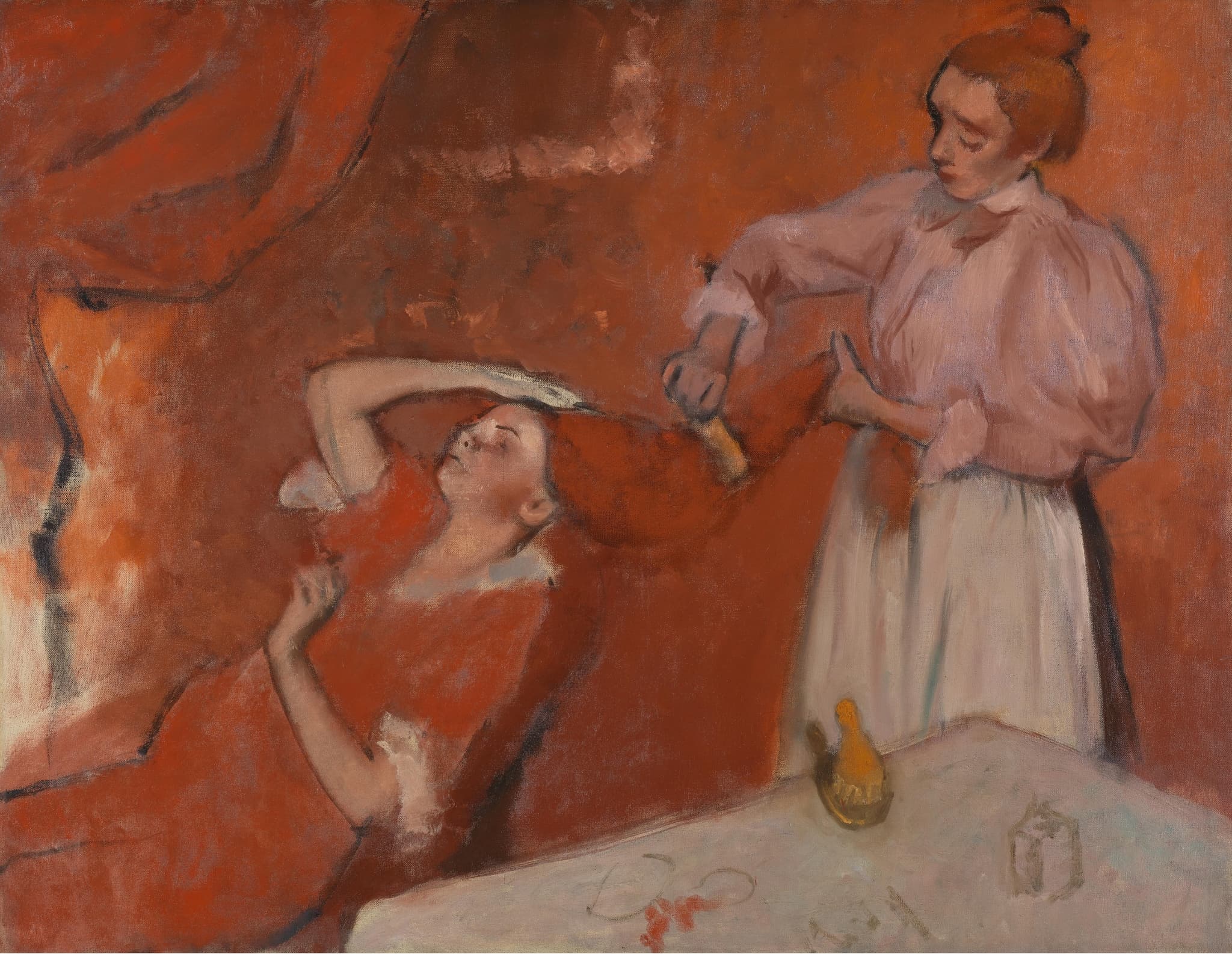
We estimate Edgar Degas’s Combing the Hair (La Coiffure), c.1896, at $50–70 million. A large, high-chroma late oil in a signature motif with distinguished provenance and a museum home, it merits pricing above Degas’s historical 2‑D auction apex.
Valuation Analysis
Conclusion: We estimate fair market value for Edgar Degas’s Combing the Hair (La Coiffure), c.1896 (oil on canvas, National Gallery, London, NG4865), at $50–70 million. This is a museum‑caliber late oil from a core Degas theme, of imposing scale and celebrated provenance (Henri and Pierre Matisse), long enshrined in a UK national collection [1].
Method and benchmarks: The range is derived from a comparable‑based analysis triangulating (i) Degas’s top auction benchmarks, (ii) subject/medium premiums, and (iii) scarcity. Degas’s overall auction record is $41.6m for a Petite danseuse de quatorze ans bronze (2022) [2], while his long‑standing 2‑D high is $37.0m (2008) for a dancer work on paper [3]. In the current market (2025–26), strong dancer pastels trade around $5–6m (e.g., Trois danseuses, $5.78m in 2025) [4], and a closely related subject pastel, La Coiffure, made ~$3.7m in Nov 2025 [5]. A large, saturated late oil on the same toilette motif commands a significant multiple of top pastels and should rationally price above the older 2‑D record, supporting a $50–70m band.
Quality, rarity, and subject: Combing the Hair epitomizes Degas’s late 1890s “bathers/toilette” investigations: audacious cropping, intense color, and painterly density. Fully resolved late oils of this subject and scale are scarce—many reside in institutions—whereas pastels circulate more regularly. This scarcity premium, coupled with the work’s art‑historical centrality within Degas’s oeuvre, underwrites the high estimate.
Provenance and institutional stature: The canvas surfaced in the artist’s posthumous studio dispersal at Galerie Georges Petit (May 6–8, 1918), passed to the Copenhagen Consortium, and was acquired by Henri Matisse in 1921 before entering Pierre Matisse’s New York gallery and, ultimately, the National Gallery in 1937 [1][6]. Such a distinguished chain adds material confidence and a “trophy” cachet that typically amplifies competitive bidding for truly best‑in‑class examples.
Market context and positioning: Despite a contraction in 2024, the marquee end of the market rebounded in late 2025 with deep demand for blue‑chip, historically resonant works; supply scarcity remains the primary governor of price at the top [7]. Within this backdrop, a universally recognized late oil of this caliber could plausibly surpass Degas’s prior 2‑D benchmarks. The upper bound would be influenced by condition, timing, and sale choreography; nothing in the public record suggests impediments here. As the work is not for sale (UK national collection), the estimate represents a hypothetical fair‑market valuation consistent with recent trophy dynamics.
Key Valuation Factors
Art Historical Significance
High ImpactCombing the Hair stands at the center of Degas’s late investigations into women at their toilette, a theme that, alongside dancers, defines his legacy. The composition’s daring cropping, chromatic richness, and tactile handling exemplify his 1890s innovations, when he pushed color and pattern to near‑abstract effect while maintaining observational intimacy. Canonical status is reinforced by frequent reproduction, scholarship, and its long tenure in a leading national museum. Within Degas’s hierarchy of subjects, dancers are most universal, but connoisseurs prize the late bathers/toilette oils as the apex of his painterly experimentation. That combination of subject centrality and late‑period mastery supports top‑tier pricing relative to the broader oeuvre.
Rarity and Scale
High ImpactLarge, fully resolved late oils of the bather/toilette motif are exceptionally scarce in private hands; many are in museums. By contrast, pastels on the theme appear more regularly and trade in the low‑ to mid‑seven figures today. This canvas’s substantial dimensions and saturated palette place it among the most desirable manifestations of the series. Scarcity at this level commands a pronounced premium—especially when the example is both compositionally and chromatically outstanding. In a trophy‑driven market where supply dictates outcomes, the rarity of late oils like this creates competitive tension that can propel prices above historical benchmarks for Degas’s two‑dimensional works.
Provenance and Exhibition History
High ImpactThe painting’s chain—from Degas’s 1918 studio sale to the Copenhagen Consortium, to Henri Matisse (1921), Pierre Matisse in New York, and finally the National Gallery in 1937—confers exceptional credibility and cachet. Matisse’s ownership adds art‑historical resonance, while long institutional custody signals quality and stabilizes scholarly reputation. Works with such pedigrees benefit from heightened buyer confidence, smoother due diligence, and a “trophy premium.” A deep exhibition and publication record typically accompanies such museum pieces, further widening the global buyer base and improving the likelihood of strong competition should a comparable example come to market.
Market Benchmarks and Positioning
Medium ImpactDegas’s overall auction record is $41.6m for a Petite danseuse bronze (2022), while his 2‑D apex remains $37.0m (2008). Recent top pastels on dancers—his highest‑demand subject—achieve ~$5–6m, and a related La Coiffure pastel brought ~$3.7m in 2025. A museum‑grade late oil of the toilette motif warrants a substantial multiple over pastel comparables and should price above the older 2‑D record, especially in today’s selective but well‑capitalized trophy market. The $50–70m range reflects this triangulation, adjusting for scarcity, subject prestige, and institutional stature, while recognizing that dancer oils might still set the absolute peak in certain cycles.
Sale History
Galerie Georges Petit, Paris (Degas 1ère Vente, lot 44)
Posthumous studio sale; acquired by the Copenhagen Consortium (Hansen/Heilbuth/Winkel & Magnussen). Price in francs not confirmed here.
Galerie Barbazanges, Paris (to Henri Matisse)
Purchased by Henri Matisse; later with Pierre Matisse, New York (c.1936).
National Gallery, London (acquisition)
Bought by the National Gallery with the Knapping Fund; price not published online.
Edgar Degas's Market
Edgar Degas remains a blue‑chip cornerstone of the Impressionist/Modern category, with robust global demand anchored in his dancer imagery and late bathers. His current overall auction record is $41.6 million for Petite danseuse de quatorze ans (2022), and the long‑standing 2‑D benchmark is $37.0 million (2008). High‑quality dancer pastels continue to transact reliably around $5–6 million, while strong bronzes occupy the low‑ to mid‑seven figures with outliers for iconic casts. Liquidity is broad across media, but buyers are increasingly selective on condition, subject, and freshness. Top‑tier, museum‑caliber works with exemplary provenance are scarce and can attract competitive bidding that challenges historical highs, particularly when they represent signature themes in Degas’s practice.
Comparable Sales
Danseuse au repos
Edgar Degas
Record price for a 2‑D work by Degas; core subject (dancer), late period aesthetic; anchors upper bound for 2‑D Degas pricing.
$37.0M
2008, Sotheby's New York
~$54.2M adjusted
Danseuses à la barre
Edgar Degas
Top‑tier pastel in a signature motif; long‑standing benchmark for Degas works on paper and 2‑D pricing.
$26.5M
2008, Christie's London
~$38.8M adjusted
Petite danseuse de quatorze ans (bronze, cast 1927)
Edgar Degas
Artist’s overall auction record; establishes the current market ceiling for Degas trophies (different medium, but key for top‑end demand).
$41.6M
2022, Christie's New York
~$44.8M adjusted
Trois danseuses (c. 1897), pastel
Edgar Degas
Late‑period pastel close in date to Combing the Hair; demonstrates current (2025) demand around $5–6m for quality works on paper.
$5.8M
2025, Sotheby's New York
Danseuse à la barre (1877), pastel
Edgar Degas
Strong recent pastel result for a core dancer subject; shows durable $5–6m level for prime sheets.
$5.6M
2023, Christie's New York
~$5.8M adjusted
La Coiffure (La Toilette), pastel (c. 1896)
Edgar Degas
Direct subject‑matter match (coiffure/toilette) and close in date; indicates 2025 market appetite for the motif in pastel versus an oil.
$3.7M
2025, Christie's New York
Current Market Trends
The upper tier of the Impressionist/Modern market contracted in 2024 amid fewer $10m+ consignments, then rebounded in late 2025 as supply improved and capital concentrated on historically resonant names. Blue‑chip Impressionists benefited from renewed institutional programming around the 150th anniversary of Impressionism and a continued preference for proven masters. Buyers are selective and data‑driven, rewarding top condition, strong provenance, and signature subjects, while penalizing compromised or secondary works. In this environment, trophy‑level, museum‑grade pictures—especially scarce late oils—command premiums over historical comps, whereas mid‑tier works face price dispersion. Scarcity remains the key swing factor for price outcomes at the very top.
Sources
- National Gallery, London: Combing the Hair (La Coiffure), NG4865
- Forbes: Degas 'Little Dancer' Fetches Record-Breaking $41.6 Million
- The Art Wolf: Sotheby’s Impressionist and Modern Art, Nov 3, 2008 (record for 2-D Degas)
- Sotheby’s: Trois danseuses (c. 1897), Modern Evening Auction, Nov 20, 2025
- Le Monde: A two-headed art market in 2025 (notes 2025 'La Coiffure' pastel result)
- INHA Digital Library: 1ère Vente Degas (6–8 May 1918) catalogue
- Art Basel & UBS: The Art Market 2025 (Auctions analysis)