How Much Is Miss La La at the Cirque Fernando Worth?
Last updated: March 8, 2026
Quick Facts
- Methodology
- comparable analysis
If legitimately offered today, Miss La La at the Cirque Fernando would realistically be valued in a working commercial range of USD 25–70 million, with a practical auction estimate of USD 30–60 million in an optimal evening sale. This opinion is hypothetical: the painting is held by the National Gallery (NG4121) and any market sale would depend on an exceptional, regulated deaccession and a current condition report.
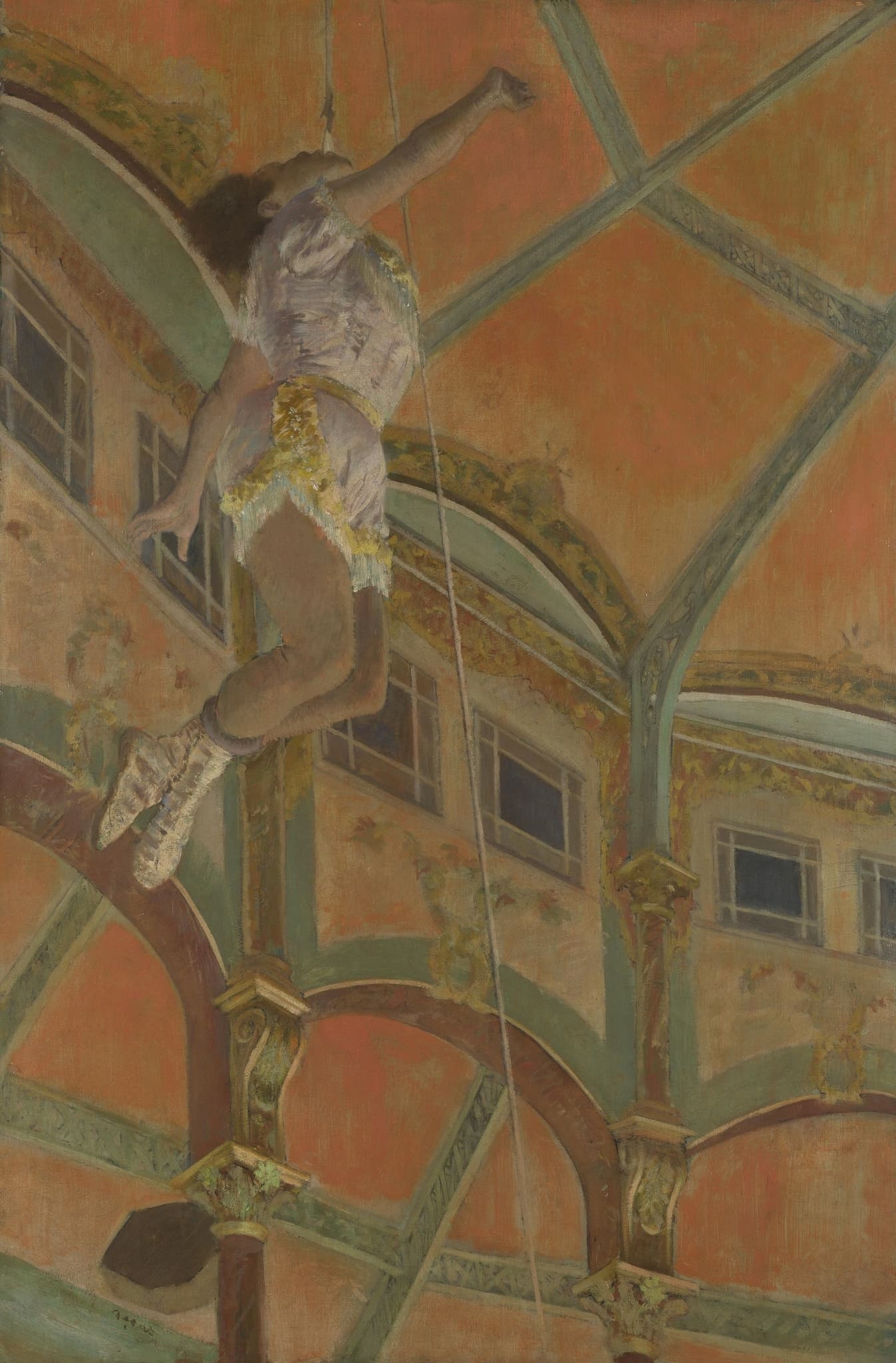
Miss La La at the Cirque Fernando
Edgar Degas, 1879 • Oil on canvas
Read full analysis of Miss La La at the Cirque Fernando →Valuation Analysis
Valuation conclusion: If lawfully offered in the commercial market today, Hilaire‑Germain Edgar Degas’s Miss La La at the Cirque Fernando would realistically fall into a working valuation range of approximately USD 25,000,000–70,000,000, with a practical auction estimate of USD 30,000,000–60,000,000 at a major evening sale under optimal conditions. This opinion is necessarily hypothetical: the painting is in the National Gallery (NG4121) and is not a normal market lot absent an exceptional, regulated deaccession [1].
Comparable basis and price precedent: The upside in the band is supported by modern high‑end Degas results and the scarcity of museum‑quality oils on the secondary market. The 2022 Christie’s result for a marquee Degas example (the "Petite danseuse") realized US$41.6M and demonstrates buyer willingness to pay tens of millions for canonical Degas works; two‑dimensional Degas benchmarks such as major pastels/gouache sales have historically reached the high‑tens of millions when sized to current market dynamics [2]. Older oil sales (for example Les Blanchisseuses, 1987) must be inflation‑adjusted and market‑moment indexed; when uplifted they sit in the high‑$30M neighborhood and provide an oil anchor. Because Miss La La is an iconic, museum‑quality oil with a unique subject and composition, these comparables justify positioning it above typical mid‑market pastels but subject to the condition and marketability adjustments noted below.
Provenance, exhibition and condition considerations: The painting’s continuous, well‑documented provenance and extensive exhibition history materially increase buyer confidence and therefore value. Institutional ownership in a major national collection implies professional conservation oversight and strong documentation, which reduce attribution risk and support top‑tier pricing. That said, a formal, current conservator’s report is essential: significant restoration, relining, or paint instability would reduce market value materially, while a pristine, original surface and full conservation documentation would justify the upper portion of the band.
Marketability and legal constraints: Practical marketability is the principal limiting factor. UK public‑collection policy and the National Gallery’s collecting remit make a sale highly unlikely; any deaccession would be exceptional, tightly regulated and potentially encumbered by export or in‑country retention conditions. If a lawful deaccession did occur, intense institutional and private interest could push final prices toward the top of the band, but transactional complexity, legal scrutiny and reputational considerations can also compress competitive bidding.
Recommendation: My working commercial valuation range for Miss La La is USD 25–70 million (displayed as $25–70 million), with a likely auction band of USD 30–60 million for an evening sale under optimal conditions. To convert this working range into a definitive insured or reserve number, obtain the National Gallery’s insurer valuation, a current conservation report, and written pre‑sale estimates from two major auction houses; those documents will materially alter the final achievable figure and sale strategy [1][2].
Key Valuation Factors
Art Historical Significance
High ImpactMiss La La is among Degas’s most distinctive painted works: executed and exhibited in 1879, it presents an unusual subject (a Black circus performer suspended in mid‑air) combined with daring foreshortening and compositional experimentation. The canvas is repeatedly cited in scholarship on modernity, performance and race, and functions as a focal image in major exhibitions about Degas and the circus. That level of art‑historical importance elevates its status beyond a decorative or workshop piece and typically drives a material premium in the market because collectors and institutions pay for canonical, well‑documented masterpieces. The combination of rarity, scholarship and public recognition is a principal value driver.
Provenance & Exhibition History
High ImpactThe painting benefits from an unusually robust provenance and exhibition record: shown by Degas in the Fourth Impressionist Exhibition (1879), retained by the artist until 1904, sold via Paul Durand‑Ruel and ultimately acquired for the Courtauld Fund and presented to the National Gallery in 1925 (transferred from Tate 1950). Continuous institutional ownership and repeated museum loans/publications reduce attribution risk and increase buyer confidence, which supports a higher valuation. At the same time, this same provenance contributes directly to the practical unavailability of the work on the market—museum holdings are rarely sold—so provenance is both value‑enhancing and a marketability constraint.
Market Comparables & Price Precedent
High ImpactComparable pricing for canonical Degas works anchors this appraisal. Recent marquee results (for example a 2022 Christie’s marquee sale achieving US$41.6M for a high‑profile Degas object) demonstrate that buyers will pay tens of millions for Museum‑quality Degas works [2]. Major two‑dimensional sales have historically reached similar orders of magnitude; older oil sales when inflation‑adjusted fall into the high‑$30M range. Because Miss La La is an iconic oil and very rarely, if ever, offered, these comparables justify a multiten‑million valuation, with placement inside the 25–70M band determined by condition, sale format and legal constraints.
Condition & Conservation
Medium ImpactPhysical condition and treatment history materially influence value. Museum stewardship typically means professional conservation, but only a current, detailed conservator’s report will confirm the picture’s structural and surface integrity. Major interventions, relining, overpainting or unstable paint layers would reduce market value—commonly by a significant percentage—because they increase restoration costs and deter aggressive bidding. Conversely, an original, well‑preserved surface with full treatment documentation will support the top of the range. Procuring a certified conservator’s statement is essential to translate the working range into a specific reserve or insured value.
Legal / Deaccession Likelihood & Marketability
High ImpactThe single most consequential non‑artistic factor is that the painting is held by the National Gallery. UK public‑collection policy, institutional mandates and public accountability severely restrict the probability of a market sale; any deaccession would be exceptional and subject to legal and policy conditions, which may include in‑country retention or export restrictions. These constraints can narrow the buyer pool and alter sale mechanics, reducing competitive international bidding or imposing sale conditions. Thus, the practical likelihood of a free commercial sale is low and materially affects achievable price.
Sale History
Miss La La at the Cirque Fernando has never been sold at public auction.
Edgar Degas's Market
Edgar Degas is a blue‑chip, canonical Impressionist/Post‑Impressionist artist with durable institutional and collector demand across media. His market includes multi‑tens‑of‑millions results—most notably recent marquee sales in both sculpture and two‑dimensional media—while also showing growing polarization: museum‑quality masterpieces remain highly sought after, whereas mid‑tier pastels and drawings face softer demand. Degas’s ballet and performance subjects are particularly prized; rarity, provenance and technical pedigree are decisive in pricing. For an iconic, museum‑quality oil such as Miss La La, the artist’s market supports a top‑tier valuation relative to most of his works.
Comparable Sales
Petite danseuse de quatorze ans
Edgar Degas
Same artist; marquee, museum‑quality work that set the modern auction record for Degas — demonstrates top collector willingness to pay tens of millions for canonical Degas works (though it is a sculpture rather than a painting).
$41.6M
2022, Christie's New York
~$45.1M adjusted
Danseuse au repos (pastel/gouache)
Edgar Degas
Same artist and two‑dimensional medium (pastel/gouache). At time of sale this was a two‑D Degas benchmark — useful for valuing a high‑quality, museum‑calibre Degas painting/pastel after inflation adjustment.
$37.0M
2008, Sotheby's New York
~$54.5M adjusted
Les Blanchisseuses (The Laundry Maids)
Edgar Degas
Important Degas oil sold on the modern market; an historical oil benchmark that must be inflation‑adjusted and market‑updated when comparing to an institutional oil like Miss La La.
$13.7M
1987, Christie's London
~$38.2M adjusted
Danseuse attachant son chausson (pastel)
Edgar Degas
Contemporary sale from the same high‑profile 2022 sale as the Little Dancer example — shows price levels for high‑quality Degas pastels in the current collector pool (useful for mid‑tier vs. top‑tier calibration).
$9.0M
2022, Christie's New York (Anne H. Bass sale)
~$9.7M adjusted
Current Market Trends
Since post‑pandemic peaks the Impressionist sector has softened and become more selective: auction turnover declined in 2023–2024, and the market has polarised so that museum‑quality masterpieces outperform while decorative or mid‑tier works underperform. Major exhibitions and technical scholarship continue to stimulate institutional demand for canonical pieces, but timing and sale format are now central to achieving top results. For a flagship Degas oil, a marquee evening sale in a strong market window will maximize value; legal or availability constraints can compress outcomes.