The Ballet Master in The Ballet Class
A closer look at this element in Edgar Degas's 1873–1876 masterpiece
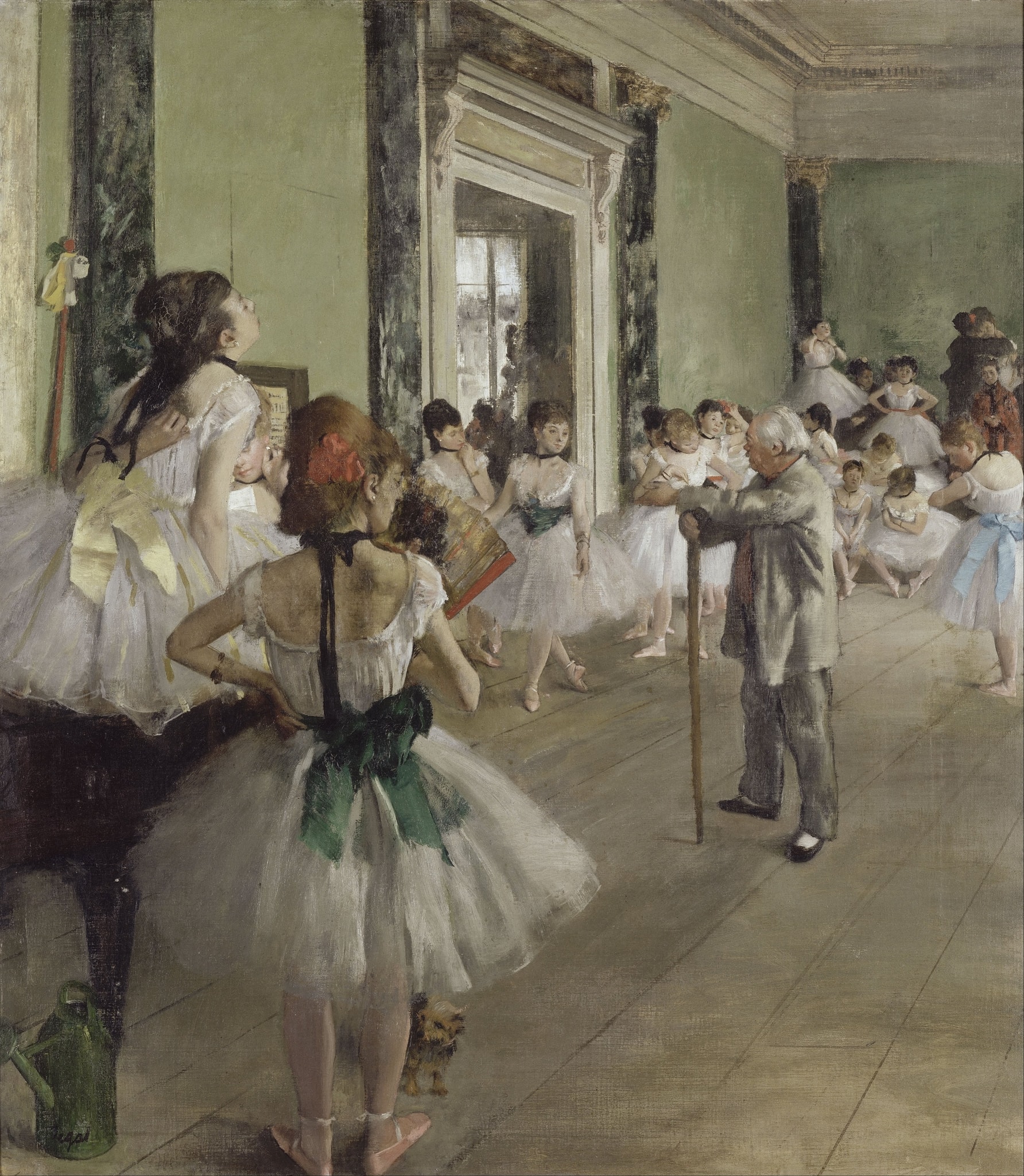
Degas’s “ballet master” is no anonymous overseer but the famed Jules Perrot, planted mid‑studio with cane in hand, literally beating time. His compact, still figure crystallizes the painting’s modern drama: behind the shimmer of tutus lies measured labor, correction, and the counting-off of work.
Historical Context
Painted between 1873 and 1876, The Ballet Class belongs to Degas’s sustained exploration of the Paris Opéra’s workrooms rather than its stage. The Musée d’Orsay identifies the elderly instructor as Jules Perrot (1810–1892) and stresses his role as the class’s timekeeper, “beating time on the floor with his baton”—a concise cue to the studio’s regimen at the close of a lesson 1.
The picture aligns with a companion composition, The Dance Class (Metropolitan Museum of Art), created for the baritone Jean‑Baptiste Faure and linked to the Opéra’s milieu of performers, teachers, and patrons. Met curators note the setting’s ties to the former Opéra on the rue Le Peletier—destroyed by fire in 1873—and describe how Degas organizes a rehearsal moment rather than spectacle, with Perrot conducting and assessing the students 2. Together these contexts explain why Degas installed the ballet master at the center of his project: to register the contemporary institution of the Opéra and to picture the disciplined labor that made Paris’s dance culture run 12.
Symbolic Meaning
Perrot’s cane functions as the studio’s metronome, turning him into a living emblem of authority, discipline, and time. The Orsay account explicitly casts him as the inflexible master who keeps count; the surrounding dancers stretch, retie ribbons, or wait their turn, visually dramatizing obedience and drift around a single clocklike presence 1. Britannica emphasizes that the moment is evaluative—the pupils await Perrot’s judgment—so the figure also stands for hierarchy and scrutiny within a modern professional system 5.
For many interpreters, Degas’s dance imagery is a metaphor for artistic practice itself: the backstage world reveals that grace rests on grueling, systematic work and on the correction of error. In that reading, the ballet master personifies rule‑bound craft, the necessary counterweight to the effortless illusion the audience expects onstage 4. His age and sobriety, set against the dancers’ youth and fluttering tutus, heighten this symbolic polarity between appearance and discipline. He is the picture’s guarantor that beauty is made—counted, drilled, and refined—within an institution that regulates bodies, time, and ambition 145.
Artistic Technique
Degas stages Perrot’s authority through viewpoint and structure. A slightly raised, diagonally raked perspective sends the parquet’s converging lines toward the master, while the floor’s breadth becomes a visual instrument for counting steps and spacing bodies 12. Perrot’s compact silhouette and planted cane form a firm vertical accent against the swirl of white tutus; his gray suit and silver hair create a subdued tonal island amid pale skirts and green walls, separating command from motion 1.
Process scholars note that Degas often re‑positioned figures in these class scenes; some argue the teacher’s dominance was strengthened during revisions, an after‑the‑fact recalibration that clarifies authority within the ensemble 6. The result is a quietly emphatic portrait—less by facial likeness than by stance, rhythm, and the pictorial geometry that gathers around him 26.
Connection to the Whole
Perrot is the composition’s anchor and the narrative hinge. The long, curving procession of dancers, glimpsed from back to front, resolves toward his steady posture and baton, where gestures must be judged and regularized 2. Around him, the end‑of‑class fatigue—slumped shoulders, fidgeting hands, loosened ribbons—meets the unbending beat of instruction described by the Orsay 1.
This counterpoint of weariness and rule gives the painting its modern charge. Perrot unites the scene’s realism (labor, rest, waiting) with its architecture of time and space (counted beats, measured distances). He is the still point that converts observation into order, aligning Degas’s candid view of practice with the institutional frame that makes performance possible 12.
Explore the Full Painting
This is just one fascinating element of The Ballet Class. Discover the complete interpretation, symbolism, and hidden meanings throughout the entire work.
← View full analysis of The Ballet ClassSources
- Musée d’Orsay, La Classe de danse (The Ballet Class) – artwork record
- The Metropolitan Museum of Art, The Dance Class – curatorial overview
- Fitzwilliam Museum, Portrait of the dancer Jules Perrot (study)
- National Gallery of Art, Degas’s Dancers (online scholarly publication)
- Encyclopaedia Britannica, The Ballet Class
- Web Gallery of Art, The Dance Class – entry with process note