The Waiting Dancers in The Ballet Class
A closer look at this element in Edgar Degas's 1873–1876 masterpiece
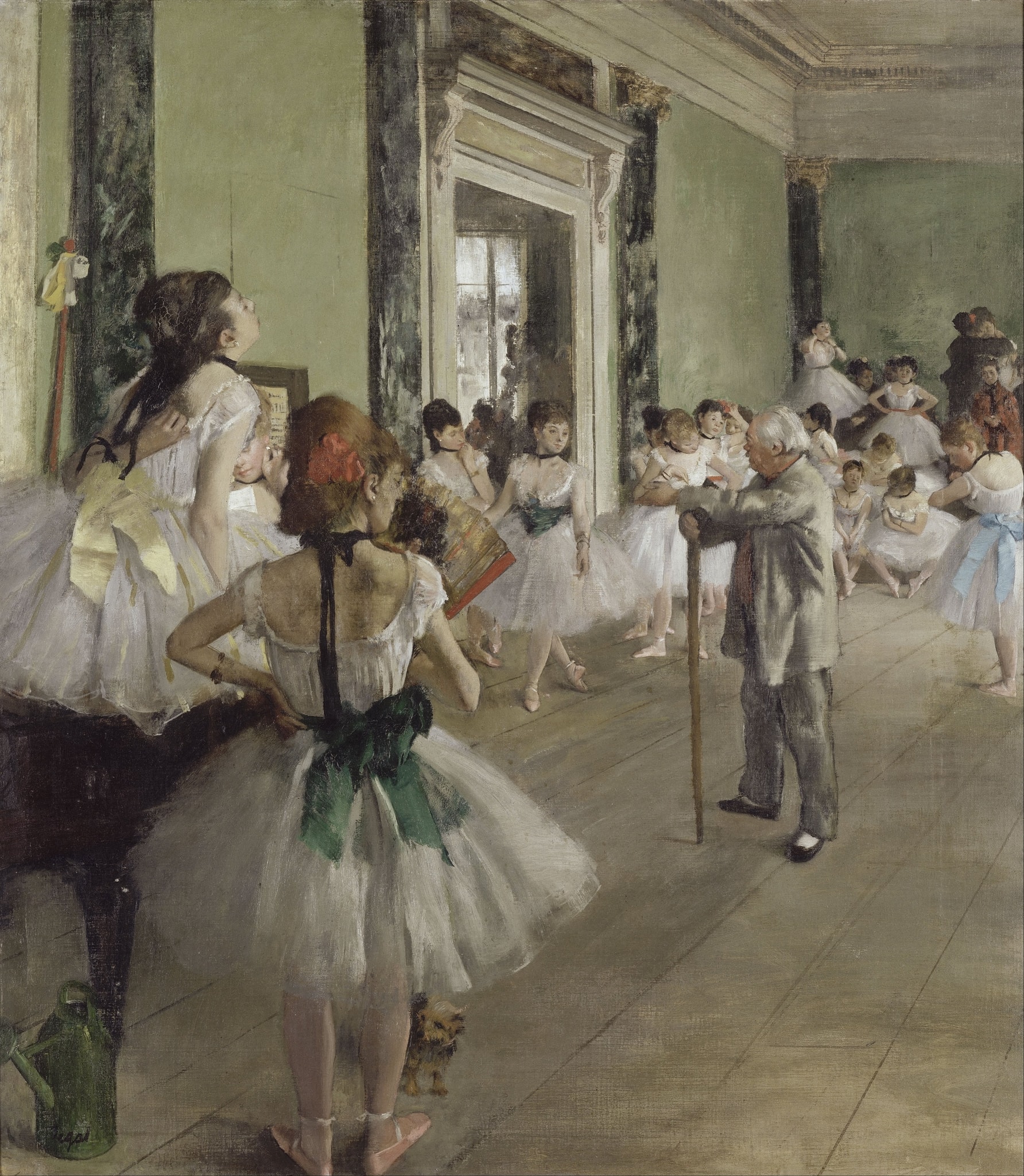
In The Ballet Class, Degas turns the room’s edges into a stage of another kind: the waiting dancers who stretch, scratch, fidget, and adjust ribbons. Their idle, unscripted pauses expose the labor and discipline behind grace, transforming a classroom “examination” into a modern study of bodies in transition.
Historical Context
Painted between 1873 and 1876, The Ballet Class situates its scene in a rehearsal room of the old Paris Opéra, with the ballet master Jules Perrot presiding over an end‑of‑class “examination.” Around the room’s perimeter, Degas records pupils after exertion—fixing hair, scratching a shoulder, resting on the baseboards. The Musée d’Orsay notes that these edge figures are observed at their most spontaneous, the very gestures that occur when concentration slackens 1.
Degas built such scenes from sketches and memory rather than a single witnessed event, a composite method that let him gather many waiting postures into one credible modern moment. The closely related Met variant makes the function explicit: while one dancer is tested, “some twenty‑four women, ballerinas and their mothers” wait—distracted, anxious, or bored—seemingly unobserved 2. In the wake of the 1873 fire that destroyed the Opéra’s Salle Le Peletier, Degas’s classroom focus aligned with his long-standing interest in rehearsal and backstage routines rather than stage spectacle; the waiting dancers were essential to that sober, contemporary viewpoint 12.
Symbolic Meaning
The peripheral, waiting dancers embody Degas’s modern credo: beauty is underwritten by work. By showing girls slumped on the wall bar, tugging at gloves, or twisting a torso to ease a cramp, he “depoetizes” ballet, replacing theatrical illusion with the truth of labor, fatigue, and discipline 15. These off‑duty gestures are not narrative asides; they are the subject. They register the toll exacted by a profession built on repetition and scrutiny.
At the same time, waiting becomes a visual metaphor for transition and potential. Degas’s classroom scenes, the Met observes, juxtapose incidental movement with formal poses; the pause is the hinge between practice and performance, effort and display 32. The periphery thus reads as a temporal threshold: bodies poised to become art, not yet arrested in choreography. Socially, the Opéra’s ecosystem—students (petits rats), mothers, masters, and the world of subscribers—cast these pauses within networks of hierarchy and surveillance, even when abonnés are offstage here 5. In this register, the waiting dancers testify to the structures that shape youthful ambition: discipline, scrutiny, and the transactional rhythms of modern urban culture 35.
Artistic Technique
Degas anchors the room with a slightly raised, diagonal viewpoint that sends perspective coursing along the parquet. The floorboards become a structural grid; the edge figures mark stations in depth, articulating space while forming a frieze‑like rhythm around the walls 12. Cropped silhouettes and asymmetry—devices shaped by photography and classical friezes—let the periphery lead the eye in a winding curve from back to front 24.
Color is restrained: cool greens and stone grays offset the bloom of white tutus and pastel waist ribbons. Thinly scumbled whites describe tulle’s airy nap, while sharper accents—a music stand, a fan, a watering can—punctuate the intervals of waiting. The casual poses are drawn with exactitude: bent wrists, slack knees, and tilted necks translate fleeting, unscripted motion into durable pictorial form 14.
Connection to the Whole
Compositionally, the waiting dancers are the picture’s scaffolding. They frame the central examination, establish the tilted corridor of space, and meter the viewer’s progress across the room in a measured cadence of pauses and reprises—the Met’s “winding curve” of bodies 23. Their relaxed postures counterpoint the single dancer under scrutiny, turning a potential tableau of performance into an essay on process.
Thematically, they define Degas’s modern program: not spectacle but training; not climax but interval. Remove the periphery and the scene collapses into a momentary feat. Keep them, and the painting reads as a living continuum of labor, boredom, anticipation, and grace—the real conditions that make ballet possible 12.
Explore the Full Painting
This is just one fascinating element of The Ballet Class. Discover the complete interpretation, symbolism, and hidden meanings throughout the entire work.
← View full analysis of The Ballet ClassSources
- Musée d’Orsay, La Classe de danse (object page)
- The Metropolitan Museum of Art, The Dance Class (object page and audio)
- The Met, Heilbrunn Timeline of Art History, “The Ballet”
- Musée d’Orsay, Degas at the Opera (exhibition texts)
- Smithsonian Magazine, “Degas and His Dancers”
- Britannica, “The Ballet Class”
- National Gallery of Art, Picturing France (education packet)