The Watering Can in The Ballet Class
A closer look at this element in Edgar Degas's 1873–1876 masterpiece
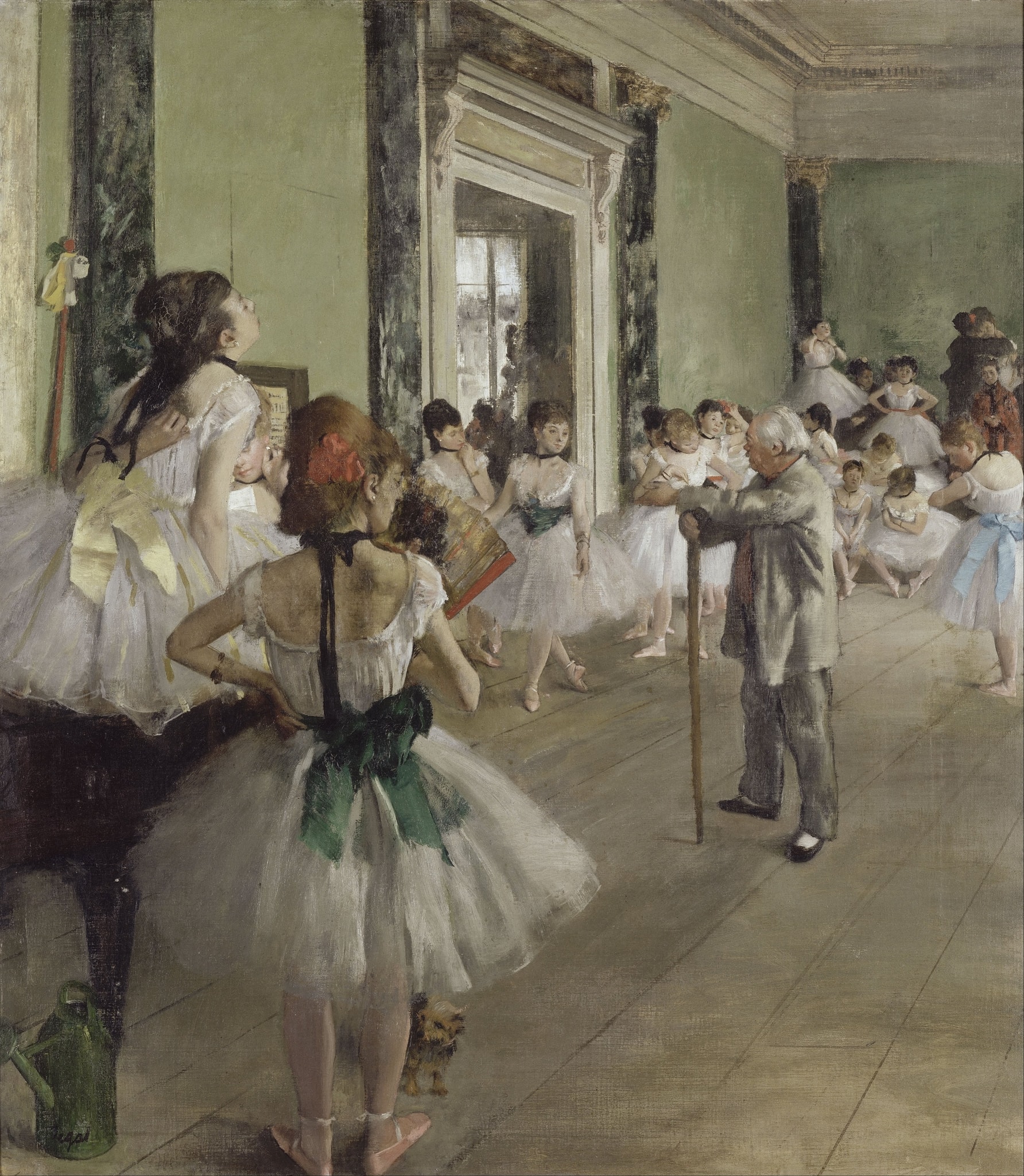
Degas’s small, cropped watering can at the lower left of The Ballet Class is a working tool, not a decoration. By placing this standard studio fixture right at our feet, Degas insists on the realities of practice—dampened floors, dust, and discipline—beneath ballet’s shimmer.
Historical Context
Painted between 1873 and 1876, The Ballet Class distills Degas’s sustained access to the rehearsal rooms of the Paris Opéra. The little can on the floor is exactly the kind of vessel used in those studios to sprinkle water over the wooden boards, suppressing dust and improving traction as dancers worked. The Musée d’Orsay’s record explicitly lists the arrosoir among the painting’s objects, confirming that this was not a casual detail but part of the depicted environment 1. Degas observed such routines repeatedly and folded them into his ballet imagery across the decade.
Contemporary museum scholarship identifies the watering can as a standard studio fixture. The Met notes that rehearsal rooms kept cans for moistening floors and even discusses how Degas explored the motif elsewhere in his ballet series, underscoring his close study of backstage practice 2. In the Orsay canvas the can sits near the artist’s signature at lower left, tying this workaday object to the painting’s deliberately constructed foreground and to Degas’s broader project of portraying labor behind performance 12.
Symbolic Meaning
The watering can reads as a compact emblem of ballet as work. Rather than idealized ornament, it signals maintenance, repetition, and the unglamorous logistics that make grace possible. Art historians have long framed Degas’s rehearsal interiors as studies of modern labor, populated by paraphernalia—piano, music stand, dog, and can—that ground the spectacle in routine tasks 5. By foregrounding this humble tool, Degas embeds the class in a system of care: floors must be prepared, bodies trained, and materials managed. The can’s presence therefore aligns the scene with the practical economy of the Opéra’s studios and with Degas’s realist interest in the infrastructure of performance.
Writers have also tracked the motif through Degas’s series to show how it sharpens his play between artifice and reality. The “water” that dampens boards coexists with the optical “waters” of mirrors and reflected light in these interiors, a conceptual rhyme that extends Degas’s fascination with seeing and staging 6. Because the can was literally part of studio life, its symbolism is never allegorical for its own sake; it is documentary truth raised to meaning. RMN’s analysis of the composition’s candid, unflattering moments reinforces this reading: the can stands for discipline and the prosaic conditions that underwrite grace 42.
Artistic Technique
Degas renders the can in dark green with a warm, reddish rim, laid in with brisk, economical strokes that make it a sharp chromatic accent against tutus and chalky walls 7. He crops it at the extreme lower-left corner, a modern compositional device that drops the viewer onto the floorboards and anchors the long diagonals that drive the room’s perspective 4. Its silhouette is compact and legible, yet not fussed over—typical of Degas’s balance between observation and pictorial economy. The nearby signature at lower left further knits the object into the painting’s designed foreground, signaling the artist’s conscious placement of this everyday tool as a structural and thematic pivot 8.
Connection to the Whole
Compositionally, the can weights the painting’s “void” foreground, counterbalancing the dense knot of dancers and the maestro to the right while guiding the eye along the diagonals of the parquet toward the doorway and back wall 4. Thematically, it partners with other backstage markers to insist that this is a working class, not a performance: maintenance and method precede display 5. Because the object was actually used to moisten studio floors, its inclusion tethers Degas’s carefully arranged scene to real practices at the Paris Opéra in the 1870s, reinforcing the painting’s hybrid of construction and truthful detail 1. In short, the watering can is a small but decisive device that fuses realism, structure, and meaning across the canvas.
Explore the Full Painting
This is just one fascinating element of The Ballet Class. Discover the complete interpretation, symbolism, and hidden meanings throughout the entire work.
← View full analysis of The Ballet ClassSources
- Musée d’Orsay – La Classe de danse (artwork record)
- Metropolitan Museum of Art – Dancers Practicing at the Barre (Heilbrunn Timeline)
- National Gallery of Art – Degas: The Dancers (exhibition publication)
- RMN–GrandPalais/ Panorama de l’art – La Classe de danse (composition analysis)
- Metropolitan Museum of Art – The Ballet (Heilbrunn Timeline essay)
- The New Yorker – “Degas’s Mystery Painting” (conceptual reflections)
- High‑resolution image of the painting (for visual corroboration)
- Degas Digital Catalogue Raisonné – La Classe de danse (signature/location)