How Much Is The Ballet Rehearsal Worth?
Last updated: February 4, 2026
Quick Facts
- Methodology
- comparable analysis
Anchored to Degas’s top auction benchmarks and the rarity of prime 1870s dancer oils, The Ballet Rehearsal (c.1874) would command approximately $45–65 million if marketable. This positions the work at or above the best pastels and near the artist’s overall record, reflecting its subject, period, and museum-grade quality.
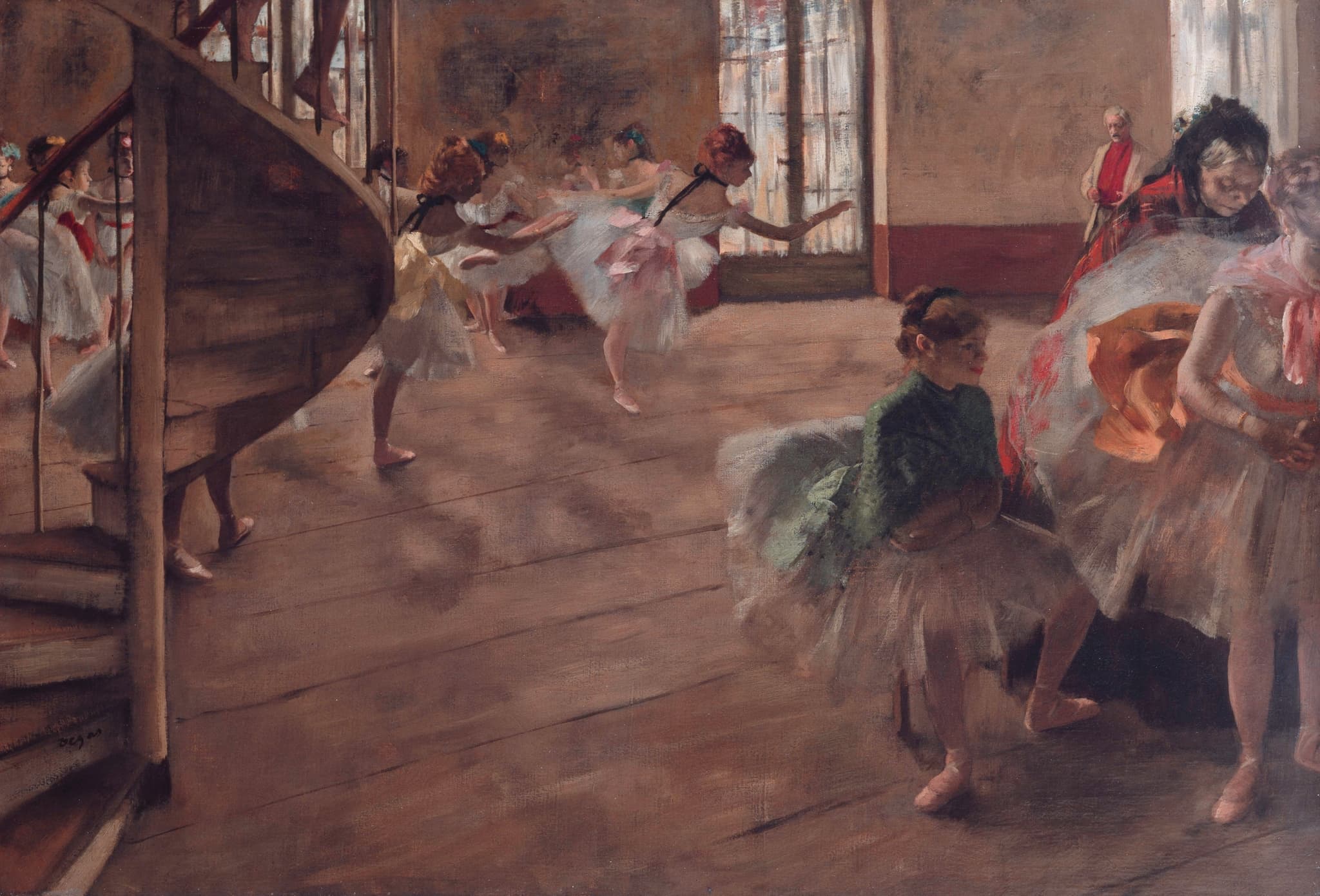
The Ballet Rehearsal
Edgar Degas, c. 1874 • Oil on canvas
Read full analysis of The Ballet Rehearsal →Valuation Analysis
Conclusion: Based on direct comparables within Edgar Degas’s market and the exceptional attributes of an 1870s ballet rehearsal oil, a fair open‑market estimate for The Ballet Rehearsal (The Burrell Collection, Glasgow; c.1874; oil on canvas; Lemoisne II, 430) is $45–65 million. The work’s size (c. 58.4 × 83.8 cm), prime subject, and institutional pedigree justify placement at the very top of Degas’s pricing spectrum if it were hypothetically offered for sale [1].
How the estimate was derived: The anchor points are Degas’s artist record of $41.61m for Petite danseuse de quatorze ans (Christie’s, 2022) and the $37.04m peak for a top pastel, Danseuse au repos (Sotheby’s, 2008) [2][3]. While the 2022 record was for a bronze cast, The Ballet Rehearsal is a unique, prime‑period oil in Degas’s most coveted theme. Top 1870s dancer oils are extremely scarce at auction, and when scarcity meets a trophy‑caliber subject, pricing credibly exceeds pastels and tests the artist’s overall ceiling. Our $45–65m bracket therefore sits above the best on‑paper results and near the overall record, with upside justified by uniqueness and period significance.
Qualitative drivers: The ballet rehearsal motif is central to Degas’s identity and innovation in oblique viewpoints and staged studio dynamics. An 1874 dating places the picture squarely within his formative exploration of rehearsal imagery. Rarity of comparable oils in private hands (most are in museums) amplifies value. The Burrell canvas has deep provenance and consistent scholarly visibility; it was acquired by William Burrell in 1926 and has remained museum‑held since 1944, reinforcing its status as a “museum‑quality” benchmark for the subject [1]. Although the institution does not publish an object‑level insurance figure, a 2018 council report valued a tour of 58 French works (including this Degas) at £180.7m, underscoring the high‑value framework applied to the group [4].
Market positioning and timing: Recent seasons show a selective but resilient market for Impressionist blue‑chips, with a “flight to quality” and strong demand for canonical subjects. While recent Degas pastels have typically traded in the ~$1–6m range, a late‑2025 example achieved ~$5.8m, evidencing healthy depth for strong material and reaffirming the premium for dancer imagery [5]. Against that backdrop, a top‑tier 1870s oil with bulletproof provenance would likely draw aggressive global bidding and third‑party support, placing it firmly in the mid‑eight‑figure range. The estimate assumes sound condition and full scholarly endorsement.
Bottom line: By triangulating the artist’s record, the prime‑period pastel benchmark, and the pronounced scarcity of 1870s dancer oils, The Ballet Rehearsal should transact at $45–65 million in today’s market if it were available, with potential to challenge the artist’s record in a highly competitive, trophy‑driven sale.
Key Valuation Factors
Art Historical Significance
High ImpactBallet rehearsal is one of Degas’s defining subjects, crystallizing his innovations in composition (oblique viewpoints, cropped space) and his fascination with modern life backstage. Dated circa 1874, this canvas sits at a pivotal moment when Degas refined the rehearsal/studio imagery that would become central to his oeuvre. The work has strong scholarly citations (Lemoisne II, 430) and long institutional visibility through the Burrell Collection. Within Degas’s hierarchy of subjects and periods, an 1870s rehearsal scene in oil stands in the “A‑tier,” rivaled only by the most iconic oils and the very greatest pastels. This art‑historical weight is a primary driver of value and supports pricing near the artist’s top auction benchmarks.
Subject, Period, and Medium
High ImpactThe combination of subject (ballet rehearsal), period (early/mid‑1870s), and medium (oil on canvas) is near‑optimal for Degas’s market. Dancer images consistently lead demand; 1870s works carry special cachet for their freshness and structural daring; and oils—being unique and scarcer than pastels—can surpass the best works on paper. While record prices for Degas include a bronze and a top pastel, a prime 1870s dancer oil aligns with trophy‑level buyer priorities. In a competitive setting with guarantees and international bidding, this trio of attributes typically commands the very top of the artist’s price band and can credibly test or exceed on‑paper records.
Rarity and Provenance
High ImpactComparable 1870s dancer oils are rarely available; many reside in museums. This particular canvas has distinguished provenance—from Théo van Gogh’s trade in 1888 through William Burrell’s acquisition in 1926—and continuous institutional holding since 1944. Such provenance materially elevates confidence and buyer appetite. Scarcity is reinforced by frequent scholarly and exhibition exposure, establishing the work as a recognized reference within the ballet series. In markets where fresh, blue‑chip material is limited, rarity plus ‘name’ provenance typically commands a scarcity premium, supporting a valuation that clusters around the artist’s upper historical outcomes.
Market Benchmarks and Momentum
Medium ImpactDegas’s overall auction record stands at $41.61m (Christie’s, 2022, Little Dancer bronze), with the top pastel at $37.04m (Sotheby’s, 2008). Recent seasons show renewed strength for Impressionist blue‑chips amid a broader ‘flight to quality,’ with competitive bidding for canonical subjects. While recent Degas pastels mostly realized $1–6m, a late‑2025 example at $5.8m reflects healthy depth. Against this backdrop, a prime 1870s oil—rarer and more singular than works on paper—justifies a valuation above the pastel benchmark and near the artist ceiling. The factor is ‘medium’ only because outcomes depend on condition and day‑of‑sale dynamics.
Sale History
Galerie Georges Petit / via Théo van Gogh (Boussod, Valadon & Cie), Paris
Purchased by Théo van Gogh for 5,220 FRF; USD reflects contemporaneous gold-standard conversion.
Boussod, Valadon & Cie (Théo van Gogh), Paris
Resold within weeks for 8,000 FRF to Jacques-Émile Blanche; USD reflects contemporaneous conversion.
Alex Reid & Lefevre, London
Sold to Sir William Burrell for £6,500; USD converted at $4.86/£ in 1926.
Edgar Degas's Market
Edgar Degas is a cornerstone of the Impressionist market, with deep institutional and private demand across dancers, bathers, and milliners. His overall auction record is $41.61 million for Petite danseuse de quatorze ans (Christie’s New York, 2022), while the on‑paper record is $37.04 million for Danseuse au repos (Sotheby’s New York, 2008). Strong, market‑fresh pastels of dancers typically command low‑ to mid‑seven figures today, with exceptional examples higher. Unique, prime‑period oils are scarce and can sit above top pastels, potentially approaching or challenging the artist’s overall ceiling. Collectors prize works with early dates, canonical subjects, distinguished provenance, and solid condition—criteria satisfied by very few market‑available Degas works in any given year.
Comparable Sales
Petite danseuse de quatorze ans
Edgar Degas
Artist record; iconic ballet subject that benchmarks trophy-level demand for Degas’s dancer imagery, albeit a later bronze cast rather than a unique 1870s oil.
$41.6M
2022, Christie's New York
~$45.2M adjusted
Danseuse au repos
Edgar Degas
Top-tier dancer pastel from Degas’s prime period; closest high-water mark for two-dimensional dancer imagery in recent decades (though on paper, not oil).
$37.0M
2008, Sotheby's New York
~$54.7M adjusted
Danseuse (pastel)
Edgar Degas
Strong, market-fresh dancer pastel confirming current appetite for high-quality Degas ballet subjects; good benchmark for upper single-digit millions in recent market.
$11.8M
2021, Sotheby's New York
~$13.8M adjusted
Trois danseuses (pastel)
Edgar Degas
Late pastel of dancers; shows 2025 pricing depth for quality but non-trophy works on paper within Degas’s core ballet theme.
$5.8M
2025, Sotheby's New York
Danseuses sur la scène (mixed media on paper)
Edgar Degas
On-paper stage scene closely aligned in subject to ballet rehearsal imagery; indicates pricing for smaller/lesser works on paper in the current market.
$1.1M
2025, Christie's New York
Current Market Trends
Impressionist and Impressionist–Modern markets rebounded in late 2025 after a softer 2023–2024, with a clear flight to quality and widespread use of third‑party guarantees. Trophy‑caliber works with canonical subjects and museum‑level provenance drew the strongest bidding, while mid‑tier material faced greater selectivity. Degas remains a blue‑chip anchor in this environment: dancer imagery is liquid, and museum‑grade examples are supply‑constrained. Recent Degas pastels in the $1–6m range confirm depth, while the artist’s overall record near $42m defines today’s ceiling. A prime 1870s dancer oil—rarer than top pastels—would logically price at the high end of the band, provided excellent condition and competitive sale choreography.
Sources
- Glasgow Museums – The Rehearsal (Edgar Degas) collection record
- Christie’s – May 2022 Marquee Week results (record for Degas, Petite danseuse de quatorze ans)
- Sotheby’s (reported via The Art Wolf) – Danseuse au repos, $37,042,500 (Nov 3, 2008)
- The Art Newspaper – Burrell touring valuation for 58 French works (£180.7m), 2018
- Observer – Sotheby’s November 2025 results (Trois danseuses ~ $5.8m)