How Much Is The Opera Orchestra by Edgar Degas | Analysis Worth?
Last updated: January 16, 2026
Quick Facts
- Methodology
- extrapolation
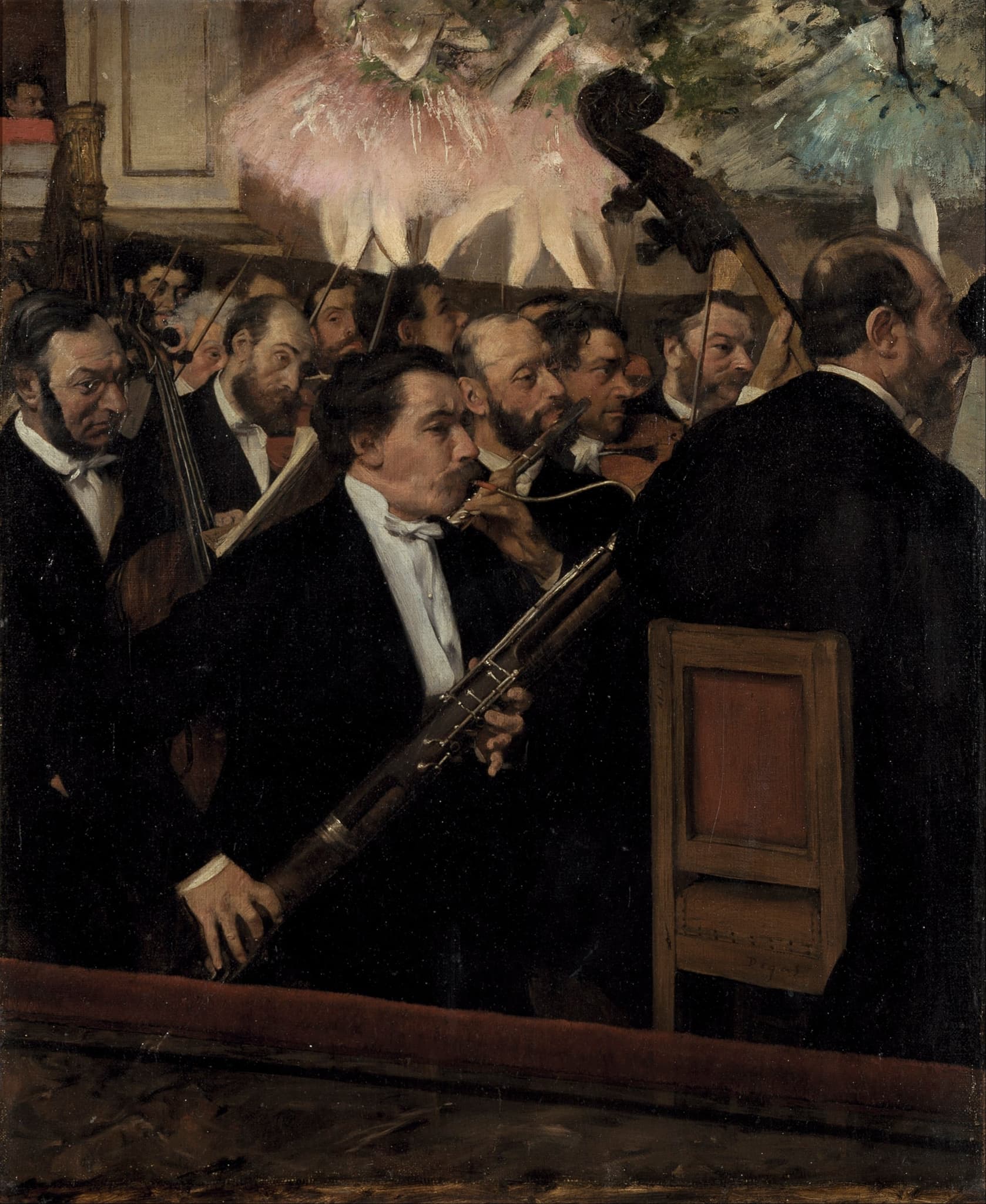
Assuming the object is Edgar Degas’s The Orchestra at the Opera (L’Orchestre de l’Opéra, ca. 1870, Musée d’Orsay), we estimate a hypothetical market-equivalent value of $60–100 million. This range extrapolates above Degas’s auction records, reflecting the painting’s canonical status, rarity as a museum-caliber oil, and centrality to his ballet/stage imagery. The work is not market-available; the range indicates likely private-sale or insurance parity if it were offered today.
The Opera Orchestra by Edgar Degas | Analysis
Edgar Degas
Read full analysis of The Opera Orchestra by Edgar Degas | Analysis →Valuation Analysis
Conclusion: We estimate Edgar Degas’s The Orchestra at the Opera (L’Orchestre de l’Opéra, ca. 1870, oil on canvas, Musée d’Orsay) at $60–100 million on a hypothetical market-equivalent basis. This is a trophy-tier, canonical painting that inaugurated Degas’s radical stage/orchestra cropping and his defining exploration of modern spectacle; it is firmly ensconced in a national museum and is not market-available. The estimate reflects what a comparably significant Degas oil could command in today’s top private market or as an insurance proxy for a loan, not a forecast of a public auction result for this specific object. [1]
Method and benchmarks: We extrapolate upward from Degas’s highest public prices. The artist’s current record is $41.6 million for Petite danseuse de quatorze ans (bronze; Christie’s, 2022) and the top price for a two‑dimensional work is $37,042,500 for Danseuse au repos (Sotheby’s, 2008). Both underscore deep demand for Degas’s signature ballet motif, yet neither is a unique, early oil of the Orsay painting’s art-historical weight. A landmark, museum-caliber canvas would reasonably command a premium into the $60–100 million band in a tightly contested sale. [2][3]
Qualitative drivers: The Orsay painting is a touchstone in Degas’s oeuvre: an audacious composition that foregrounds the orchestra pit, glimpsing dancers as cropped, luminous fragments, and announcing his modern, photographic sensibility. It prefigures the ballet series that would come to define the artist and is discussed widely in scholarship and survey exhibitions. Such canonical early oils by Degas are exceptionally scarce outside institutions, intensifying substitution risk for collectors and powering valuation premiums for any comparably important example. [1]
Rarity and ownership context: This work belongs to the French national collections (Musée d’Orsay); French state museums are effectively self‑insuring for permanent collections, and deaccession is not contemplated. No public insurance number is disclosed. The value here is a market-equivalent proxy were a work of identical quality and importance to surface privately, anchored to Degas’s records and the broader blue‑chip Impressionist trophy market dynamics. [4]
Market positioning: While the Impressionist/Post‑Impressionist auction sector has been value‑selective in 2023–2025, the very top end remains resilient when true masterpieces appear. Our range reflects both the discipline of recent Degas pricing at mid‑levels and the proven outlier demand for iconic, museum‑grade material. The upper bound recognizes that nine‑figure liquidity for Degas is less tested than for Monet or Cézanne, while the lower bound already represents a significant premium over the artist’s existing records. [5]
Key Valuation Factors
Art Historical Significance
High ImpactThe Orchestra at the Opera is a foundational statement in Degas’s modern vision. Its daring orchestral foreground, radical cropping, and backstage vantage crystallize themes that would dominate his career. As an early, frequently illustrated and taught masterwork, it carries art-historical primacy beyond most privately tradable Degas works. This significance translates directly into price leadership: canonical, syllabus-level paintings tend to clear well above medium-specific records because they transcend connoisseurship niches, appealing to encyclopedic museums and top cross-category collectors. Its scholarly prominence and exhibition history increase its irreplaceability relative to other strong but less pivotal Degas subjects.
Medium and Quality
High ImpactUnique oils by Degas of this caliber are scarce on the market. While pastels are beloved and have achieved the artist’s top painting/drawing prices at auction, a museum-grade, early oil with defining compositional innovation typically commands a premium. The execution here—tight orchestral portraiture against a theatrical, cropped stage—demonstrates exceptional control and conceptual audacity. Because most of Degas’s best oils now reside in institutions, supply for a comparable oil is effectively rationed. In valuation terms, this medium-quality combination supports a step-change over the best pastel and bronze benchmarks when adjusted for uniqueness and art-historical weight.
Rarity and Ownership
High ImpactThis painting is in a French national collection (Musée d’Orsay) and is not market-available; French state museums are effectively self-insured and do not publish insurance valuations for permanent holdings. Its inalienable status heightens scarcity by removing one of the most coveted Degas canvases from any potential supply pool. For collectors, this scarcity pushes demand toward the nearest substitutes—other top-tier, early ballet/Opera oils and pastels—bidding up their values. In a hypothetical scenario where a directly comparable work appeared, this rarity premium would be a key determinant of pricing at or above the artist’s historic auction peaks.
Market Benchmarks and Liquidity
Medium ImpactDegas’s artist records—$41.6m for a bronze (2022) and $37.0m for a pastel (2008)—anchor the upper range of public results. A unique, canonical oil merits a premium above those numbers, but Degas’s nine‑figure liquidity is less tested than Monet’s or Cézanne’s. Recent years show selectivity at mid‑levels and strong competition for fresh, best‑in‑class material. Our $60–100m range balances the picture’s unique status against current market discipline: the low end reflects a robust premium above records, while the high end acknowledges trophy-chasing capacity in private sales without assuming Monet‑level depth for Degas.
Sale History
The Opera Orchestra by Edgar Degas | Analysis has never been sold at public auction.
Edgar Degas's Market
Edgar Degas is a blue-chip pillar of Impressionism, with sustained collector demand for dancers, racehorses, and bathers—especially in pastels and high-quality oils. His current auction record is $41.6 million for Petite danseuse de quatorze ans (bronze; Christie’s, 2022), while the top price for a two-dimensional work is $37,042,500 for Danseuse au repos (Sotheby’s, 2008). Strong, fresh ballerina pastels and select bronzes continue to perform, but mid-tier works have shown price discipline in recent seasons. Supply of museum-caliber oils is extremely thin, and when such works surface privately, competition can drive results above public benchmarks, particularly for canonical images.
Comparable Sales
Danseuse au repos
Edgar Degas
Top auction price for a Degas painting/pastel; signature ballet subject closely aligned with the Orsay oil’s importance to Degas’s stage imagery.
$37.0M
2008, Sotheby's New York
~$55.2M adjusted
Petite danseuse de quatorze ans (bronze)
Edgar Degas
Current artist auction record; iconic ballet subject establishing a ceiling for Degas at auction, even though it is an editioned sculpture rather than a unique oil.
$41.6M
2022, Christie's New York
~$45.6M adjusted
Danseuse au repos (earlier version)
Edgar Degas
Another benchmark for a prime ballerina image; corroborates depth of demand for Degas’s most desired subject matter.
$27.9M
1999, Sotheby's London
~$53.6M adjusted
Eugène Manet
Edgar Degas
Oil on canvas by Degas (same medium as the Orsay painting); illustrates pricing for strong but non‑trophy Degas oils.
$7.7M
2022, Sotheby's London
~$8.4M adjusted
Trois danseuses
Edgar Degas
Recent market datapoint for a desirable ballerina pastel; shows current liquidity and price sensitivity for quality but non‑trophy works.
$5.8M
2025, Sotheby's New York
Jeanne (Spring)
Édouard Manet
Cross‑artist anchor: a canonical, museum‑caliber Impressionist oil achieving mid‑eight figures; brackets the trophy range a Degas masterwork could approach.
$65.1M
2014, Christie's New York
~$87.9M adjusted
Current Market Trends
Impressionist/Post‑Impressionist auction values contracted in 2023–2024 amid fewer trophy consignments and heightened selectivity, though lot volumes held up. Even so, the very top of the market remains resilient: when truly iconic masterpieces appear, bidding can exceed estimates, while ordinary examples see tighter pricing. Paris has gained relative strength as a selling center, and institutional programming around the Impressionist anniversary sustained visibility. Within this climate, a canonical Degas oil would likely find deep private demand, but nine‑figure outcomes would depend on fresh-to-market status, condition, and cross-category competition from collectors who typically pursue Monet, Cézanne, or Picasso.