How Much Is The Rehearsal of the Ballet Onstage Worth?
Last updated: January 21, 2026
Quick Facts
- Methodology
- comparable analysis
We estimate Edgar Degas’s The Rehearsal of the Ballet Onstage at $35–60 million (auction equivalent), based on prime comparables for 1870s ballet imagery and the work’s museum-grade stature. This anchors to Degas’s top dancer pastels at $37.0m and his overall $41.6m auction record, with adjustments for medium, scale, and condition.
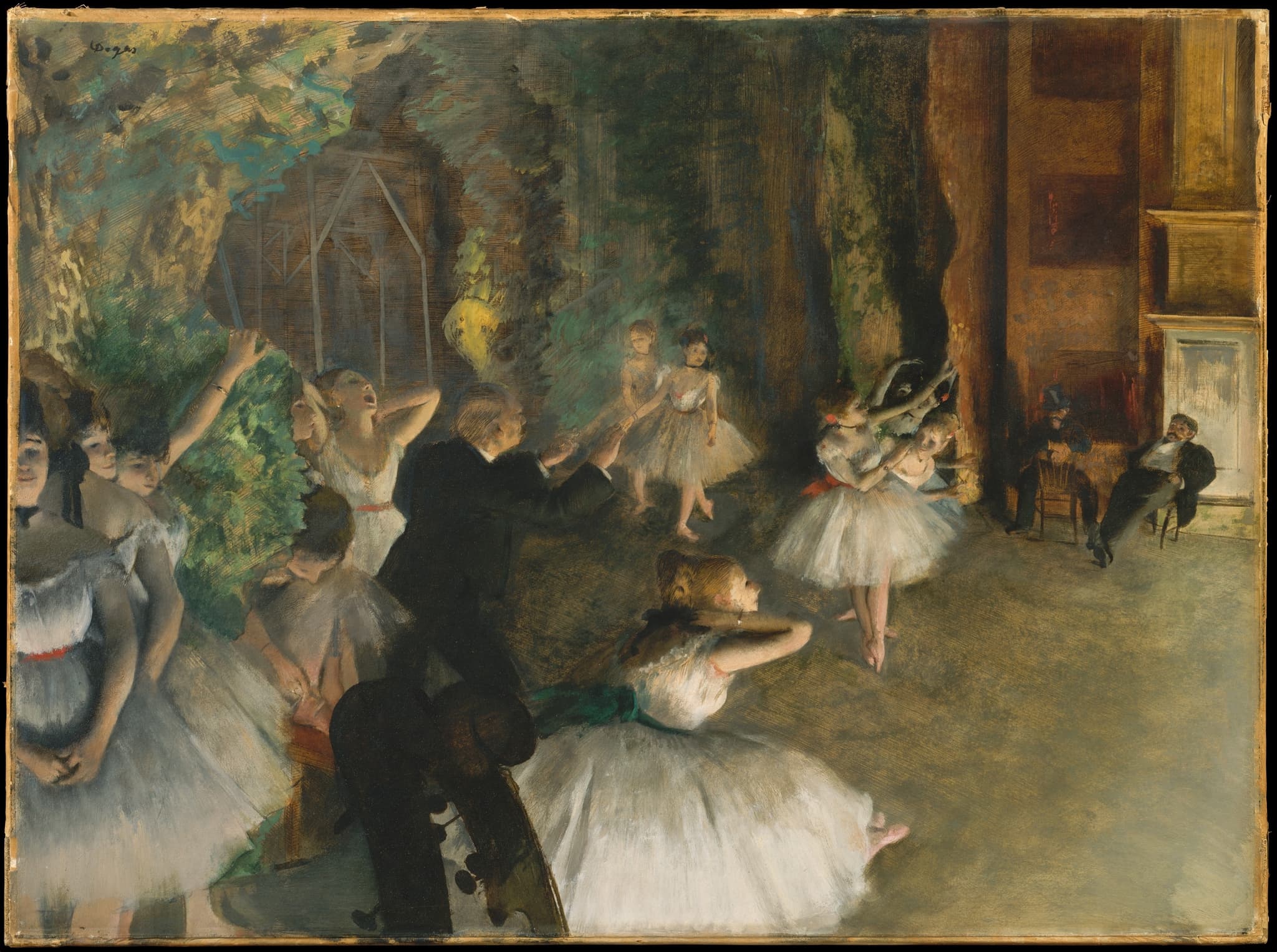
The Rehearsal of the Ballet Onstage
Edgar Degas, ca. 1874 • Oil colors mixed with turpentine, with traces of watercolor and pastel, over pen-and-ink on wove paper, laid on bristol board and mounted on canvas
Read full analysis of The Rehearsal of the Ballet Onstage →Valuation Analysis
Conclusion: The Rehearsal of the Ballet Onstage is a top-tier, 1870s ballet composition by Degas and merits an auction-oriented estimate of $35–60 million today, with private-sale potential into the low-to-mid $70 millions under competitive conditions. The work is held by The Metropolitan Museum of Art and is not realistically available; this is a hypothetical market orientation grounded in direct comparables and current demand dynamics [1].
Method and anchors: We triangulate against the two strongest market benchmarks for Degas’s signature dancer imagery: the record pastel Danseuse au repos at $37.0m (Sotheby’s New York, 2008) and the long-standing 1999 London record for a similar subject at ~$27.9m—both reflecting prime, multi-figure ballet works of high pictorial impact [2]. In today’s dollars, these benchmarks sit in roughly the mid‑$50m band, establishing a ceiling for best-in-class “pictures” by Degas. The artist’s overall auction record remains $41.6m for Petite danseuse de quatorze ans (Christie’s New York, 2022), reinforcing the meaningful but not unlimited headroom at the top of the Degas market [3].
Why this work prices near the top: The Met’s sheet is an archetypal, ambitious stage-rehearsal composition set under gaslight, spanning dancers, orchestra pit and wings—precisely the iconography that commands premium pricing in Degas [1]. It is closely related to the large grisaille shown at the first Impressionist exhibition (1874) and to a companion pastel at The Met, situating it at the core of Degas’s most coveted decade and subject. The provenance is blue-chip (Hill, Sickert, Durand‑Ruel/Boussod‑Valadon, Havemeyer) and the work is deeply published and exhibited—each factor reliably expanding bidder depth and underwriting value [4].
Medium and condition adjustments: Although not a pure oil, the work’s build—oil colors freely mixed with turpentine, with traces of watercolor and pastel over pen-and-ink on wove paper laid to bristol and canvas—has a pictorial presence comparable to oils while preserving Degas’s hallmark graphic vitality [1]. Market behavior shows that major, mixed-media “on paper laid down” Degas pictures can approach oil pricing when subject and date are prime. That said, price realization at the very top is condition-sensitive: stability of the media layers, the integrity of the laid-down support, and any restoration history should be vetted and would shift the estimate within the stated band.
Market tone and scarcity: Trophy Impressionist supply was thin in 2023–24, but demand for pre‑war masterpieces re‑accelerated in late‑2025, with buyers showing a clear flight to quality. Recent Degas ballet pastels of quality have been met with healthy competition—e.g., Trois danseuses at $5.78m—signaling active depth below the trophy tier and readiness to stretch for best-in-oeuvre examples [5]. Against this backdrop, true 1870s, multi‑figure on‑stage compositions are exceptionally scarce (many in museums), a structural tailwind that supports the top half of our range. Broader auction data confirm a rebound for blue‑chip Modern/Impressionist when works are best-in-class [6].
Positioning: Our $35–60m range sits just below the inflation-adjusted pastel records and acknowledges the slight discount for mixed media versus the very top pastels, while fully crediting the subject, date, scale, and scholarly renown. In a tightly brokered private context with multiple prepared buyers, $50–75m is realistic.
Key Valuation Factors
Art Historical Significance
High ImpactThis is a quintessential 1870s ballet composition—the subject and decade most closely associated with Degas’s legacy. The complex, on‑stage rehearsal scene under gaslight, with dancers, orchestra pit, and wings, epitomizes the artist’s innovative staging and vantage. It belongs to a small cluster of related works, including a large grisaille exhibited at the first Impressionist exhibition, and a companion pastel at The Met. Deep publication and exhibition history make it a cornerstone image in scholarship and teaching. Such canonical status expands the international buyer pool and supports pricing at, or near, the top of the Degas market.
Rarity and Market Supply
High ImpactMuseum retention and private long‑term holding have severely limited opportunities to acquire 1870s multi‑figure, on‑stage ballet compositions by Degas. The closest high‑end comparables that have traded publicly—major pastels like Danseuse au repos—are rare and long‑dated, yet have set benchmarks in the high eight figures. With most top examples in institutions, scarcity functions as a structural tailwind: when a work of comparable subject/date and complexity does appear, competition intensifies, pushing realizations toward the upper end of estimate ranges.
Medium and Condition
Medium ImpactExecuted in oil colors freely mixed with turpentine, with traces of watercolor and pastel over pen‑and‑ink on wove paper laid to bristol and mounted on canvas, the work presents a rich, ‘oil‑like’ surface while retaining Degas’s graphic immediacy. While pure oils sometimes command a premium, important mixed‑media pictures on paper laid down have approached oil pricing when subject and date are prime. Valuation is sensitive to conservation findings: support integrity, fixative history, surface stability, and any restoration. A strong, stable condition would anchor the estimate near the top of the range; notable issues would pull it lower.
Provenance, Exhibition, and Literature
High ImpactBlue‑chip provenance traces from Henry Hill and Walter Sickert through Durand‑Ruel/Boussod‑Valadon to H. O. Havemeyer, culminating in The Met’s 1929 gift. The Havemeyer connection and sustained museum exhibition/publication record enhance trust, importance, and international recognition. Works with such pedigrees typically face fewer market frictions (authenticity, restitution, acceptance), invite institutional interest, and support aggressive bidding by seasoned collectors, reinforcing a top‑quartile valuation within the artist’s market.
Market Benchmarks and Momentum
Medium ImpactDegas’s overall auction record is $41.6m for Petite danseuse de quatorze ans (2022). The strongest ‘picture’ comps—Danseuse au repos pastels at $37.0m (2008 NY) and ~$27.9m (1999 London)—translate to roughly mid‑$50m in today’s dollars. Recent sales show renewed appetite for quality pre‑war works and steady depth for desirable Degas pastels in the mid‑seven figures, indicating a ready buyer base beneath the trophy tier. This supports an estimate that aligns to historic benchmarks while factoring medium and condition nuances.
Sale History
Christie's London
The Henry Hill sale, lot 29; price not located in public sources
Boussod-Valadon, Paris
Sold to H. O. Havemeyer (via Durand‑Ruel/Boussod‑Valadon)
The Metropolitan Museum of Art, New York
Gift of Horace Havemeyer; accession 29.160.26
Edgar Degas's Market
Edgar Degas remains a foundational, globally collected master of Impressionism, with deep institutional holdings and a long, liquid auction record. His top prices cluster around signature ballet subjects in oils and exceptional pastels, as well as lifetime and early casts of Petite danseuse de quatorze ans. The overall auction record stands at $41.6m (Christie’s New York, 2022; Petite danseuse), while the high-water mark for a two‑dimensional ‘picture’ is the pastel Danseuse au repos at $37.0m (Sotheby’s New York, 2008). High‑quality works on paper regularly achieve six to seven figures; truly outstanding ballet compositions can reach the low‑to‑mid eight figures. Demand is international, led by U.S. and European collectors and institutions.
Comparable Sales
Danseuse au repos
Edgar Degas
Same artist and peak 1870s ballet subject; major, museum‑caliber pastel that set the benchmark price for a Degas ‘picture’. Closest high-end proxy for a top ballet image’s market ceiling.
$37.0M
2008, Sotheby's New York
~$54.8M adjusted
Danseuse à la barre
Edgar Degas
Same artist; iconic dancer motif from c.1880 in pastel/gouache. A top-tier Degas ballet work establishing late‑19th‑century ballet image pricing near the top of the market.
$26.5M
2008, Christie's London
~$39.2M adjusted
Danseuse au repos
Edgar Degas
Same artist and 1870s ballet subject; record-setting pastel of a dancer at rest. Confirms long-run top pricing for best-in-class Degas ballet ‘pictures’.
$27.9M
1999, Sotheby's London
~$53.3M adjusted
Trois danseuses
Edgar Degas
Same artist and ballet subject; pastel with three figures (c.1897). A current-market data point for desirable but non‑trophy ballet pastels, useful for gauging contemporary demand.
$5.8M
2025, Sotheby's New York
Danseuses sur la scène
Edgar Degas
Same artist and explicit on‑stage dancer subject (closest to the ‘Rehearsal’ theme), but on a small mixed‑media sheet. Useful for subject alignment; scale/importance are much lower.
$1.1M
2025, Christie's New York
Current Market Trends
After a 2023–24 period marked by reduced trophy supply and selective bidding, late‑2025 brought a rebound for blue‑chip Modern/Impressionist material, with a flight to quality benefiting canonical pre‑war names. Within Degas, mid‑ to upper‑tier pastels saw healthy competition, confirming depth beneath the trophy level. Category-wide data point to fewer $10m+ lots overall but strong outcomes when masterpieces appear. In this environment, a major, 1870s, on‑stage ballet composition with impeccable provenance would attract global bidding and price near historical benchmarks, while medium and condition would be the key swing factors within the estimate band.
Sources
- The Metropolitan Museum of Art – The Rehearsal of the Ballet Onstage (object page)
- Sotheby’s – Danseuse au repos (3 Nov 2008) lot page
- The Art Newspaper – Christie’s evening sales hit $831m; Degas record $41.6m (May 13, 2022)
- Degas: The Catalogue – The Rehearsal of the Ballet Onstage (provenance entry)
- Observer – Sotheby’s November Auctions: Degas Trois danseuses sells for $5.78m (Nov 2025)
- Art Basel & UBS – The Art Market 2025: Auctions