How Much Is The Accolade Worth?
Last updated: April 10, 2026
Quick Facts
- Insurance Value
- $3.8M (Analyst recommendation (retail replacement, ~25% above high auction estimate))
- Methodology
- extrapolation
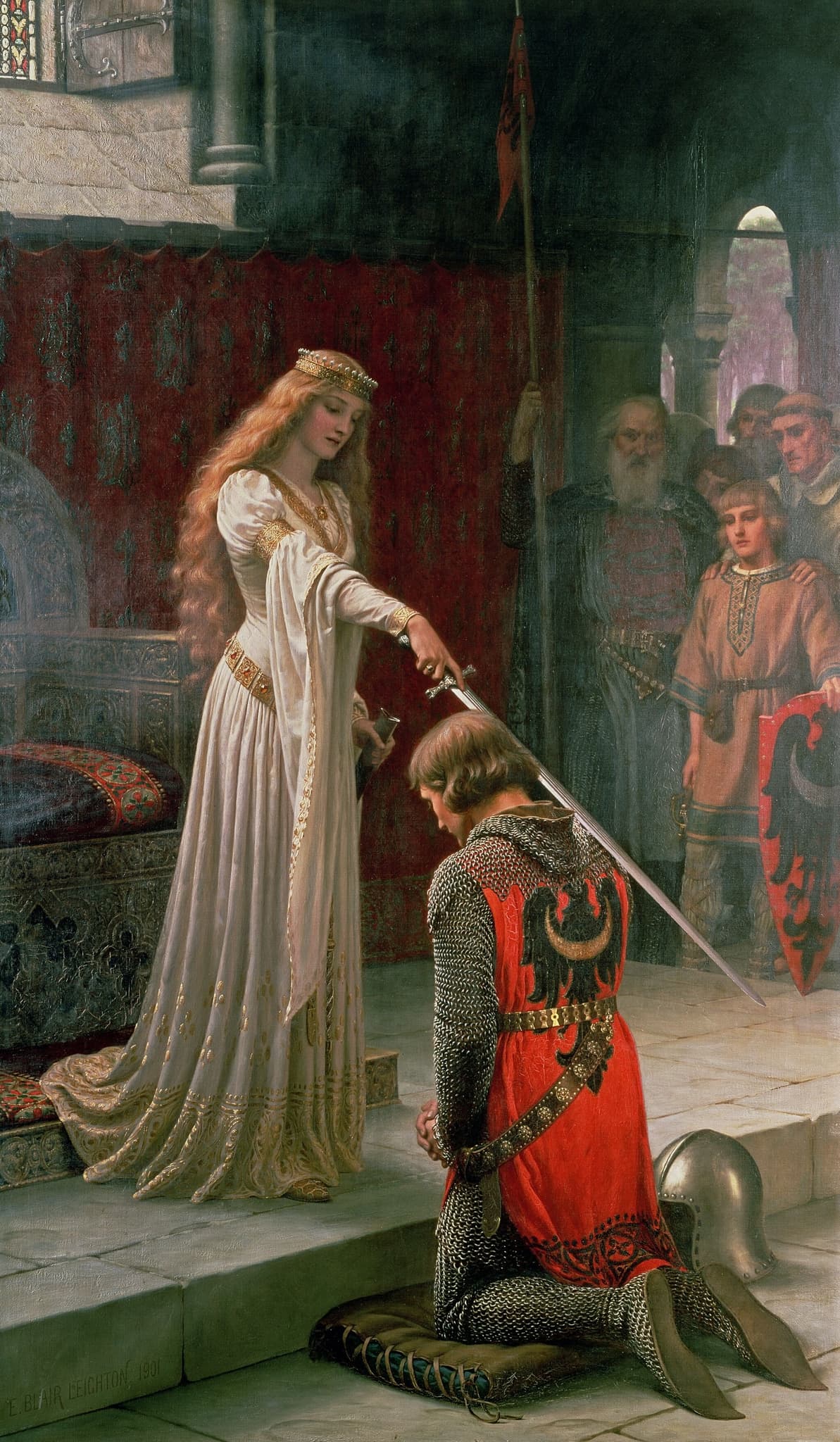
Estimated at $1.5–3.0 million if brought to a top-tier auction. The Accolade (1901) is Edmund Leighton’s signature masterpiece—exhibited at the Royal Academy in 1901 and long in a private collection—with clear potential to challenge and surpass the artist’s past auction benchmarks.
Valuation Analysis
Conclusion: We estimate Edmund Leighton’s The Accolade (1901) at $1.5–3.0 million in a well-marketed auction setting, with a recommended insurance (retail replacement) value around $3.8 million. This range is derived by extrapolating from the artist’s strongest public results for closely comparable, large medieval–romance subjects and applying a justified masterpiece premium for Leighton’s most iconic image.
Market anchors: Leighton’s auction ceiling has been established by a small cluster of large, prime subjects. A King and a Beggar Maid realized £662,500 (~$1.12m) at Sotheby’s London in 2014, a widely cited record for the artist in USD terms [1]. God Speed—The Accolade’s closest counterpart (painted the year before, 1900)—sold for £707,750 at Christie’s London in 2000 (≈$1.07m at contemporaneous FX) [2] and later achieved £481,250 at Sotheby’s London in 2012 (≈$0.78m) [4]. In today’s dollars, these benchmarks cluster roughly around low-to-mid seven figures, providing a robust floor for pricing an image of The Accolade’s fame.
Why The Accolade should price above the comp band: The Accolade is broadly regarded as Leighton’s signature masterpiece—arguably the most reproduced medieval-chivalric image of its era—exhibited at the Royal Academy in 1901 and consistently recorded as being in a private collection [3]. This combination of iconic status, exhibition pedigree, and long-term scarcity on the open market supports meaningful uplift over historical comp medians. The work’s cultural reach can attract bidders beyond core Victorian specialists, a dynamic that has historically pushed “poster-image” pictures to record-challenging levels in selective markets [1][2].
Assumptions and risk adjustments: This valuation assumes the painting is the prime 1901 autograph canvas with strong condition and an unproblematic provenance. Independent conservation reports (including UV/IR), continuous ownership documentation, and scholarly confirmation would all support the upper half of the range. Conversely, significant condition interventions (e.g., heavy overpaint/abrasion), authenticity doubts, or title issues could compress value into a $0.8–1.5 million downside band, consistent with stressed outturns for important but compromised works in this category.
Positioning and execution: If brought fresh to market by a top-tier house with international marketing, museum-quality presentation, and (ideally) a third-party guarantee, The Accolade is well placed to challenge and potentially reset the artist’s record. The proposed $1.5–3.0 million auction estimate balances recent historical comp data with an explicit masterpiece premium for an image whose market stature equals or exceeds God Speed and whose public auction supply has been effectively nil in the modern era [1][2][3][4].
Key Valuation Factors
Art Historical Significance
High ImpactThe Accolade (1901) is widely regarded as Edmund Leighton’s signature image and one of the most recognizable medieval–chivalric scenes of the period. Painted at the height of his career and exhibited at the Royal Academy, it encapsulates the artist’s idealized courtly-romance aesthetic with consummate polish. Its extensive reproduction history (posters, book covers, popular media) has cemented the composition in the cultural imagination, elevating its status beyond the core Victorian collector base. This level of art-historical and popular recognition translates directly into a ‘masterpiece premium’ in the auction room, where iconic, career-defining images tend to outperform an artist’s typical range, especially when supported by exhibition pedigree and long-term scarcity.
Market Comparables and Record Benchmarking
High ImpactPricing is anchored to Leighton’s best-performing medieval–romance canvases: A King and a Beggar Maid (Sotheby’s London, 2014, ~$1.12m) and God Speed (Christie’s London, 2000, ~$1.07m; Sotheby’s London, 2012, ~£481k). These results define the artist’s upper band and demonstrate sustained demand for his large, narrative subjects. Because The Accolade is at least as iconic—and arguably more famous—than these benchmark works, a justified uplift is warranted. The $1.5–3.0m range reflects both inflation-adjusted comparables and a premium for the composition’s exceptional image recognition, while accommodating market selectivity and execution risk. In an optimal sale configuration, the work could challenge or reset the artist’s auction record.
Provenance, Exhibition, and Documentation
High ImpactExhibited at the Royal Academy in 1901, The Accolade benefits from early, prestigious exposure that enhances confidence and liquidity. Repeated scholarly references to its private-collection status indicate long-term scarcity in the public market, which can intensify competition when such a trophy emerges. To maximize price, buyers will expect a complete provenance chain, high-resolution recto/verso imagery, and an independent condition report (with UV/IR). Any inclusion in authoritative catalogues or a forthcoming catalogue raisonné further de-risks the purchase. While the known RA exhibition and consistent private attribution are positives, the absence of a modern public sale history increases sensitivity to condition and authentication disclosures at the point of sale.
Condition and Authenticity
High ImpactAt this price level, condition is price-critical. Collectors will scrutinize lining status, retouching, overpaint, varnish, and canvas stability via specialist reports and imaging. A clean surface, original dimensions, and minimal intervention will support the upper end of the range. Conversely, structural issues (e.g., extensive overpaint, cupping, or abrasion) will move bidders to discount materially, even for a masterpiece image. Authentication must explicitly confirm the work as the prime autograph 1901 canvas, not a period copy or studio variant. Because The Accolade has not appeared at modern auction, best-practice pre-sale vetting—conservation analysis and catalogue-résumé confirmation—will be decisive for unlocking full market value.
Buyer Pool and Cross-Over Appeal
Medium ImpactThe Accolade’s fame extends beyond Victorian specialists to a broader audience of collectors drawn to iconic, narrative images with cinematic appeal. This cross-over potential can expand the bidder base, particularly in evening or marquee contexts with international exposure. That said, the Victorian/Pre-Raphaelite market remains selective: depth is greatest for top-tier, ‘poster’ images and thins quickly for secondary material. The work’s broad recognition and exhibition pedigree help counter this selectivity, but pricing discipline still matters. The $1.5–3.0m range is calibrated to attract competition across traditional British 19th-century buyers and non-specialists seeking a trophy image, while leaving upside for momentum in the room.
Sale History
The Accolade has never been sold at public auction.
Edmund Leighton's Market
Edmund Blair Leighton (1852–1922) is a key figure in late Victorian/Edwardian historical genre painting, renowned for medieval-romance and chivalric scenes rendered with refined finish. His market is bifurcated: minor works and small panels often realize low five figures, while large, prime-subject canvases can achieve high six to low seven figures. The strongest public benchmarks are A King and a Beggar Maid at ~£662,500 (~$1.12m; Sotheby’s London, 2014) and God Speed at £707,750 (Christie’s London, 2000), with subsequent sales confirming sustained demand for his signature themes. Compared to category leaders such as Waterhouse or Alma-Tadema, Leighton sits a tier below, but his most iconic images attract cross-over bidders and can outperform typical Victorian genre pricing when quality, subject, and marketing converge.
Comparable Sales
God Speed
Edmund Blair Leighton
Most direct comp: same artist; consecutive-year counterpart (1900 vs. Accolade 1901); large, iconic medieval–romance subject with near-identical market appeal and image recognition.
$1.1M
2000, Christie's London
~$2.0M adjusted
God Speed
Edmund Blair Leighton
Same artist and subject type; seven-figure US-dollar price for the quintessential medieval–romance image; demonstrates transatlantic demand for Leighton’s poster images.
$1.0M
2007, Sotheby's New York
~$1.6M adjusted
God Speed
Edmund Blair Leighton
Repeat-sale data point for the top subject by the same artist; confirms liquidity band for prime medieval–romance Leightons in a selective market.
$776K
2012, Sotheby's London
~$1.1M adjusted
A King and a Beggar Maid
Edmund Blair Leighton
Artist auction record (widely cited) for another large, signature medieval–romance composition; close in date and appeal to The Accolade.
$1.1M
2014, Sotheby's London
~$1.5M adjusted
Current Market Trends
The Victorian/Pre-Raphaelite market is healthy but selective. Sell-through and pricing are strongest for best-in-class, exhibition-worthy works with compelling subjects and fresh provenance. While overall auction turnover moderated in 2024, transaction volume remained resilient, and London’s 19th-century sales have shown competitive bidding when estimates are disciplined. Trophy-level ‘poster’ images continue to command attention across an international buyer base, even as mid-tier material faces tighter demand. In this environment, a masterpiece-caliber Leighton—presented with thorough scholarship and condition reporting—can catalyze broader participation and challenge historical price ceilings, particularly if positioned in a marquee sale with global marketing and, ideally, third-party financial backing.
Sources
- Sotheby’s London, British & Irish Art (22 May 2014), lot 211: Edmund Blair Leighton, A King and a Beggar Maid
- Christie’s London (14 June 2000): Edmund Blair Leighton, God Speed
- Christie’s: Catalogue note for Edmund Blair Leighton’s God Speed (cites The Accolade as Private Collection; RA 1901, no. 434)
- Sotheby’s London (10 May 2012): Edmund Blair Leighton, God Speed, price realized