How Much Is Berthe Morisot with a Bouquet of Violets Worth?
Last updated: January 27, 2026
Quick Facts
- Methodology
- comparable analysis
Manet’s Berthe Morisot with a Bouquet of Violets (1872) is a museum-grade, signature portrait of a pivotal Impressionist figure. Benchmarking against Manet’s $65.1m record for Le Printemps (2014) and the $51.9m Venice view (2022), and adding a justified trophy premium for this work’s greater art-historical centrality, we estimate $100–140 million. The painting resides in France’s inalienable national collection; this valuation is a market-based hypothetical.
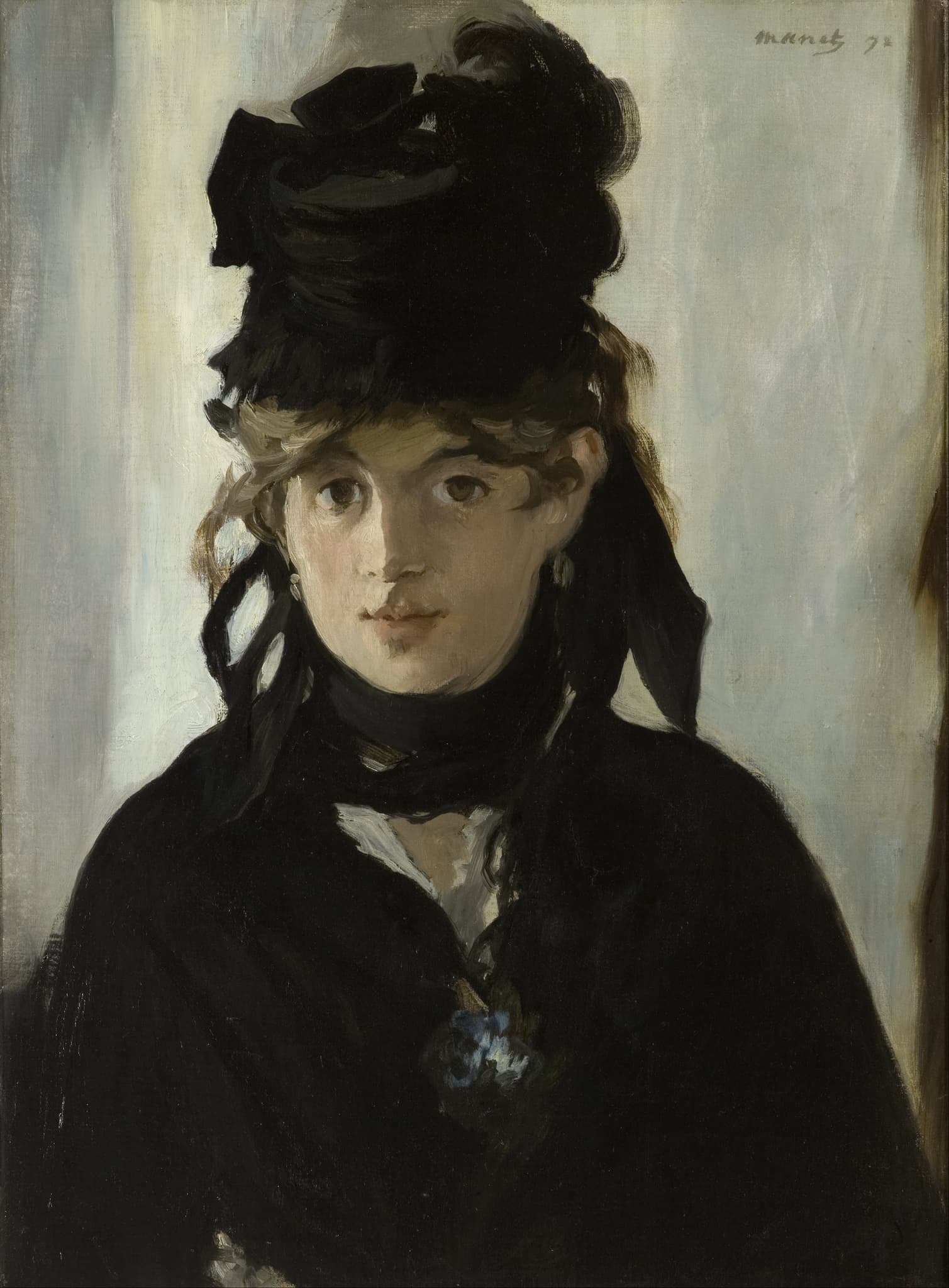
Berthe Morisot with a Bouquet of Violets
Édouard Manet, 1872 • Oil on canvas
Read full analysis of Berthe Morisot with a Bouquet of Violets →Valuation Analysis
Overview. Berthe Morisot with a Bouquet of Violets (1872) is among Édouard Manet’s most iconic portraits and a cornerstone image of the Impressionist circle. Depicting his close confidante (and future sister-in-law) Berthe Morisot, it combines a prime date, a celebrated sitter, and a refined half-length format that has become emblematic of Manet’s portraiture. The work belongs to the Musée d’Orsay and is frequently exhibited and reproduced, underscoring its canonical status within the artist’s oeuvre and the broader narrative of early Modernism [1].
Comparable analysis and benchmarks. The closest market proxy is Manet’s auction record, Le Printemps (Spring, 1881), which realized $65,125,000 at Christie’s in 2014—a highly finished, late female portrait that set the artist’s benchmark [2]. Another key data point is Le Grand Canal à Venise (1874), which made $51,915,000 in the Paul G. Allen sale at Christie’s in 2022, demonstrating deep demand for prime 1870s Manets in a marquee setting [3]. More recently, a late floral still life sold for $10,101,000 at Sotheby’s (May 2024), confirming strong liquidity for quality Manets across categories [4]. Against these anchors, the Morisot portrait carries superior art-historical resonance: a signature sitter intimately tied to the movement, and an image that is arguably more central to Manet’s portrait practice than the current record holder.
Resulting estimate. Given the painting’s stature, scarcity of comparable Manet portraits in private hands, and the depth of today’s trophy market for late 19th- to early 20th-century masterpieces, a price well above the 2014 record is supportable. We synthesize these factors into a hypothetical open-market estimate of $100–140 million. This band reflects: (i) a premium over Le Printemps for subject centrality; (ii) demonstrated capacity for >$50m Manet results in recent years; and (iii) a rational “trophy premium” for a museum-grade, widely published portrait that would likely command global competition at auction or in a top-tier private sale.
Institutional status and caveat. The work forms part of France’s national collections and is legally inalienable under the Code du patrimoine; any valuation is therefore hypothetical and for benchmarking or insurance context only [5]. No public insurance value is disclosed. Our estimate is derived from direct artist comparables, recent category performance, and qualitative adjustments for art-historical significance and scarcity.
Key Valuation Factors
Art Historical Significance
High ImpactPainted in 1872, this portrait of Berthe Morisot—Manet’s confidante and a leading Impressionist—sits at the heart of Manet’s portraiture and the movement’s formation. It captures a pivotal figure with whom Manet had a sustained artistic dialogue, and the painting’s spare elegance, psychological acuity, and signature black palette encapsulate Manet’s modernity. The image is heavily published, frequently loaned, and widely taught, placing it just below his most canonical provocations (Olympia, Déjeuner) while ranking at the apex of his portraits. For collectors, the combination of prime date, iconic sitter, and museum-grade quality confers maximum cultural capital and justifies a premium above other strong but less central Manet subjects.
Rarity and Supply
High ImpactTop-tier Manet portraits of named sitters—especially those with deep ties to Impressionism—are exceptionally scarce in private hands. The best examples are concentrated in museums, and the market sees few opportunities to compete for works of similar renown or quality. This scarcity amplifies competition and pricing when anything close surfaces. While high-quality landscapes and still lifes can still achieve robust prices, they do not match the historical and narrative power of a definitive portrait like Morisot. In a thinly supplied, globally contested trophy segment, rarity is a core value driver, increasing the likelihood of record-setting bidding dynamics should a comparably important Manet portrait ever come to market.
Market Benchmarks and Trophy Premium
High ImpactThe 2014 record for Le Printemps at $65.1m establishes the floor for A+ Manet portraiture, while the $51.9m Venice view (2022) reinforces depth above $50m for top-quality works. Recent results such as the $10.1m floral (2024) evidence sustained liquidity across the artist’s categories. Relative to these, the Morisot portrait carries greater art-historical centrality and name recognition, supporting an upward adjustment. In today’s “flight to quality” environment—where nine-figure results for late 19th-/early Modern masterpieces remain achievable—the incremental trophy premium for an image of this stature plausibly elevates value into low nine figures, consistent with our $100–140m range.
Provenance, Publication, and Exhibitions
Medium ImpactEarly provenance threads through Théodore Duret (a key critic and Manet champion) and Berthe Morisot herself, then through her heirs before the 1998 acquisition for the French State and allocation to the Musée d’Orsay. The work’s extensive exhibition and publication history—most recently in major international shows—cements its scholarly weight and public profile. Such a pedigree typically reduces perceived risk and enhances desirability at the top end of the market. While precise conservation details would further refine pricing, the combination of blue-chip institutional ownership, illustrious provenance, and sustained visibility strengthens confidence in a premium valuation and supports the upper half of the proposed range.
Sale History
Théodore Duret sale, Paris
Sold in the Théodore Duret sale; acquired by Berthe Morisot. Some sources note a price of 5,100 francs.
Édouard Manet's Market
Édouard Manet occupies a blue-chip, cornerstone position in the evolution of modern art, with limited supply at the top end and consistent global demand. His current auction record is $65.1 million for Le Printemps (Christie’s, New York, 2014). Subsequent marquee sales have reinforced depth, notably Le Grand Canal à Venise at $51.9 million in 2022, while high-quality smaller works like a late floral achieved $10.1 million in 2024. The market prizes portraits and late florals, with the very best examples often entering institutions, constraining turnover. As a result, competition for prime, named-figure portraits can be intense, and a true “trophy” could credibly reset the artist’s record under the right conditions.
Comparable Sales
Jeanne (Spring)
Édouard Manet
Best direct comp: same artist; iconic half-length female portrait (1881) with similar format/scale and A+ status; current Manet auction record.
$65.1M
2014, Christie's New York
~$86.6M adjusted
Le Grand Canal à Venise
Édouard Manet
Same artist; 1870s masterpiece sold in a peak marquee setting (Paul G. Allen sale), calibrating current trophy-level demand for Manet.
$51.9M
2022, Christie's New York
~$58.1M adjusted
Vase de fleurs, roses et lilas
Édouard Manet
Same artist; prime late floral (1882) shows strong liquidity for smaller, high-quality Manets in the current market.
$10.1M
2024, Sotheby's New York
~$10.4M adjusted
Self-Portrait with a Palette
Édouard Manet
Same artist; A-tier portrait and prior record at the time, anchoring values for iconic Manet portraiture even in earlier market cycles.
$32.9M
2010, Sotheby's London
~$48.7M adjusted
Ambroise Adam dans le jardin à Pressagny
Édouard Manet
Same artist; early (1861) small-scale portrait indicating sustained appetite for fresh, figurative Manets, useful for portrait-category depth (though far less iconic).
$1.0M
2025, Christie's Paris
Current Market Trends
The current Impressionist/early-Modern segment shows a pronounced flight to quality: historically established names with museum-level works continue to draw deep bidding, while broader markets remain selective. Nine-figure outcomes for category-defining masterpieces underscore available trophy capital, and recent marquee sales in New York and Paris demonstrate resilience at the high end. Supply is the main constraint for Manet and peers; when top examples appear, they catalyze competitive bidding and often surpass expectations. Major museum exhibitions and anniversaries have kept the period culturally salient, supporting confidence and pricing power for iconic works with strong provenance and publication histories.
Sources
- Musée d’Orsay – Berthe Morisot au bouquet de violettes
- Christie’s – 2014 Impressionist & Modern Evening Sale Results (Manet record)
- Christie’s/Paul G. Allen Sale Coverage – USA Art News
- The Art Newspaper – Sotheby’s Modern Evening Sale, May 2024
- Legifrance – Code du patrimoine, Art. L451-5 (Inalienability of public collections)