How Much Is Jeanne (Spring) Worth?
Last updated: January 19, 2026
Quick Facts
- Last Sale
- $65.1M (2014, Christie's New York)
- Insurance Value
- $135.0M (Appraiser's estimate based on replacement-cost analysis and recent trophy-market comparables)
- Methodology
- comparable analysis
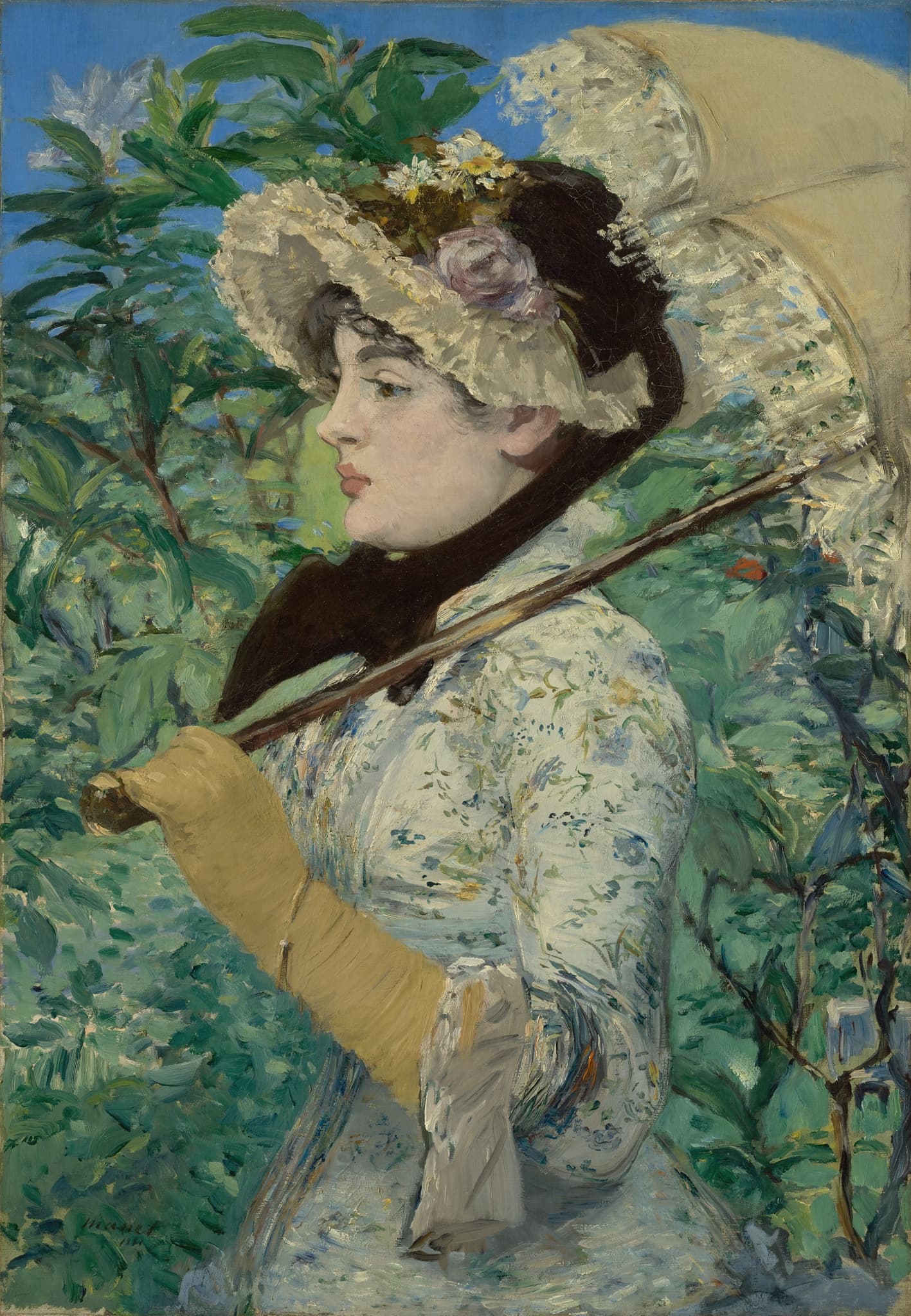
Anchored to its 2014 Christie’s sale at $65.125 million and the sustained depth for museum‑grade Impressionist masterpieces, Manet’s Jeanne (Spring) is estimated today at $90–120 million fair‑market value. Replacement/insurance is set at approximately $135 million, reflecting near‑zero substitutability and museum ownership.
Valuation Analysis
Fair-market value (FMV): $90–120 million. This estimate is derived via comparable analysis anchored to the painting’s last public sale at Christie’s New York on November 5, 2014, where it realized $65,125,000 including premium and set Manet’s standing auction record [1]. Immediately acquired by the J. Paul Getty Museum, Jeanne (Spring) has since been positioned as a late-career masterpiece and emblematic portrait within the artist’s oeuvre [2]. The step-up from the 2014 result reflects a decade of trophy-market appreciation, the work’s canonical status, and the acute scarcity of equivalent Manet paintings.
Comparable benchmarks and positioning. On the artist level, Jeanne remains the apex result and the most market-desirable Manet likely to trade in our time. Recent Manet activity underscores the steep quality gradient: a strong late still life brought $10.1 million in 2024, far below the tier at which celebrated portraits transact, reinforcing Jeanne’s singularity [3]. On the category level, blue-chip Impressionist/Post‑Impressionist masterpieces continue to command nine-figure pricing—evidenced by Monet’s Haystacks at $110.7 million (2019) and the Paul G. Allen collection’s Cézanne and Seurat at $137.8 million and $149.2 million, respectively—bracketing the upper end for 19th‑century icons [4][5].
Rarity and substitutability. Manet’s masterpiece-level supply is largely sequestered in museums; few late, signature portraits with comparable art-historical weight remain in private hands. Jeanne (Spring) itself is museum-held, which not only removes the best example from potential circulation but also makes true replacement effectively impossible. In a hypothetical sale, this scarcity and institutional endorsement would concentrate demand from global, top-tier collectors seeking a definitive Manet, supporting an FMV comfortably above the 2014 record result.
Insurance/replacement value: $135 million. Replacement cost for an object of this stature typically exceeds auction-indexed FMV, given the need to compete for an equally significant substitute (if one can be found). Recent marquee outcomes for category-defining works demonstrate buyers’ willingness to pay substantial premiums for museum-caliber masterpieces, justifying a replacement value well above the 2014 purchase and above FMV today [4][5]. The $135 million indication sits within a plausible $110–150 million bracket given current trophy dynamics.
Market context and timing. While aggregate Impressionist/Post‑Impressionist auction values declined in 2023–2024, reporting attributes this primarily to thinner supply of top lots rather than diminished demand. When true trophies surface, competition remains deep and global, a pattern consistent with Jeanne’s likely reception were it ever to re-enter the market [6]. Taken together—record-setting provenance, canonical importance, extreme scarcity, and supportive cross-artist benchmarks—the synthesized valuation of $90–120 million FMV and ~$135 million replacement is well supported.
Key Valuation Factors
Art Historical Significance
High ImpactJeanne (Spring) is widely regarded as a late-career masterpiece within Manet’s corpus and is among the most iconic portraits he produced. Conceived as part of his Seasons project, it distills Manet’s modern approach to portraiture—economy of brushwork, fashionable contemporaneity, and psychological presence—into a highly legible, celebrated image. Its sustained prominence in scholarship and exhibitions has elevated it beyond a strong work to a touchstone for Manet’s late style. Among Manets that could plausibly trade, its art-historical importance is unmatched, putting it at the apex of collector demand and making it the artist’s premier market benchmark since the 2014 record-setting sale.
Rarity and Supply
High ImpactMasterpiece-level Manets are exceptionally scarce on the open market; most are long in museums. Jeanne itself is in the J. Paul Getty Museum, removing the strongest example from circulation and driving near-zero substitutability. In practice, a collector seeking a comparably famous, late Manet portrait would have extremely limited options, if any. This structural scarcity intensifies competition whenever even secondary-tier Manets appear and supports a pronounced premium for a work with Jeanne’s stature. The scarcity effect compounds over time as institutional holdings increase and private owners become stickier, making replacement costs climb relative to standard auction-based fair-market indicators.
Provenance and Exhibition History
High ImpactThe painting’s provenance is exemplary: long-term private ownership, extended institutional loan in Washington prior to sale, and acquisition by a world-class museum (Getty) at its record-setting 2014 auction. Such a chain confers confidence in attribution, title, and cultural significance. Works with this level of institutional validation typically command premium pricing due to enhanced visibility, scholarly coverage, and public recognition. The Getty’s stewardship also implies best-practice conservation and documentation, reinforcing liquidity and value perception in any hypothetical transaction or appraisal context, and contributing materially to both fair-market and insurance-level valuations.
Market Benchmarks and Demand
High ImpactCross-artist benchmarks in the Impressionist/Post‑Impressionist category demonstrate deep global demand for museum-caliber masterpieces, with consistent nine-figure results for best-in-class works by Monet and Cézanne. Within Manet’s own market, the 2014 Jeanne sale remains the apex, while recent late-period works (e.g., floral still lifes) show robust but much lower pricing—highlighting Jeanne’s unique position at the very top. This quality gradient, combined with active institutional and private trophy buyers, underpins the $90–120 million FMV range and supports a higher replacement value. The comp set indicates capacity to stretch for iconic, publication-level works when they are available.
Sale History
Christie's New York
World auction record for Manet at the time; acquired by the J. Paul Getty Museum.
Édouard Manet's Market
Édouard Manet is a foundational figure of modern art whose masterpiece-level works are exceptionally scarce on the market. His standing auction record—Jeanne (Spring) at $65.125 million—has remained unchallenged since 2014, underscoring how rarely top-tier Manets surface. The market is deep and globally diversified, with committed collectors across the U.S., Europe, and Asia. Typical Manet oils vary widely by subject, date, and quality: late still lifes and secondary portraits can achieve seven to low-eight figures, while truly iconic figure paintings are effectively priceless due to institutional holdings. When best-in-class examples emerge, competition is fierce and pricing can recalibrate sharply upward.
Comparable Sales
Jeanne (Spring) [Le Printemps]
Édouard Manet
Same work; identical medium/date/size. This is the anchor comp and Manet’s standing auction record.
$65.1M
2014, Christie's New York
~$87.5M adjusted
Self-Portrait with a Palette
Édouard Manet
Same artist; late, museum-caliber portrait and prior Manet auction record pre-2014; close in stature and desirability.
$33.2M
2010, Sotheby's London
~$48.4M adjusted
Vase de fleurs, roses et lilas
Édouard Manet
Same artist; same late 1881–83 period. Shows current pricing for strong late Manet oils (though still life, not a portrait).
$10.1M
2024, Sotheby's New York
~$10.4M adjusted
Ambroise Adam in the Garden at Pressagny
Édouard Manet
Same artist; portrait subject, but early (1861) and small. Useful for showing the wide quality/period gradient in Manet portraits.
$1.0M
2025, Christie's Paris
Meules (Haystacks)
Claude Monet
Blue-chip Impressionist trophy benchmark; evidences depth of demand for museum-grade works in the same category.
$110.7M
2019, Sotheby's New York
~$137.8M adjusted
La Montagne Sainte-Victoire
Paul Cézanne
Category-level Post‑Impressionist trophy from the Paul G. Allen sale; brackets top-end pricing for canonical 19th‑century masterpieces.
$137.8M
2022, Christie's New York
~$149.8M adjusted
Current Market Trends
Impressionist/Post‑Impressionist auction values contracted in 2023–2024 amid thinner supply of top-ticket lots, yet demand for museum-grade trophies remained resilient. Category-defining works by Monet and Cézanne continued to achieve nine-figure prices, signaling sustained appetite at the high end when quality and freshness align. Within Manet’s market, post-2014 sales reaffirm the steep quality gradient: strong late works sell well, but nothing rivals Jeanne’s stature. Overall, the segment favors historically validated masterpieces with clear provenance and institutional exposure, and scarcity—more than macro sentiment—remains the primary determinant of pricing power at the very top.
Sources
- Christie’s: Impressionist & Modern Art Evening Sale Results (Nov 5, 2014)
- Getty Museum Acquisition Announcement: Manet’s Spring (2014)
- Sotheby’s Lot Result: Manet, Vase de fleurs, roses et lilas (May 15, 2024)
- Sotheby’s: Monet’s Meules Sells for $110.7 Million (2019)
- Christie’s: Paul G. Allen Collection Achieves $1.5 Billion (Nov 9, 2022)
- Art Basel & UBS: The Art Market 2024 – Auctions