How Much Is Music in the Tuileries Worth?
Last updated: January 27, 2026
Quick Facts
- Methodology
- comparable analysis
Fair‑market value for Édouard Manet’s Music in the Tuileries (1862) is estimated at $120–170 million. This range reflects the work’s canonical status within Manet’s oeuvre, extreme scarcity of comparable early masterpieces, and the demonstrated depth of today’s top-tier Impressionist and early Modern market.
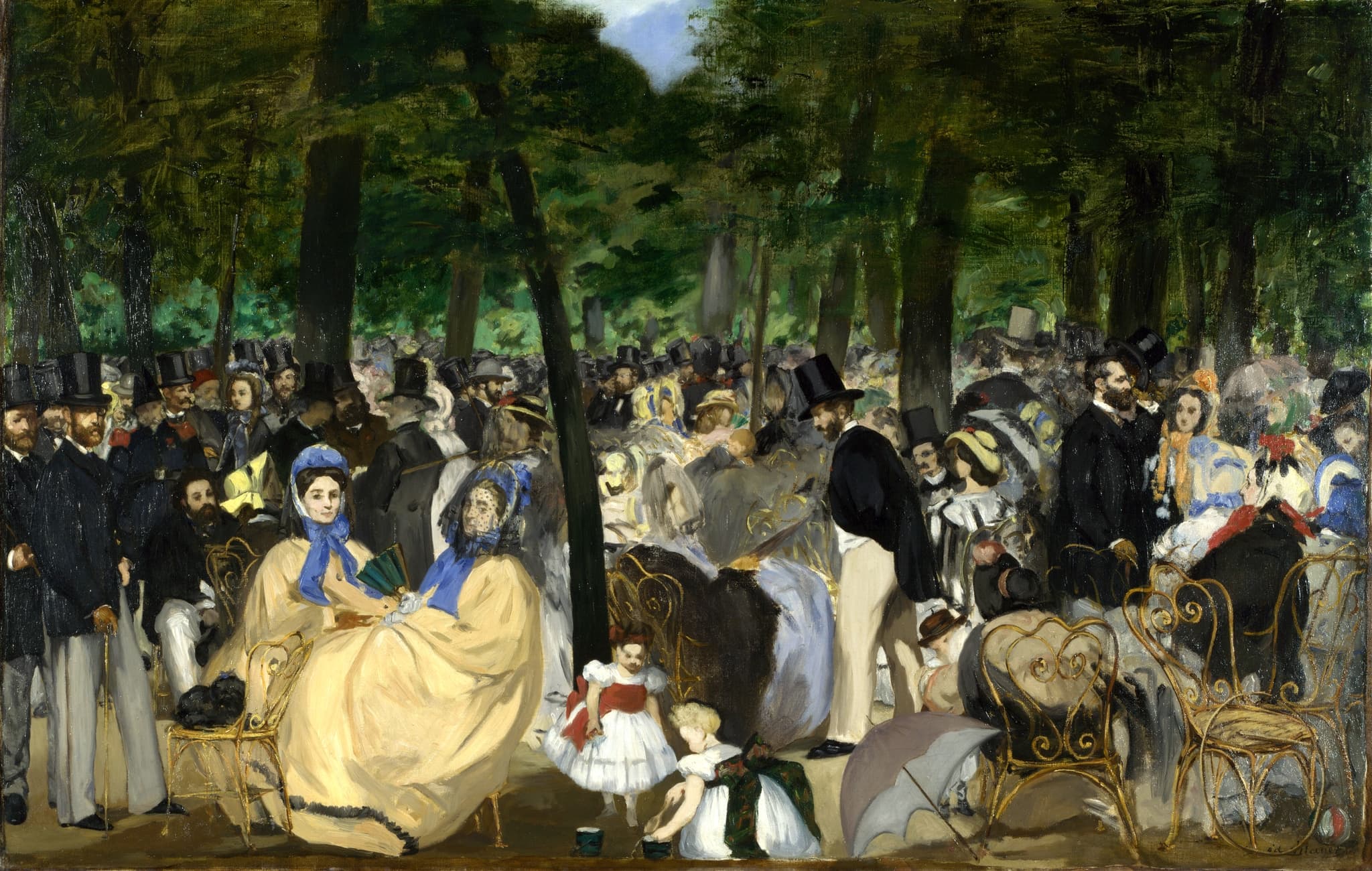
Music in the Tuileries
Édouard Manet, 1862 • Oil on canvas
Read full analysis of Music in the Tuileries →Valuation Analysis
Conclusion: Music in the Tuileries merits a fair‑market value of $120–170 million if offered today in a fully competitive sale, assuming sound condition and standard market exposure. This bracket positions the work well above Manet’s public auction record and within the current trophy range for historically foundational paintings in the Impressionist/early Modern canon.
Why this work commands a premium: Painted in 1862, Music in the Tuileries is a cornerstone of Manet’s vision of modern life—a dynamic urban crowd scene featuring the artist’s circle (including Baudelaire) and a pivotal statement that bridges Realism and the birth of Impressionism. Its art‑historical stature sits just below Olympia and Le Déjeuner sur l’herbe, both untouchable museum anchors, and places it among the most important Manets that could conceivably be valued against the market. It is jointly stewarded by the National Gallery, London, and the Hugh Lane Gallery, Dublin, underscoring its institutional caliber and off‑market status [1][6].
Comparables and market positioning: Manet’s auction record stands at $65.1 million for Jeanne (Spring), sold in 2014 to the J. Paul Getty Museum, establishing clear demand for prime, museum‑level Manet oils even outside his most revolutionary early 1860s subjects [2][3]. Since then, the trophy segment has reaffirmed its depth: 2025 saw a new modern-art auction pinnacle with Klimt at $236.4 million, while top Impressionist works like Monet’s Nymphéas reached $65.5 million in 2024, confirming robust appetite for blue‑chip classics at the highest level [5][7]. Against this landscape, an early, canonical, crowd‑scene Manet of textbook significance would be expected to surpass his decade‑old record by a wide margin. This estimate also factors the scarcity of directly comparable, early‑period Manets in private hands.
Market conditions and risk: After a contraction in 2024 (global art sales down 12%), late 2025 brought a widely observed rebound led by best‑of‑category masterpieces, with a pronounced “flight to quality” in established historical segments [4][5]. Music in the Tuileries benefits from that dynamic. The joint institutional ownership effectively precludes an actual sale; however, insurance or indemnity values for museum loans (typically confidential) would be expected to align with, or exceed, the midpoint of this range in line with standard risk tolerance for irreplaceable works [1][6].
Bottom line: The $120–170 million range synthesizes art‑historical primacy, cross‑category benchmarks, and current trophy‑market strength. It is a disciplined, upward extrapolation from Manet’s last public record, reflecting what a freely traded, early‑masterpiece Manet would command today in a mature global market.
Key Valuation Factors
Art Historical Significance
High ImpactMusic in the Tuileries (1862) is a seminal articulation of Manet’s modern-life project, depicting a cosmopolitan Parisian crowd that includes figures from his circle (such as Baudelaire). The canvas compresses observation, social portraiture, and painterly innovation into a single image that helped set the stage for Impressionism’s subjects and strategies. Within Manet’s oeuvre, it is a foundational statement—only marginally below Olympia and Le Déjeuner sur l’herbe in canonical weight—and is among the most frequently reproduced works in surveys of modern art. This status drives demand from top private collectors and institutions and justifies a significant premium above late-career portraits or still lifes.
Rarity and Supply
High ImpactLarge, museum-grade Manets from the early 1860s very rarely appear on the market. Most peers are permanently held in major museums, leaving virtually no supply of comparable works. Scarcity amplifies competition and price outcomes, especially for pieces that define the transition from Realism to Impressionism and encapsulate the emergence of modern urban life. Music in the Tuileries is precisely this type: a key early statement with few true substitutes. In today’s trophy environment, where world-class Impressionist and early Modern pictures are tightly held, this rare early Manet would command a substantial scarcity premium over later, more available works.
Comparable Market Benchmarks
High ImpactManet’s public record ($65.1m for Jeanne/Spring in 2014) demonstrates established demand for top Manet oils, even outside his most groundbreaking early period. Since that sale, the trophy segment has posted strong results, including the 2025 Klimt record at $236.4m and Monet’s $65.5m Nymphéas in 2024, reaffirming depth for blue-chip masterpieces. While not direct one-to-one comparables, these benchmarks indicate headroom above Manet’s 2014 high and support a low- to mid-nine-figure valuation for a canonical early 1860s Manet. The $120–170m range reflects this upward extrapolation from intra-artist records and cross-category anchors.
Provenance and Institutional Stewardship
Medium ImpactThe painting’s long, distinguished provenance—through Durand-Ruel to Sir Hugh Lane and jointly held by the National Gallery, London, and the Hugh Lane Gallery—confers exceptional credibility and scholarly validation. Institutional stewardship also implies stringent care standards and strong documentation. While joint ownership effectively removes the work from the open market, the same factors reinforce its cultural importance, insurability, and appeal in a hypothetical valuation exercise. Any real-world figure would likely be reflected in confidential insurance or indemnity contexts, but the provenance and current partnership arrangement underscore the work’s top-tier status and help anchor the valuation at the higher end of the Impressionist field.
Sale History
Music in the Tuileries has never been sold at public auction.
Édouard Manet's Market
Édouard Manet is a cornerstone of 19th‑century modernism, with an extremely selective and supply‑constrained market. His auction record remains $65.1 million for Jeanne (Spring) at Christie’s New York in 2014, purchased by the Getty—clear evidence of institutional demand for prime Manet oils. Since then, very few works of equivalent caliber have surfaced; smaller or later works continue to transact solidly, while early, museum‑grade pictures are almost entirely institutionally held. This scarcity caps public turnover but elevates pricing power for any masterpiece that could, in theory, be sold. In the current environment—where buyers exhibit a flight to quality—Manet’s major oils are well positioned to command robust nine‑figure valuations when judged against top Impressionist and early Modern benchmarks.
Comparable Sales
Jeanne (Spring)
Édouard Manet
Same artist; top auction record for Manet; museum-caliber oil showing demand ceiling for prime Manet paintings, even though it is a single-figure portrait rather than a large modern-life crowd scene.
$65.1M
2014, Christie's New York
~$86.9M adjusted
Self-Portrait with a Palette
Édouard Manet
Same artist; rare, important large self-portrait; a leading Manet price point for a significant figural oil and a benchmark for high-quality Manets sold publicly.
$34.6M
2010, Sotheby's London
~$50.2M adjusted
Le bal de l’Opéra
Édouard Manet
Same artist; modern-life subject (crowded Paris entertainment). Smaller and far less canonical than Music in the Tuileries, but a recent signal for Manet’s market for urban leisure themes.
$3.9M
2022, Christie's New York
~$4.2M adjusted
Le Boulevard Montmartre, Spring
Camille Pissarro
Close subject analogue: grand Paris boulevard/crowd scene from the Impressionist core. Demonstrates market depth for iconic urban modern-life images of comparable ambition.
$32.1M
2014, Sotheby's London
~$42.9M adjusted
Bal du moulin de la Galette
Pierre-Auguste Renoir
Iconic Paris leisure crowd scene and a benchmark Impressionist masterpiece sale; subject and cultural importance align closely with Manet’s modern-life ambition.
$78.1M
1990, Sotheby's New York
~$188.8M adjusted
Nymphéas
Claude Monet
Category anchor sale for Impressionism in 2024; while a landscape, it reflects current trophy-level appetite and pricing for blue-chip masterpieces in the movement.
$65.5M
2024, Sotheby's New York
~$67.2M adjusted
Current Market Trends
After a challenging 2024 with global art sales down 12%, late 2025 brought a broadly reported rebound led by established historical categories and trophy masterpieces. The headline Klimt record and strong results for top Impressionists illustrate deep liquidity at the very high end, even as overall supply remains thin. Collectors continue to prioritize canonical works with museum-grade significance, pristine provenance, and compelling exhibition histories. Within this context, a foundational early Manet—particularly an urban modern‑life subject—aligns closely with what the market currently rewards: rarity, art‑historical inevitability, and blue‑chip quality that can anchor a collection or institution.
Sources
- National Gallery (London) – Object page: Manet, Music in the Tuileries Gardens
- Christie’s – Post‑sale release (Impressionist & Modern Art Evening Sale, Nov 5, 2014)
- Artnet News – Manet’s Spring sells for $65.1m (Nov 2014)
- The Art Newspaper – Global art sales fell 12% in 2024 (Art Basel & UBS report)
- The Wall Street Journal – Klimt sets modern-art auction record, 2025
- National Gallery (London) – 2021 partnership with Hugh Lane Gallery
- The Wall Street Journal – Monet Nymphéas sells for $65.5 million (Nov 2024)