How Much Is Plum Brandy Worth?
Last updated: January 21, 2026
Quick Facts
- Methodology
- comparable analysis
Based on auction benchmarks for top-tier Manet oils and the painting’s prime-period, museum-caliber status, Plum Brandy (La Prune) would command approximately $85–110 million if hypothetically offered. The range straddles Manet’s inflation-adjusted record and reflects the work’s emblematic modern-life subject, rarity, and deep scholarly visibility.
Valuation Analysis
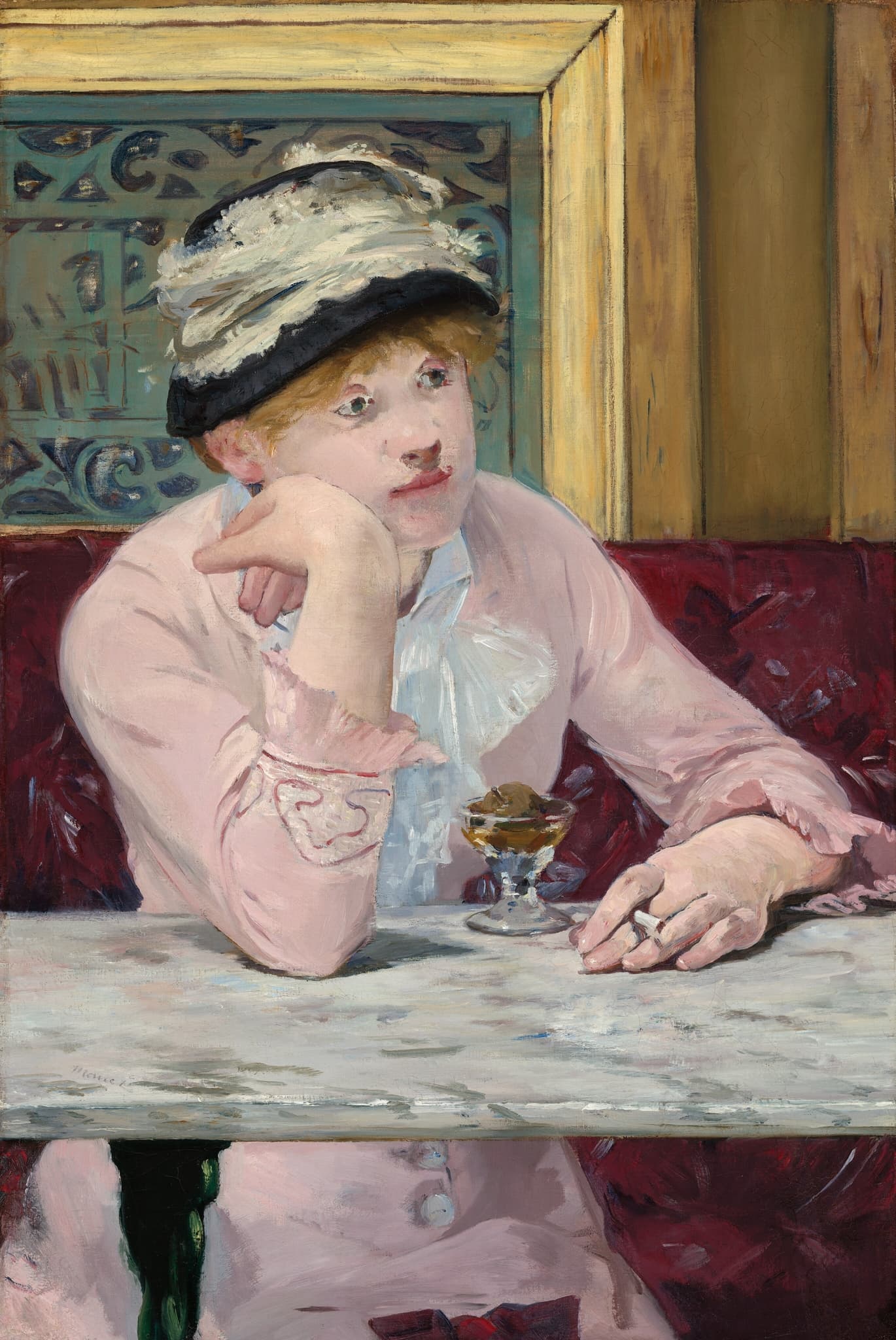
Conclusion: We estimate Édouard Manet’s Plum Brandy (La Prune), c. 1877 (oil on canvas, 73.6 × 50.2 cm; National Gallery of Art, Washington), at $85–110 million on a hypothetical sale. This is a museum-caliber, prime-period modern-life interior, widely reproduced and central to Manet’s late-1870s Parisian themes, with full institutional validation and an exemplary provenance trail [1].
Method and benchmarks: The range is anchored to Manet’s auction record—Le Printemps (Spring), sold for $65,125,000 at Christie’s New York in 2014 [2]. Adjusted for today’s dollars, that benchmark sits near the high eight to low nine figures. Against that yardstick, Plum Brandy’s subject, date, scale, and visibility merit a record-adjacent valuation. Recent sales reinforce the steep stratification in Manet’s market: late florals such as Vase de fleurs, roses et lilas (1882) achieved $10.1 million at Sotheby’s in 2024—strong, but clearly a different tier from iconic figure interiors [3].
Quality, subject, and rarity: Plum Brandy is a signature café interior from the late 1870s, an era central to Manet’s depiction of modern Paris. Works of this caliber and subject are exceptionally scarce in private hands; most reside in major museums. That scarcity, coupled with the painting’s intimacy and psychological charge, supports a scarcity premium well beyond the eight-figure band reserved for smaller or secondary subjects. Its prime-period date and highly legible narrative place it among Manet’s most sought-after categories, even if it sits below Olympia or A Bar at the Folies-Bergère in absolute canonical status [1].
Market conditions: The Impressionist and Modern segment has experienced a two-year contraction at the top end, with fewer $10m+ lots in 2023–2024; however, high-quality, right-priced blue-chip works continue to attract disciplined competition, often underpinned by guarantees [4]. Major recent Manet exhibitions—most notably Manet/Degas at the Musée d’Orsay and The Met—have further energized scholarly and collector attention to his modern-life subjects, enhancing the salience of works like Plum Brandy [5].
Positioning and sensitivity: The $85–110 million indication assumes standard museum-level condition for the period and benefits from the work’s impeccable provenance and deep publication/loan history [1]. In a well-sequenced evening sale with strong editorial framing and global outreach, the painting would be expected to test or edge above the inflation-adjusted record range for Manet, depending on timing and competitive demand.
Key Valuation Factors
Art Historical Significance
High ImpactPlum Brandy is a cornerstone of Manet’s late-1870s exploration of modern Parisian life. The introspective, single-figure café interior crystallizes the artist’s shift toward contemporary subjects and nuanced psychology while retaining his hallmark painterly directness. Its date, handling, and theme align it with the most discussed phase of Manet’s career—works that bridge Realism and the emergent Impressionist sensibility. The painting is frequently reproduced, widely taught, and paired in discourse with Degas’s café scenes, making it a touchstone for modern-life narratives. While it sits below Olympia or A Bar at the Folies-Bergère in global icon status, within the café/modern-life subset it is among the most recognizable exemplars, sustaining persistent scholarly and public interest.
Rarity and Supply
High ImpactMuseum-level Manet oils from the prime 1870s are extraordinarily scarce in private hands. A large share of the artist’s most desirable subjects—especially modern-life figure interiors—are held by institutions, drastically limiting opportunities for acquisition. When a comparably important canvas appears, competition tends to be concentrated among a small set of global collectors and institutions, driving price discovery above typical benchmarks. The 2014 record for Le Printemps demonstrated the depth of demand for late, emblematic Manets. Given that Plum Brandy carries equivalent period gravitas and subject resonance, its scarcity value is acute. The absence of recent, like-for-like offerings accentuates the premium, particularly in a market environment that rewards singular, best-in-class material.
Subject and Scale
Medium-high ImpactThe subject—a contemplative young woman with a glass of plum brandy—embodies Manet’s incisive observation of urban modernity. It offers narrative intrigue, social context, and psychological depth that outperform still lifes and many small portraits in market appeal. The scale (approximately 29 × 19 3/4 inches) is intimate yet substantial, optimal for private display while retaining a commanding wall presence. Among Manet’s market strata, late still lifes can reach low eight figures, but modern-life figure interiors typically command meaningful premiums. Though not on the icon tier of Olympia, this painting stands near the apex of collector demand for narrative Manets, benefiting from cross-category appeal to Impressionist, Modern, and even contemporary-leaning buyers who prioritize subject-driven works.
Provenance, Exhibition, and Condition
High ImpactThe work’s provenance—from early private ownership through Paul Rosenberg and Paul Mellon to its current home at the National Gallery of Art—meets the highest standards of market acceptability. Extensive publication and exhibition history reinforce its scholarly stature and curatorial endorsement. Although formal condition details would be required in a sale context, long-term museum stewardship typically correlates with excellent conservation and stability. These elements reduce transaction risk and enhance bidder confidence, supporting record-adjacent pricing. Taken together, the fully documented ownership, institutional validation, and anticipated conservation profile are consistent with the price tier reserved for masterworks by Manet, particularly those with unmistakable placement within his modern-life corpus.
Sale History
Plum Brandy has never been sold at public auction.
Édouard Manet's Market
Édouard Manet is a blue-chip cornerstone of 19th-century art, bridging Realism and Impressionism and shaping the course of modern painting. His auction record stands at $65.1 million for Le Printemps at Christie’s New York (2014), a museum acquisition that underscored the intense demand for late, iconic subjects. Supply of prime oils is constrained, as many are in institutions, and the price gradient is steep: smaller or secondary works trade in the low- to mid-seven figures, late still lifes in the low eight figures, and true museum-level subjects can challenge the record tier. Collectors value Manet’s historical centrality, freshness to market, and strong provenance; when these align, competition is focused and deep.
Comparable Sales
Le Printemps (Spring)
Édouard Manet
Same artist; late-career masterpiece, museum-caliber; benchmark for top-tier Manet oils and closest quality proxy for a major, iconic subject.
$65.1M
2014, Christie's New York
~$89.0M adjusted
Vase de fleurs, roses et lilas
Édouard Manet
Same artist; high-quality late floral (1882) offering a current-market read for strong but non-figurative Manet oils.
$10.1M
2024, Sotheby's New York
~$10.4M adjusted
Le bal de l’Opéra
Édouard Manet
Same artist; 1873 figure/modern-life subject, providing a price anchor for smaller-scale interior/genre scenes in the Manet market.
$3.9M
2022, Christie's New York
~$4.3M adjusted
Ambroise Adam dans le jardin à Pressagny
Édouard Manet
Same artist; early small oil (1861) that brackets the low end of Manet’s oil market and underscores the steep premium reserved for major subjects.
$1.0M
2025, Christie's Paris
Current Market Trends
Impressionist and Modern auctions experienced a contraction at the very top end in 2023–2024, with fewer $10m+ lots and greater estimate discipline. Yet blue-chip, high-quality works continued to perform strongly, often supported by guarantees and careful positioning. The Art Basel & UBS Global Art Market Report 2024 documented lower headline values alongside stable or improved sell-through for well-priced masterworks. Recent blockbuster exhibitions (including Manet/Degas) have amplified attention to core 19th-century names, supporting demand for best-in-class examples. In this bifurcated market, scarcity, subject importance, and museum-level provenance are decisive, which favors a painting like Plum Brandy in a tightly curated evening sale.
Sources
- National Gallery of Art (NGA), Plum Brandy (La Prune) object page
- Christie’s Press Release: Impressionist & Modern Art Evening Sale Results (includes Manet record, 2014)
- The Art Newspaper: Sotheby’s Modern Evening Sale report (May 16, 2024)
- The Art Market 2024 (Art Basel & UBS) — Auctions Overview
- The Metropolitan Museum of Art — Manet/Degas exhibition (press/exhibition page)