How Much Is Self-Portrait with Palette (Autoportrait à la palette) Worth?
Last updated: March 10, 2026
Quick Facts
- Last Sale
- $33.1M (2010, Sotheby's, London (Impressionist & Modern Evening Sale))
- Methodology
- comparable analysis
I estimate Édouard Manet's Self‑Portrait with Palette (Autoportrait à la palette) at US$30,000,000–$60,000,000. The identical painting’s public sale at Sotheby’s London in June 2010 (reported ≈US$33.09M) anchors this range, with the artist’s top auction benchmarks and present market liquidity setting the ceiling.
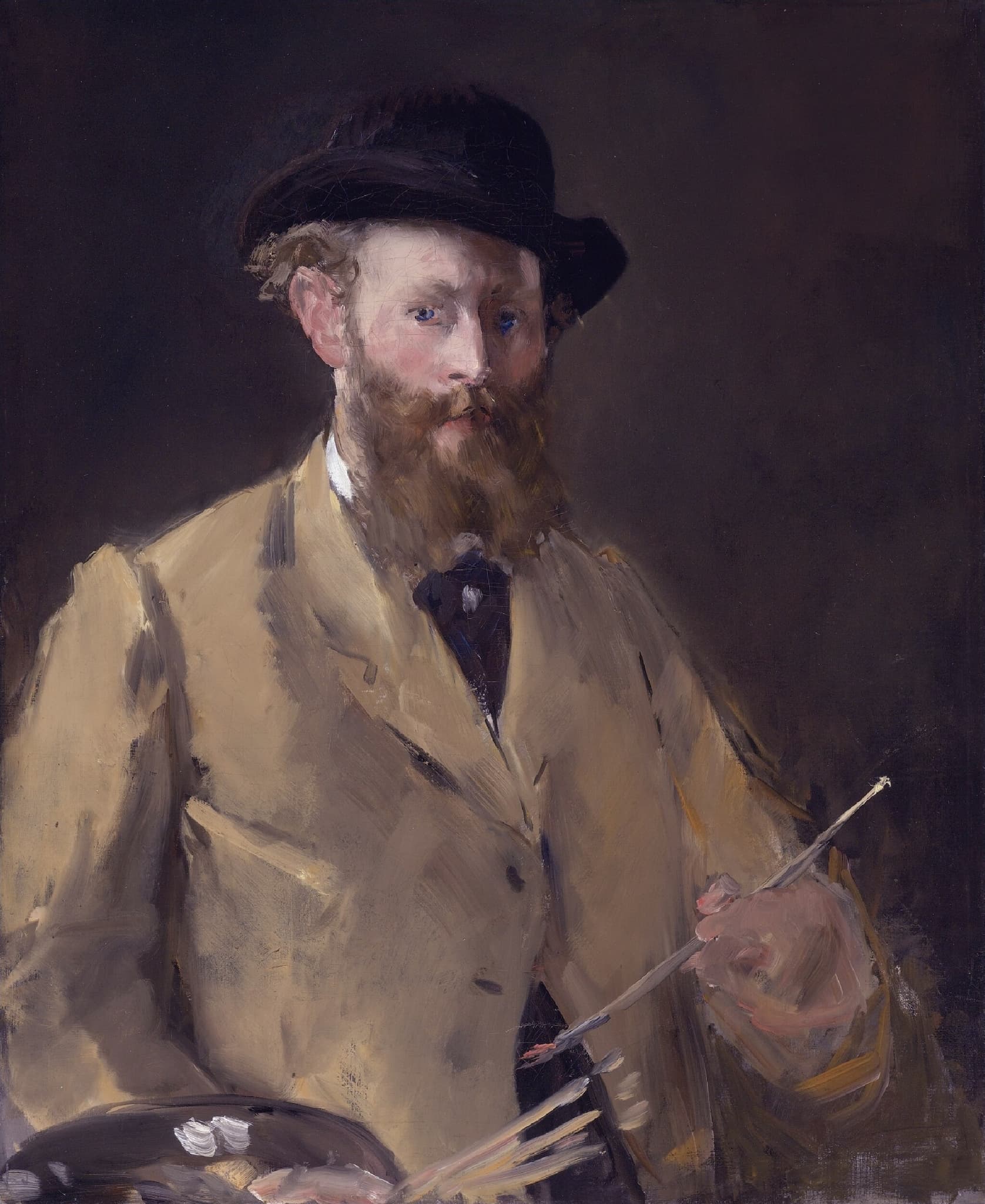
Self-Portrait with Palette (Autoportrait à la palette)
Édouard Manet • Oil on canvas
Read full analysis of Self-Portrait with Palette (Autoportrait à la palette) →Valuation Analysis
Valuation conclusion: Based on the painting’s public auction history, comparables and current market context, a realistic realised range for Édouard Manet’s Self‑Portrait with Palette is approximately US$30,000,000 to US$60,000,000. The most directly relevant datum is the work’s appearance as a lead lot at Sotheby’s, London, on 22 June 2010 where it sold for a reported £22,441,250 (≈US$33,087,379) [1]. That 2010 result anchors market expectations for this exact canvas.
The 2010 result is particularly valuable because it is the identical painting sold under strong provenance and evening‑sale presentation; an earlier public sale (Christie’s New York, Loeb collection, May 1997, ≈US$18.7M) confirms long‑term demand and appreciation. Major museum‑quality Manet oils provide the market ceiling — Christie’s sale of Le Printemps (Spring) in 2014 at US$65.125M remains the record benchmark and therefore informs the upper bound of this appraisal [2].
Why the $30–60M range? If the work is confirmed as the autograph, in sound condition, and retains the strong provenance and exhibition history recorded in public catalogues, it will be considered museum‑quality and should trade in the mid‑to‑high tens of millions. The lower bound reflects a conservative evening‑sale outcome with restrained bidding or modest condition issues; the upper bound assumes competitive bidding at a major evening sale or a private sale backed by a guarantee, which can push results toward the artist’s high market band.
Market sensitivities are material: attribution/authentication, the technical/conservation history, and completeness of provenance (including prior important owners and exhibition citations) will each move price significantly. Recent high‑end Manet outcomes (large museum‑quality canvases selling in the $50M+ band) and solid mid‑market showings (examples in the $5M–$15M band) demonstrate how subject, size and documentation drive realized value; these comparables justify the spread in the estimate and explain why a confirmed / well‑placed Self‑Portrait with Palette can reasonably achieve up to or slightly above the upper end of the range [2][4][5].
Next steps to firm a final figure: secure high‑resolution recto/verso images, commission a full technical/condition report (X‑ray, IRR, pigment analysis), and assemble the complete provenance and exhibition bibliography. With those materials, major auction houses or a specialist dealer can provide a formal pre‑sale estimate or negotiate a private placement within this stated US$30–60M range [1][2].
Key Valuation Factors
Art Historical Significance
High ImpactThis is a Manet self‑portrait, a subject category that is relatively rare and important in the artist’s output because it directly contributes to scholarship on his self‑image and technique. Self‑portraits by Manet attract curatorial interest and institutional demand, which increases marketability and the probability of institutional bidding. While Manet’s canonical compositions (e.g., Le Printemps, Olympia) command the very highest prices, a museum‑quality self‑portrait with confirmed authorship sits noticeably above typical portrait/study levels, giving the work meaningful price premium potential when provenance and condition are clean.
Attribution & Authentication
High ImpactClear, uncontested attribution to Édouard Manet is essential. Catalogued, published, and exhibited status (or inclusion in a catalogue raisonné) materially increases buyer confidence and can move the painting from the lower‑millions into the mid‑tens of millions. Conversely, any unresolved attribution doubts, conflicting technical evidence, or absence from standard scholarly references will sharply depress realized value. A technical examination (IRR, X‑ray, pigment analysis) and endorsements from recognized Manet scholars or museum curators are therefore high‑value investments prior to sale.
Provenance & Exhibition History
High ImpactThis painting benefits from a notable provenance (recorded inclusion in the Goldschmidt sale, Loeb collection, and later consignments) and evening‑sale exhibition placement, which significantly increases collectability. Clear, continuous ownership records and exhibition/publication citations lower buyer risk and justify premium bidding, particularly from institutions and blue‑chip private collectors. Any gaps, disputed transfers, or missing documentation will reduce liquidity and may force conservative estimate setting or private‑sale routes.
Condition & Technical State
High ImpactCondition issues (major relinings, heavy restorations, large retouching, paint loss) materially reduce market value even for authenticated Manets. A sound technical report that shows original surface and limited invasive treatment supports a higher estimate; conversely, extensive conservation problems create bidding reluctance and increased buyer allowance. Estimated sale costs for restoration or disclosure-adjustments should be factored into pricing and reserve strategy.
Market Liquidity & Demand (venue effects)
Medium ImpactMarket appetite for top Manet works remains strong but selective: museum‑grade canvases attract institutional buyers and wealth‑market bidders, while mid‑tier works sell in a deeper but less headline‑driven band. Auction venue, timing, and whether the sale uses guarantees or private‑sale placement materially affect outcomes. An evening‑sale presentation at a major house generally supports higher realized results; a private placement can either compress or enhance proceeds depending on buyer competition and confidentiality.
Sale History
Sotheby's, London (Impressionist & Modern Evening Sale)
Christie's, New York (Loeb collection)
Sotheby's, London (Jakob Goldschmidt sale)
Édouard Manet's Market
Édouard Manet is a cornerstone 19th‑century French painter whose works are central to modern art collections worldwide. Autograph oils by Manet are scarce in the market and command strong institutional interest; the artist’s auction record is US$65.125M (Le Printemps, 2014), which establishes a top‑end ceiling. While canonical large works are largely museum‑held, high‑quality portraits, self‑portraits and late still lifes regularly achieve multi‑million results. Collectors and museums prize Manet for his role between Realism and Impressionism, sustaining durable demand for well‑provenanced, well‑documented canvases.
Comparable Sales
Self-Portrait with Palette (Autoportrait à la palette)
Édouard Manet
Exact same painting; led a major evening sale and has strong provenance/exhibition history — the primary benchmark for valuing this work.
$33.1M
2010, Sotheby's, London (Impressionist & Modern Evening Sale)
~$49.2M adjusted
Self-Portrait with Palette (Autoportrait à la palette)
Édouard Manet
Earlier public sale of the identical painting — shows long-term appreciation and establishes a lower anchor in the painting's auction history.
$18.7M
1997, Christie's, New York (Loeb collection sale)
~$37.7M adjusted
Le Printemps (Spring)
Édouard Manet
Record-level Manet oil (museum-quality, canonical subject) — establishes the upper echelon of the market for top Manet paintings and a ceiling for valuation.
$65.1M
2014, Christie's, New York (Evening Sale)
~$89.2M adjusted
Le Grand Canal à Venise
Édouard Manet
Recent high-value sale of a large, museum-quality Manet oil — a close market analogue for how competitively sought top Manet canvases can perform in the 50M+ band.
$51.9M
2022, Christie's, New York (Paul G. Allen collection sale)
~$57.5M adjusted
Vase de fleurs, roses et lilas
Édouard Manet
Mid-market example of a late-career Manet (still life) sold in New York — useful lower-end comparator for scale and demand for quality but non-trophy Manet works.
$10.1M
2024, Sotheby's, New York (Impressionist & Modern Evening Sale)
~$10.4M adjusted
Current Market Trends
The Impressionist/Modern market has become more selective at the very top since 2022, with fewer blockbuster auction outcomes and greater use of private sales and guarantees. Mid‑market demand for well‑provenanced works remains healthy; institutional buying still supports trophy works. For Manet specifically, scarcity of museum‑quality canvases coupled with episodic museum interest keeps realized prices for top examples elevated, while market timing and sale venue strongly influence final results.
Sources
- Sotheby's — Impressionist & Modern Evening Sale, Lot 9 (Self‑Portrait with Palette) — 22 June 2010 (lot page / catalogue entry)
- Christie's press release / coverage — Le Printemps (Spring) sale — Christie’s New York, 5 Nov 2014 (auction record benchmark)
- The Guardian — coverage of the 2010 Sotheby’s sale (contemporaneous market reporting)
- Coverage of recent high‑value Manet sales (Paul G. Allen collection; Christie’s Nov 2022 summary)
- Sotheby's — Vase de fleurs, roses et lilas (May 15, 2024) — recent mid/high‑market Manet comparable