How Much Is The Dead Toreador Worth?
Last updated: January 27, 2026
Quick Facts
- Methodology
- comparable analysis
The Dead Toreador (c. 1864) is a cornerstone of Manet’s Spanish period and a highlight of the National Gallery of Art’s Widener collection. Using top-tier comparables—anchored by Manet’s auction record for Le Printemps at $65.1 million (2014)—and today’s trophy-market dynamics, a current open‑market price would be $85–115 million. The range reflects extreme scarcity, blue‑chip provenance (Durand‑Ruel, Faure, Widener), and the work’s central art-historical status.
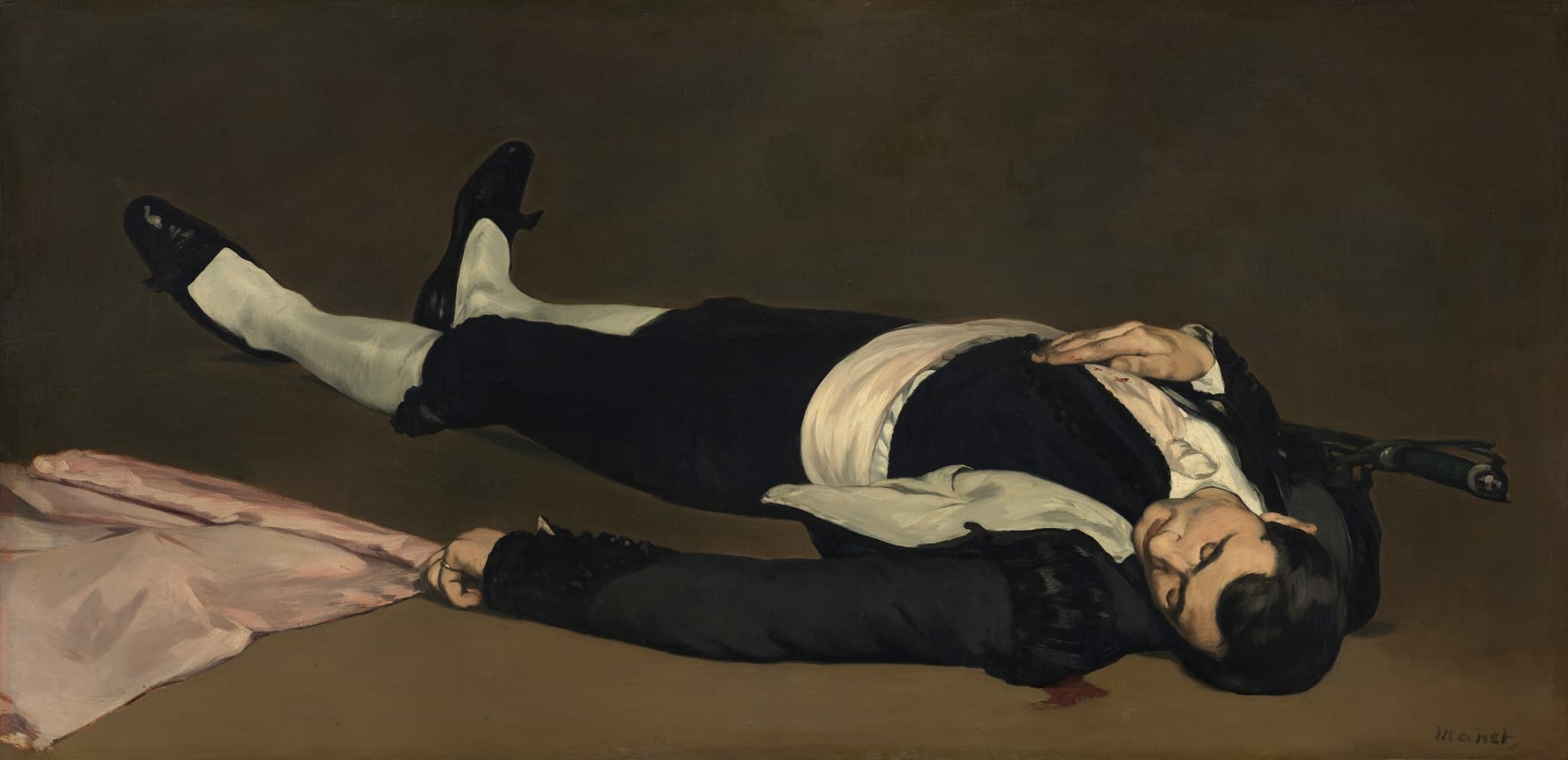
The Dead Toreador
Édouard Manet, probably 1864 • Oil on canvas
Read full analysis of The Dead Toreador →Valuation Analysis
Conclusion: On a hypothetical, unconstrained sale today, Édouard Manet’s The Dead Toreador would command approximately $85–115 million. The painting is a museum-caliber masterwork: a keystone of Manet’s early “Spanish” period, long in the National Gallery of Art (Widener Collection), and extensively published and exhibited [1].
What it is and why it matters: The Dead Toreador (probably 1864) is the lower portion of a larger bullfight canvas that Manet famously cut after the work’s contentious Salon reception. Its radical cropping and dialogue with Velázquez make it a touchstone in the literature; the companion upper segment is The Bullfight at the Frick. This formation history is central to understanding Manet’s modern pictorial strategies and has been rigorously documented by major museums [2].
Method and anchors: We benchmark against Manet’s auction record, Le Printemps (Spring), which realized $65.125 million at Christie’s in 2014. Adjusted for a decade-plus of inflation and trophy scarcity, that result equates to the high‑$80m range in today’s dollars. Given Dead Toreador’s scholarly weight, scale, and rarity relative to market-friendly but less seminal portraits, a level above the inflation‑adjusted record is warranted [3].
Comparables and subject positioning: Recent public sales underscore a bifurcated Manet market: smaller late still lifes continue to sell strongly (e.g., Vase de fleurs, roses et lilas at $10.1m in 2024), while true museum highlights are extraordinarily scarce. Dead Toreador sits in the latter camp. Although a fallen bullfighter is less “decorative” than a fashionable portrait, this subject is rarer at this scale and carries exceptional scholarly resonance—attributes that drive competition among top collectors and institutions when masterpieces surface [4].
Market climate and range selection: At the very top end of the Modern market, buyers exhibit a flight to quality: when canonical, fresh material appears, bidding remains deep and disciplined. Broader auction data show selectivity overall but resilience for blue‑chip trophies, a context supportive of a record‑challenging Manet should one come forward [5]. Balancing art‑historical gravitas, provenance (Durand‑Ruel, Jean‑Baptiste Faure, Widener), and the subject’s austere appeal yields an $85–115 million range. This positions Dead Toreador as a potential record contender, consistent with its status among Manet’s most discussed early masterpieces.
Key Valuation Factors
Art Historical Significance
High ImpactThe Dead Toreador is a canonical statement from Manet’s early “Spanish” period and a key document of his radical modernity. Its origin as the lower section of a larger bullfight composition—subsequently cut and resolved by the artist—has made it a case study in Manet’s cropping, staging, and engagement with Velázquez. The painting appears regularly in scholarly treatments and museum narratives, and it is integral to understanding Manet’s break with academic convention. Its pairing in the literature with The Bullfight (Frick) further amplifies its importance. Works that define an artist’s experimentation and influence typically command premium pricing because they anchor the oeuvre and are widely recognized by curators, scholars, and top-tier collectors.
Rarity and Supply Constraints
High ImpactMasterpiece-level Manets are exceptionally scarce on the market; most reside in museums or in long-held private collections. Since the Getty’s acquisition of Le Printemps in 2014, very few museum-highlight Manets have surfaced at auction, reinforcing the supply-demand imbalance. Monumental, early Spanish-subject canvases of this scholarly standing almost never come up for sale. When true trophies reappear after long institutional stewardship, buyers apply a rarity premium that lifts prices above historical benchmarks. In this context, The Dead Toreador’s combination of scale, notoriety, and early date would drive record-challenging competition from the limited pool of museums able to deaccession or bid (where permitted) and ultra-high-net-worth collectors focused on canonical 19th-century masterpieces.
Provenance, Exhibition, and Literature
High ImpactThe chain of ownership—Durand-Ruel (1872), the celebrated singer/collector Jean‑Baptiste Faure (1874), Cottier & Co., and the industrialist Peter A.B. Widener (1894), before entering the National Gallery of Art—constitutes an exemplary provenance. The picture has been on view for decades and is extensively cited in the scholarly literature, increasing confidence and reducing transactional friction. Deep documentation, museum visibility, and Widener pedigree meaningfully enhance liquidity and price outcomes for paintings at this level. For buyers, such a provenance not only guarantees authenticity and historical importance but also aligns with collecting standards for institutional or legacy-quality acquisitions, which can justify bidding beyond prior public records for the artist.
Subject Appeal and Market Taste
Medium ImpactWhile the image of a fallen toreador is less traditionally ‘decorative’ than Manet’s celebrated portraits, it carries a potent modern narrative and is a signature Spanish theme. The stark, cinematic composition and life-size presence deliver exceptional wall power. For trophy buyers, narrative gravity and art-historical centrality can outweigh decorative appeal, especially when supply is extremely thin. That said, market psychology often rewards elegant portraiture with broader bidder pools; we therefore account for a modest demand discount relative to a comparably ranked portrait, while recognizing that rarity, scholarship, and provenance more than offset this effect at the nine-figure level for a work of this caliber.
Market Benchmarks and Inflation
High ImpactManet’s auction record stands at $65.125 million (Christie’s, 2014, Le Printemps). Adjusted for inflation and the intervening scarcity of top-tier Manets, that benchmark aligns with the high‑$80 million zone today. Meanwhile, recent results (e.g., a late still life at $10.1 million in 2024) confirm healthy demand for quality across lower tiers, highlighting a two-speed market that is especially rewarding for true trophies. Combining these data with the current ‘flight to quality’ at the top of the Modern category supports an $85–115 million range for The Dead Toreador, reflecting both a realistic path to a new artist record and prudent allowance for auction dynamics and subject-specific taste differentials.
Sale History
The Dead Toreador has never been sold at public auction.
Édouard Manet's Market
Édouard Manet is a blue-chip, museum-caliber cornerstone of 19th‑century art, bridging Realism and Impressionism. His auction record, $65.125 million for Le Printemps (Christie’s New York, 2014), remains a key benchmark; second-tier masterpieces have traded in the $20–40+ million range, while smaller oils and works on paper populate the low- to mid-seven figures. Supply is structurally tight—most top works are in institutions—so fresh, high-quality paintings attract intense competition. In 2024, a late floral still life fetched $10.1 million, underscoring steady depth for desirable smaller works. Private sales for top Manets can exceed auction prices given scarcity. Overall, demand is global and institutionally anchored, with collectors prioritizing period-defining subjects, strong provenance, and exhibition histories.
Current Market Trends
After a brisk post‑pandemic cycle, 2023–2024 saw more selective bidding and lower overall auction totals, while 2025 marked a measured rebound concentrated in blue‑chip, fresh‑to‑market material. Data show a ‘flight to quality’: when canonical masterpieces appear, competition remains robust and pricing resilient, even as mid‑tier lots face greater scrutiny. The Impressionist/Modern category benefits from long-term institutional demand and cross‑generational collecting, and Paris has grown in importance as a venue. In this environment, museum-grade Manets are primed to outperform historical anchors, with guarantees and competitive positioning helping to unlock record-challenging outcomes for works combining art-historical centrality, impeccable provenance, and strong visibility.
Sources
- National Gallery of Art – The Dead Toreador (object page, provenance)
- MoMA – Manet and the Execution of Maximilian (context on cropping and The Dead Toreador)
- Artnet News – 10 Most Expensive Auction Trophies of 2014 (Manet record: Le Printemps, $65.125m)
- The Art Newspaper – Sotheby’s Modern Evening Sale (Manet still life at $10.1m, May 2024)
- Art Basel & UBS – The Art Market 2024: Auctions (market selectivity and flight to quality)