How Much Is The Execution of Emperor Maximilian Worth?
Last updated: January 27, 2026
Quick Facts
- Methodology
- comparable analysis
Hypothetical fair-market value for Manet’s The Execution of Emperor Maximilian (National Gallery, London) is $100–150 million. This estimate sits above Manet’s public auction record, reflecting the work’s singular art-historical importance and extreme scarcity, and is tempered by its composite, fragmentary condition. While not market-available, it would command trophy-level competition under free-trade conditions.
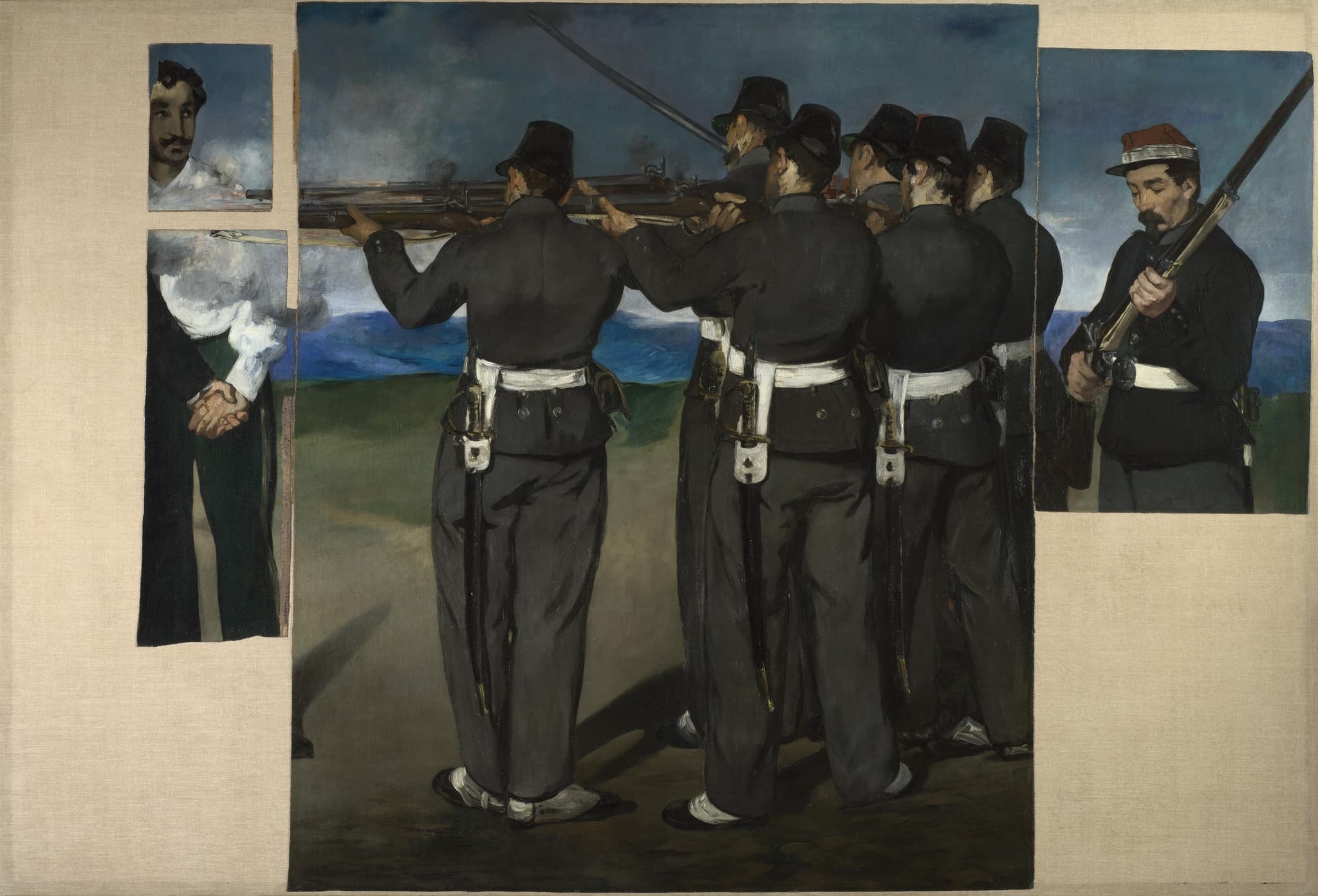
The Execution of Emperor Maximilian
Édouard Manet, 1867–1868 • Oil on canvas
Read full analysis of The Execution of Emperor Maximilian →Valuation Analysis
Estimate: $100–150 million (hypothetical fair-market value under conditions of free trade and competitive global demand). This range calibrates upward from Manet’s public auction record while reflecting the unique blend of art-historical primacy, rarity, and composite condition specific to the National Gallery, London version of The Execution of Emperor Maximilian [1].
Methodology and benchmarks. The primary anchor is Manet’s $65.1 million auction record for Jeanne (Spring) (Christie’s, 2014) [2], a pristine, museum-caliber portrait that set the modern ceiling for the artist at public sale. Recent liquidity for desirable but non-trophy Manets—e.g., the 1882 still life Vase de fleurs, roses et lilas at $10,101,000 (Sotheby’s, 2024) [3]—confirms depth of demand yet underscores how rarely A‑tier masterpieces surface. Cross-artist signals show ample market capacity for canonical late 19th/early 20th century trophies (e.g., recent nine-figure Klimt results), reinforcing that price potential is governed more by the artwork’s quality and narrative than by market liquidity constraints [5].
Why this work prices above the record. The Maximilian cycle is a cornerstone of modern history painting and a defining statement in Manet’s oeuvre, often discussed alongside Goya’s Third of May. The National Gallery canvas—reunited from fragments by Edgar Degas and remounted in 1992—has unparalleled scholarly and exhibition currency (including MoMA’s 2006 monographic focus), with all principal variants now in museums [1][4]. In a market where most headline Manets are institutionally held, the subject’s art-historical weight and near total absence of substitutes would propel bidding above the 2014 record if a comparable opportunity ever arose.
Why the upper tail is tempered. Condition is the key governor. The London picture is a composite assembled from cut fragments, with documented losses that are inseparable from its history and interpretation [1]. While the Degas provenance adds prestige, the structural reality would cap price expansion relative to an intact A‑plus Manet of similar magnitude. This pushes the estimate into a disciplined $100–150 million band—well above the artist’s auction peak but short of the $150–200+ million territory reserved for fully intact, unimpeachable masterworks across the category.
Market positioning. Within Manet’s market, this would be categorized as a “trophy with condition nuance”: academically supreme, exhibition-rich, and effectively irreplaceable, with a structural caveat priced in. In today’s selective but well-capitalized marquee environment, such works attract both institutional and top private competition. The estimate reflects the balance of these drivers: significance and scarcity pulling the value materially above precedent, with the composite state imposing a rational ceiling [1][2][3][5].
Key Valuation Factors
Art Historical Significance
High ImpactThe Execution of Emperor Maximilian is among Manet’s most consequential works and a cornerstone of modern political painting. It reframes the history painting tradition in a starkly contemporary key, frequently compared to Goya’s Third of May, and has served as a touchstone in scholarship, teaching, and exhibitions for decades. The London canvas, despite being composite, is central to the cycle’s historiography and interpretation. Its sustained visibility in major institutions and literature confers a durable cultural premium that transcends short-term market cycles. For collectors and museums, this is an academically canonical image—precisely the type of work that commands trophy-level competition when available, and that justifies extrapolation above the artist’s prior auction peak.
Rarity and Market Scarcity
High ImpactSupply of A‑tier Manets is exceptionally thin, with the vast majority of headline canvases permanently in museums. Within the Maximilian series, all principal versions reside in institutions, removing direct substitutes from the market. Manet’s public record was set by an exceptional portrait in 2014; since then, no comparably important, large-scale figure painting has tested price discovery, largely because such material is institutionally absorbed. That structural scarcity boosts the valuation of any hypothetical offering of equivalent gravitas, especially one tied to a defining chapter in Manet’s practice. In short, market-accessible peers do not exist, and the absence of alternatives supports a significant scarcity premium over historical auction benchmarks.
Condition and Creation State (Composite from Fragments)
Medium ImpactThe National Gallery canvas survives as a composite reassembled from fragments acquired by Degas, then remounted to approximate the original composition. This unique history is a celebrated part of the work’s narrative; however, areas of loss and the structural joins constitute a material condition consideration. In valuation terms, this profile adds provenance allure while imposing a rational cap relative to a pristine A‑plus Manet of similar scale and importance. The balance of these effects is explicitly priced into the $100–150 million range: condition constrains the upper tail yet does not negate the painting’s singular historical weight, exhibition pedigree, and visibility in the canon.
Provenance and Exhibition History
High ImpactThe Degas connection—his role in reuniting the fragments—and the 1918 acquisition by the National Gallery, London, create a rare, bulletproof provenance chain. The work has been the subject of deep institutional research and flagship exhibitions, including MoMA’s 2006 Manet and the Execution of Maximilian focus, which reinforced its centrality in modern art discourse. Such institutional validation functions as a multiplier in high-end pricing, especially when combined with an impeccable ownership record. This level of exhibition and literature saturation typically drives strong institutional and private interest, increases bidder confidence, and supports a value materially above the artist’s standard auction comparables.
Market Benchmarks and Demand
Medium ImpactManet’s auction record of $65.1 million for Jeanne (Spring) (2014) sets the last public high-water mark, while recent sales—such as the $10.1 million 1882 still life in 2024—demonstrate ongoing depth for quality works. Cross-artist results in the Modern category (e.g., nine-figure Klimt prices) confirm current market capacity for museum-grade trophies. Together these signals justify an estimate above Manet’s record for a work of this historical magnitude, yet below the very top tier of the category due to condition. The proposed $100–150 million band aligns with observed appetite for canonical, institutionally endorsed masterpieces in today’s selective but well-capitalized marquee auctions.
Sale History
Galerie Georges Petit, Paris (Atelier Degas sale)
Reunited fragments (lot 74) acquired for the National Gallery, London; price not publicly documented online.
Édouard Manet's Market
Édouard Manet is a foundational, blue-chip figure whose works anchor the Impressionist and early Modern categories. Supply is structurally constrained: most masterpieces (Olympia, Déjeuner sur l’herbe, A Bar at the Folies-Bergère) reside in museums. His public auction record is $65.1 million for Jeanne (Spring) at Christie’s New York in 2014, acquired by the Getty. Since then, the market has seen consistent demand for quality Manets, with late still lifes repeatedly clearing high single- to low eight-figure prices (e.g., $10.1 million in 2024). Truly A‑tier figure paintings with marquee visibility almost never reach auction, implying that when one does, pricing can step meaningfully above the last record—particularly if supported by unimpeachable provenance and exhibition histories.
Comparable Sales
Jeanne (Spring)
Édouard Manet
Same artist; A‑tier, museum‑caliber painting and Manet’s auction record. While a portrait (not a history subject) and smaller in scale, it is the clearest public benchmark for peak pricing on a masterpiece‑level Manet.
$65.1M
2014, Christie's New York
~$86.6M adjusted
Self-Portrait with Palette
Édouard Manet
Same artist; rare, iconic figure painting (one of Manet’s only self‑portraits). Museum‑grade importance; a strong anchor for high‑quality Manet oils even though subject differs from a political history scene.
$34.6M
2010, Sotheby's London
~$50.2M adjusted
Vase de fleurs, roses et lilas
Édouard Manet
Same artist; recent, clean price discovery showing current liquidity for desirable late Manet oils. Not comparable in subject or scale, but a fresh benchmark for the active Manet market in 2024.
$10.1M
2024, Sotheby's New York
~$10.3M adjusted
Ambroise Adam dans le jardin à Pressagny
Édouard Manet
Same artist; early portrait (1861), closer in date to the Maximilian cycle than late still lifes. Small, modest work but a fresh 2025 data point for period Manet oils.
$1.0M
2025, Christie's Paris
Lady with a Fan (Dame mit Fächer)
Gustav Klimt
Cross‑artist trophy benchmark. Demonstrates contemporary auction capacity for late 19th/early 20th‑century museum‑grade masterpieces. Useful as an upper‑bound market context for a headline Manet, even though subject/type differs.
$108.4M
2023, Sotheby's London
~$114.9M adjusted
Current Market Trends
The Impressionist/Modern segment has reasserted its capacity for nine-figure trophies at marquee sales, even as buyers remain selective and condition-sensitive. Scarcity at the apex is the defining feature: top-quality, museum-grade works spark intense competition and strong guarantee structures, while mid-tier material must be keenly estimated. Recent results across the category, including nine-figure Klimt prices, signal deep capital for canonical names. For Manet specifically, late still lifes continue to trade actively, but museum-scale figure paintings are largely institutionally absorbed—supporting upward extrapolation for a work of historic significance. In this environment, a landmark Manet with an iconic narrative would attract global bidding and clear above prior artist records.
Sources
- National Gallery, London — Édouard Manet, The Execution of Maximilian
- Christie’s — Impressionist & Modern Evening Sale Results (includes Manet’s Jeanne (Spring) record)
- Sotheby’s — Modern Evening Auction (May 15, 2024): Manet, Vase de fleurs, roses et lilas
- MoMA — Manet and the Execution of Maximilian (2006)
- Washington Post — Klimt portrait sells for $236.4 million at Sotheby’s (Nov 2025)